


Investing in bonds: the complete guide

The bond market is diverse and includes various types of bonds issued by companies or states. Investors need to weigh the factors that influence bond prices, including interest rates and the risk premium. In addition, central bank decisions can have a significant impact on bond valuations. This market is back in the spotlight due to rising rates and inflation.
Key points
- Investing in bonds allows you to diversify your portfolio and generate regular income.
- Factors influencing bond prices include interest rates, inflation, and central bank monetary policies.
- Understanding the different types of bonds, investment strategies and risks is essential before engaging in the bond market.
What is a bond?
Definition of obligation
THEobligation is a debt instrument issued by a company, a State or a territorial authority to finance itself on financial markets. When an investor buys a bond, he lends money to the issuer, who in exchange agrees to pay regular interest, called coupons, and to repay the capital at the maturity of the security.
https://www.youtube.com/watch?v=PwnOOdxMWI0
The big return of the bond market! | Thomas Veit | Finary Talk #23
Main characteristics of a bond
- Coupon : This is the remuneration paid to bondholders, generally on an annual or semi-annual basis. Its amount can be fixed or variable.
- Duration : The life of the bond, after which the issuer must repay the capital borrowed. It can vary from a few months to several decades.
- Nominal value : Amount of borrowed capital, representing the value of a bond when it was issued.
What are the different types of bonds?
Among the various categories of bonds, we can distinguish:
- Government bonds: Issued by states to finance their public spending. They are generally considered to be less risky than corporate bonds.
- Corporate bonds: Issued by companies to finance their investments, their development projects or to refinance their existing debt.
- Convertible bonds: They offer the possibility for the investor to convert them into shares of the issuing company at a date or under conditions determined in advance.
- Perpetual bonds: These securities do not have a fixed maturity date, and the interest paid by the issuer is considered lifetime earnings.
How does a bond work?
When an investor Buy a bond, he lends money to the issuer in exchange for remuneration in the form of coupons. Vouchers are generally paid annually or semi-annually, with a fixed or variable interest rate. At the maturity date, the issuer repays the capital borrowed to the bondholders.
Rating agencies and their criteria
Les rating agencies assess the solvency of bond issuers by assigning ratings based on their ability to meet their financial commitments. Their role is to provide investors with an indication of the risk of default by the issuer. The main rating agencies are Standard & Poor's, Moody's and fitch. Their evaluations are based on numerous criteria such as the quality of management, the financial health of the company, debt and economic conditions.
There are two main classifications of bonds, Investment Grade and High Yield bonds.
- Investment Grade (IG):
- The so-called “Investment Grade” ratings indicate that the debt issued by the entity is considered to have a low risk of default. Institutional investors, such as pension funds or insurance companies, often have guidelines that require them to invest primarily or exclusively in assets that are rated Investment Grade.
- IG ratings range from AAA (the best possible grade) to BBB- (or Baa3 at Moody's). Here is a brief description of these notes:
- AAA: The highest credit quality. Extremely low risk of defect.
- AA: Very high credit quality. Very low risk of defect, but slightly higher than AAA.
- A: High credit quality with a moderate risk of default.
- BBB: Satisfactory credit quality. Moderate risk of defect, but higher than categories AA and A.
- High Yield (HY):
- Also called “junk bond” or “lousy bond” in French, High Yield refers to credit ratings below Investment Grade. These debts have a higher risk of default, but on the other hand, they generally offer higher returns to compensate for this increased risk.
- HY notes start at BB+ (or Ba1 at Moody's) and go as far as D, which indicates a default in payment.
Australia, Denmark, Germany, Netherlands, Netherlands, Norway, Norway, Norway, Norway, Norway, Norway, Norway, Norway, Sweden, Sweden, Luxembourg, Luxembourg, Switzerland and Singapore are indeed recognized for their exceptional solvency and have, at various times, received an AAA rating from the main rating agencies. This means that these countries are perceived to have an extremely low risk of not meeting their debt obligations.
Factors influence bond prices
Key interest rates
Les key interest rates play a key role in determining bond prices. These rates are set by central banks and serve as a reference for market interest rates. When key rates rise, it usually leads to higher interest rates in the bond market.
This phenomenon has the effect of reducing the value of existing bonds compared to new bonds issued with higher interest rates. On the other hand, when key rates fall, it implies a fall in interest rates on the bond market, and existing bonds thus become more attractive and their value increases.
Risk premium
Bonds, which are debt instruments issued by companies or governments, can be classified according to the risk level. Investors generally compare the return on corporate bonds to that of “risk-free” bonds, such as those issued by the German state in Europe and by the American state in the United States. Return spreads reflect the “risk premium,” which is the additional remuneration that investors require to hold riskier bonds.
The factors influencing the risk premium are diverse and include the financial health of the issuer, the economic outlook, the liquidity of the bond, and market conditions. An issuer whose financial health is less solid will offer a higher risk premium to attract investors, which will result in increasing the return required by investors, and therefore in reducing the price of the bond.
The impact of central bank decisions
Monetary policies and their effects
The decisions of central banks, such as the European Central Bank (ECB) Or the American Federal Reserve (Fed), have a significant impact on bond markets. One of their main missions is to control the key rates that affect market interest rates.
Today, interest rates have increased significantly. For example, the key rates have passed from -0.50% to 3.75% in the Euro zone through the actions of the European Central Bank (ECB). The aim of central banks is to Make money more expensive to limit consumption and Encourage people to save rather than spending or borrowing. In the end, this helps keep inflation under control.
Monetary policies adopted by central banks can result in bond purchases on the markets, which increases demand and influences bond yields. In addition, these policies also affect long-term interest rates, which are subject to a signal effect and a recomposition effect on agent portfolios.
Objectives of central banks
Inflation control and stimulating economic growth are two major objectives of central banks. To achieve these goals, central banks change key rates and put in place appropriate monetary policies, such as buying bonds on the markets.
By controlling inflation, central banks aim to maintain price stability and the real value of assets, including bonds. This promotes investor confidence and improves the predictability of bond returns. .
Bond investment strategies
Active vs passive management
Active management involves investors and portfolio managers actively selecting and managing bonds in order to outperform a benchmark. This is achieved by adjusting the composition and weight of the various bonds in the portfolio, based on market conditions, economic prospects, and risk profiles.
Passive management, on the other hand, simply follows a specific bond index, with the aim of replicating its performance. This approach is often less expensive and less complex than active management. Index funds and ETFs (exchange-traded funds) are common examples of passive management in bond investments.
Hedge against rising interest rates (hedging)
The cover involves the use of various financial instruments or tactics to reduce the risk of loss in the event of unfavorable market movements, such as increases in interest rates. A rise in interest rates can in fact cause a drop in the value of existing bonds in the portfolio. Investors can use futures contracts, interest rate options, or swaps to protect themselves against this risk.
The ladder strategy
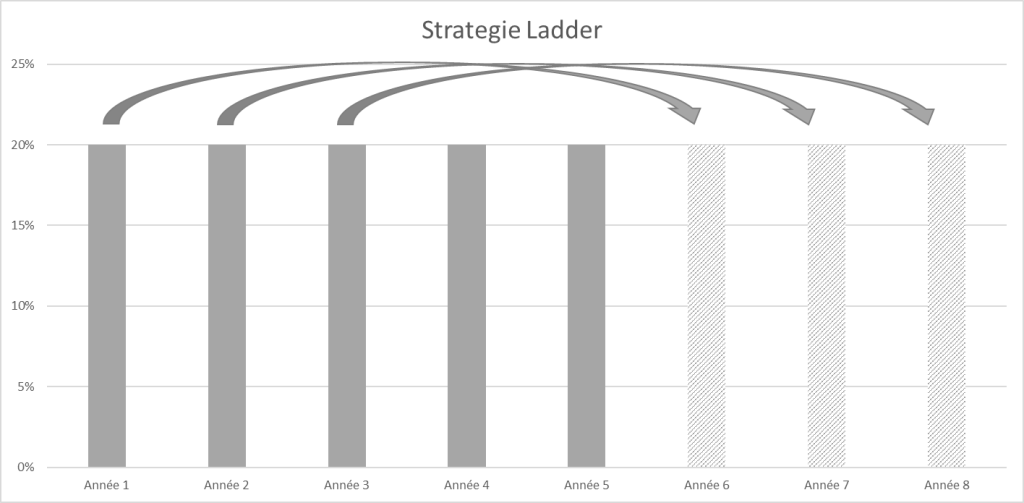
The so-called strategy Ladder consists of building a portfolio of bonds with maturities spread over a period of time, generally several years. This approach reduces the impact of interest rate fluctuations and increases portfolio diversification. At each maturity of a bond, investors can reinvest the funds into a new bond with a longer maturity in order to maintain a balanced maturity distribution.
By investing in bonds at different maturities, investors benefit from protection against interest rate fluctuations and a potentially stable return. In addition, this strategy can offer some liquidity, as part of the portfolio expires regularly, thus providing funds that can be reinvested or used for other needs.
What are the risks in the bond market?
Interest rate risk
The interest rate risk is linked to changes in interest rates in the market. When interest rates rise, the prices of outstanding bonds can fall, causing a capital loss for bondholders. Conversely, if interest rates fall, existing bonds become more attractive, causing their value to rise.
Credit risk
The credit risk concerns the ability of the issuer of a bond to repay the principal and to pay interest. If the issuer defaults or is unable to pay its debts, bondholders may suffer losses. This risk is generally a function of the credit quality of the issuer and can vary considerably from bond to bond.
Liquidity risk
The liquidity risk refers to the ease with which a bond can be bought or sold on the market. If a bond is less liquid, it may be difficult to sell at a fair price, especially during times of financial turmoil. Bonds issued by lesser-known or less solvent companies or governments may have a higher liquidity risk.
Reinvestment risk
The reinvestment risk is linked to the possibility of interest rates falling when bondholders need to reinvest the interest received or the principal paid back when the bonds mature. If interest rates are low, investors may be forced to reinvest at lower returns, which can affect their overall return.
In which bonds to invest?
Here is an example of a classic portfolio to gain exposure to the bond class.
There are two pockets: the performance pocket that will provide performance as well as the tactical/cover pocket that will allow you to hedge.
Pocket yield: 70%
InstrumentCode IsInETF Name (as of 26/07) DurationEBBB FP EquityLU1525418643Amundi EUR Corporate Bond 1-5Y ESG UCITS ETF 4.27% 2.70EUNT GY EquityIE00B4L60045iShares EUR Corp Bond 1-5yr UCITS ETF 4.29% 2.81IHYG LN EquityIE00B66F4759iShares EUR High Yield Corp Bond UCITS ETF 7.34% 2.58
Tactical pocket/cover: 30%
InstrumentCode IsInETF nameStrategy and durationLYX7 GY EquityLU1407888053Amundi US Treasury Bond 7-10Y Ucits ETF Long Part, 7.34 DurationIB1 GY EquityIE00BGPP6697iShares USD Treasury Bond 7-10yr UCITS ETF Hedged EURUSD Hedged EURUSD hedged against EURUS10 FP EquityLU1407890620AMundi US Treasury Bond 10+Y UCITS ETF Ultra Long Game, duration 15.8420A DTLE LN Equityie00bd8pgz49iShares USD Treasury Bond 20+yr UCITS ETF Hedged EURUSD hedged against EUR
What envelopes and products should you use to expose yourself to bonds?
There are various products and envelopes to expose yourself to bonds. Some of these options include bond funds, bond ETFs, and individual bonds.
Bond funds
Bond funds are portfolios composed of bonds managed by professionals, which allow investors to diversify their bond investments without having to buy each bond individually. These funds can be active or passive, and generally invest in corporate or government bonds. To benefit from advantageous taxation, it is important to choose thefiscal envelope adapted.
Bond ETFs
Les Fixed income ETFs are baskets of listed bonds that replicate a stock market index, just like equity ETFs. They offer diversified exposure to bond markets, with management fees that are generally lower than traditional bond funds. An example of a bond ETF is the one that tracks the Bloomberg Barclays Global Aggregate Bond Index, representing all global bonds. You can find out more about bond ETFs and their selection online.
Individual obligations
Investing in individual bonds allows investors to directly buy bonds issued by companies or governments. This provides total control over the securities held in the portfolio, including duration and credit quality choices. However, it may require more time and effort to research and manage the securities, as well as a larger investment amount to ensure sufficient diversification. Before getting started, it is essential to understand the bond market and to take into account the associated risks.
What is the overall portfolio allocation with bonds?
Importance of diversification
La diversification is a key part of portfolio management. It makes it possible to distribute risks between different types of assets and to avoid fluctuations in performance due to concentration on a single category. Bonds are fixed-income instruments that can offer more stable and less volatile return potential than stocks, while still generating steady income. Thus, investing a portion of your portfolio in bonds can contribute to the diversification of your investments and reduce overall risk.
Allocation according to investment horizon and risk tolerance
Portfolio allocation for bonds will depend on each investor's investment horizon and risk tolerance. For those with a long-term investment horizon and a high risk tolerance, it may be a good idea to allocate a larger proportion to riskier assets, such as equities. On the other hand, for investors who prefer to minimize risk or who have a short-term investment horizon, a larger bond allocation may be preferable.
It is possible to further diversify bond allocation by distributing investments between government bonds and corporate bonds, as well as between different regions.
Periodic portfolio rebalancing
Rebalancing is an essential step in maintaining the desired portfolio allocation and in managing risks effectively. Rebalancing involves selling assets that have outperformed and buying assets that have underperformed, in order to return to the original asset allocation. This strategy ensures that exposure to different asset classes remains consistent with the initial objectives and the investor's risk tolerance.
Periodic portfolio rebalancing is particularly important when it comes to bonds, as market conditions and interest rates can change and impact bond yields. It is therefore crucial to regularly monitor and adjust the bond allocation according to market developments and the investor's goals.
What is the point of buying bonds? Buying bonds has several advantages for investors. Bonds offer a steady stream of income in the form of coupons and the guarantee of recovering the capital invested at maturity. Additionally, bonds are generally considered to be less risky than stocks, which can make them appealing to those looking to diversify their portfolio.
Is it a good time to buy bonds? Determining if now is a good time to buy bonds is difficult because it depends on several factors, such as interest rates, economic conditions, and the outlook of the bond issuer. It is important to carefully assess these factors and to consider your investment horizon and risk tolerance before making a decision.
What are bond ETFs? Bond ETFs (Exchange Traded Funds) are investment funds that aim to replicate the performance of a bond index. They are a simple and diversified way to invest in a large portfolio of bonds without having to buy each bond individually. Bond ETFs can be traded on the secondary market, like stocks, making them more accessible and liquid for investors.

