


NASDAQ ETFs: which are the best? (2026)

Investing in a Nasdaq ETF offers various benefits, such as diversification, ease of access, and low management fees. There are several Nasdaq ETFs available on the market, each with their own characteristics and performances. Some of these ETFs are eligible for the Share Savings Plan (PEA) in France, thus allowing investors to benefit from the tax advantages associated with this type of plan.
Key points
- Nasdaq ETFs offer exposure to the top 100 non-financial companies listed on Nasdaq.
- Investing in a Nasdaq ETF allows you to diversify your portfolio and benefit from low management fees.
- It is possible to integrate Nasdaq ETFs into a PEA to take advantage of tax advantages.
NASDAQ 100: General Information
Sectoral composition
The NASDAQ 100 is a stock market index composed of 100 largest non-financial companies listed on the NASDAQ stock market. The sectoral composition of this index is dominated by the technology sector, representing around 50% of the total market capitalization. Other important sectors include health, consumer discretionary, and communication services. Multiple multiples Nasdaq 100 ETF allow investors to monitor the performance of this index.
Historic performance
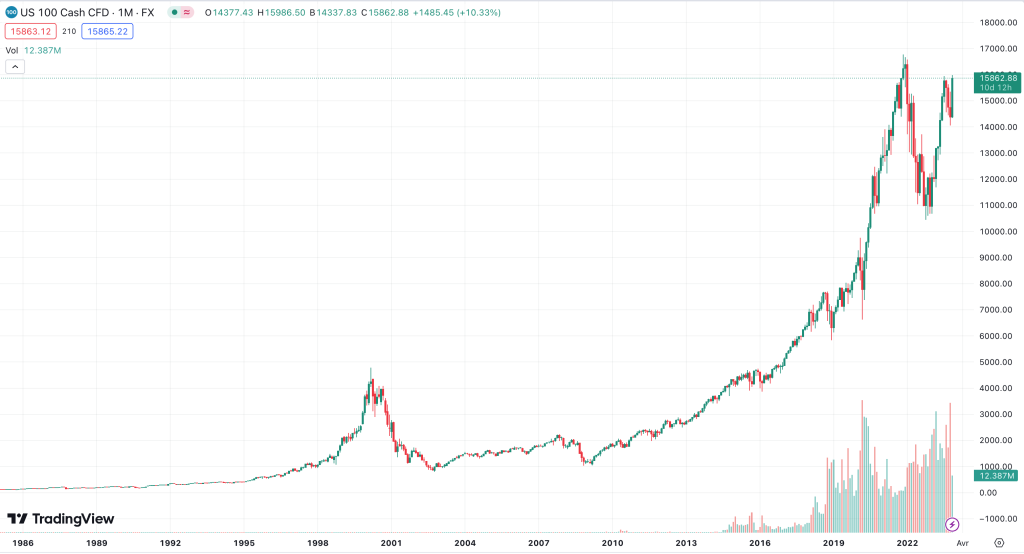
The NASDAQ 100 Index is known for its impressive performance over the years. It has achieved double-digit growth since its creation in 1985. Several technology giants such as Apple, Microsoft, Amazon, Amazon, Facebook, and Alphabet (Google) are responsible for this sustained growth. The top 100 Nasdaq ETFs allow investors to take advantage of this historic performance.
An index that does not take into account dividends
It is important to note that the NASDAQ 100 index is a price index, which means that it does not take into account dividends paid by the companies that make it up. NASDAQ 100 ETFs generally track index performance without reinvesting dividends. As a result, the performance of a NASDAQ 100 ETF may be slightly lower than that of the index itself. However, the Nasdaq 100 ETF offer an option for distributing or capitalizing dividends, allowing investors to benefit from the payments.
Why invest in a NASDAQ ETF?
Investing in a NASDAQ ETF has several advantages for investors. First, it provides easy access to a wide range of leading technology companies, such That Amazon, Apple and google. These businesses are recognized for their growth potential and their ability to generate high returns.
By investing in a NASDAQ ETF, investors benefit from the diversification offered by the distribution of assets across several companies. Instead of focusing on a single stock, a NASDAQ ETF represents a basket of stocks, which helps to reduce the risks associated with the volatility of an individual stock. Additionally, NASDAQ ETFs generally offer lower management fees than actively managed funds, which can improve long-term returns.
Another advantage of investing in a NASDAQ ETF is the ability to receive or capitalize on dividends depending on the companies in which we invest. While dividend returns are not always guaranteed, they do provide additional income for investors. In addition, NASDAQ ETFs often offer high liquidity, making it easy to buy and sell in the market.
Investors can also take comfort in the fact that NASDAQ ETFs are generally managed by reputable and solid asset management companies. Les funds under management (AUM) are an indicator of the popularity and confidence that investors have placed in these financial products.
In short, investing in a NASDAQ ETF provides diversified exposure to leading technology companies, while reducing risks and enjoying benefits such as dividends and high liquidity. Choosing a NASDAQ ETF can be an interesting and simple solution to allocate part of your portfolio to this index and take advantage of the growth of the technology sector.
The best NASDAQ ETFs
The Amundi NASDAQ-100 UCITS ETF - EUR (C) is often considered to be one of the best Nasdaq 100 ETFs. It uses synthetic replication and has a competitive expense ratio of 0.23%. As far as performance is concerned, it closely follows the evolution of the Nasdaq 100 index without leverage.
Another popular ETF is the Lyxor PEA Nasdaq 100 UCITS ETF - Capi with ISIN FR0011871110. Created in April 2019 and eligible for the PEA, it replicates the performance of the Nasdaq 100 index. Its expense ratio is slightly higher than that of the first ETF mentioned, but remains competitive.
Title (Index) IsIntickerterDistributionReplicationFund SizeDomiciliationDomiciliationEligibilityPealyxor PEA Nasdaq 100 UCITS ETF - CAPIFR0011871110PUST 0.30% Synthetic Capitaliser207 MFrance 207M France OuiInvesco QQQ TrustUS46090E1038QQQ 0.20% Physical Capitalization 5,055 United States Nonlyxor Nasdaq-100 UCITS ETF - ACCLU1829221024 UST 0.22% Synthetic capitalization 1 931 M Luxembourg NoniShares NASDAQ 100 UCITS ETFIE00B53SZB19CNDX 0.33% Physical capitalization 9 653 Mirland Enonx Trackers NASDAQ 100 UCITS ETFLU0292097747XNAS 0.33% Physical Capitalising 409 Mg Luxembourg NanoMundi Nasdaq 100 UCITS ETF EUR (C) LU1681038243ANX 0.23% Synthetic capitalization 956 m Luxembourg No
Is NASDAQ ETF for PEA possible?
Benefits of NASDAQ ETFs
NASDAQ ETFs offer several advantages, especially for investors who want to diversify their portfolio. By investing in a NASDAQ PEA eligible ETF, you can take advantage of the growth of technology companies, which are among the world leaders such as Amazon, Apple or Google.
- Diversification: NASDAQ ETFs make it possible to invest in several companies at the same time, thus offering easier diversification for portfolios.
- Yield: These ETFs generally perform better than traditional indices, especially over the long term.
- Dividends: Some NASDAQ ETFs also offer dividends, which can be attractive for long-term investors.
Disadvantages of NASDAQ ETFs
However, it is important to consider the potential disadvantages of investing in NASDAQ ETFs via a PEA:
- Risk: Investing in NASDAQ ETFs can be riskier compared to other types of ETFs, especially due to the focus on technology companies.
- PEA eligibility: Not all NASDAQ ETFs are eligible for a PEA, so it's important to check this before investing.
- Costs: Management fees for some NASDAQ ETFs may be higher than for other ETFs. It is therefore essential to compare the various associated costs before making an investment decision.
NASDAQ ETF, what alternatives?
Other index-based ETFs may be chosen, including:
- Les S&P 500 ETF
- Les Emerging Markets ETF
- Les ETF World
They can be useful for diversifying a portfolio and have performed very well.
Frequently asked questions
What is the best Nasdaq ETF for PEA?
Choosing a Nasdaq ETF for a PEA depends on your goals and investment strategy. The Lyxor PEA Nasdaq 100 UCITS ETF - Capi is one of the few NASDAQ ETFs to be eligible for PEA and has a reasonable management fee of 0.30%. However, it's important to note that not all Nasdaq ETFs are PEA eligible. So be sure to check the eligibility of each ETF before making an investment decision.
How to choose a Nasdaq 100 ETF for your PEA?
To choose a Nasdaq 100 ETF for your PEA, you need to consider several factors. Here are a few things to consider:
- Eligibility for PEA: Make sure that the Nasdaq ETF you have chosen is eligible to be included in your PEA.
- Management Expense Ratio: Management fees can reduce your returns. Look for an ETF that has a low management expense ratio.
- Past performance: While past performance does not guarantee future performance, it can provide an idea of how the ETF will perform over time.
- Diversification: A good Nasdaq 100 ETF should offer appropriate diversification across different companies and business sectors.
- Liquidity: Make sure that your chosen ETF is liquid enough to facilitate timely trading at market prices.
Additionally, consult trusted and comparative Nasdaq ETF sources to learn more about the various options available and to make an informed decision.
Choosing a Nasdaq 100 ETF that's right for your PEA depends on these factors and on your own risk tolerance and investment horizon. Take the time to carefully review these items and compare different ETFs before making your choice.