





Compound interest and investment: calculation and rate

The calculation of compound interest
Surely you are wondering how to calculate compound interest?
Let's get to the point right away by analyzing the compound interest formula:

Here are the different components of this geometric sequence:
- Vf: final investment
- Vi: initial investment
- P (rho) : the return on your investment over a given period (%). This rate is expressed as follows in the formula: 10% = 10 (not 0.10)
- hath: the number of periods (years, quarters, months, etc.).
To facilitate the calculation, using a Compound interest calculator is strongly recommended.
Illustration of compound interest with an example
Does that seem complex? Don't worry, the calculation is very simple. Here is a basic compound interest calculation. You invest €10,000 in a medium whose return is 7% per year. You keep this investment for 20 years.
10,000 * (1+0.07) ^20 = €38,696
Your initial investment has been multiplied by 3.8 thanks to the compound interest calculation, without any effort on your part.
To illustrate exactly what happens each year, here is another example of compound-interest investments.
- Year N: You invest €100 in a listed company whose share is worth €1. So you have 100 shares.
- Year N+1: The company pays a dividend of €0.10 per share, so you get €10. Instead of going to spend the dividend at an end of lockdown party, you decide to reinvest it in order to buy more shares in the same company. Let's say that the share price has not changed and is still €1, you now own 110 shares.
- Year N+2: The company is again paying a dividend of €0.10. This time, you get €11, which is 10% more than in N+1. You have just increased your wealth without reinvesting.
- Year N+30: You now have €1580, which is 15x more than at the start without any additional investment.
Note that this calculation does not even take into account the fact That historically, The equity markets have an annual return well in excess of 5%. The rise in the markets will therefore further amplify the power of compound interest. If you want to do a simulation, we recommend this Wealth simulator.
If the sum had been invested on a Livret A whose rate is currently 0.5%, you would have earned only €116 after 30 years, i.e. 16 times less despite the effect of compound interest... With inflation (or price increases) that regularly exceeds 2% per year, the real return is even negative. In other words, it is essential to generate returns in order to maximize your returns. With an annual return of around 13%, Real estate ETF can be an interesting track.

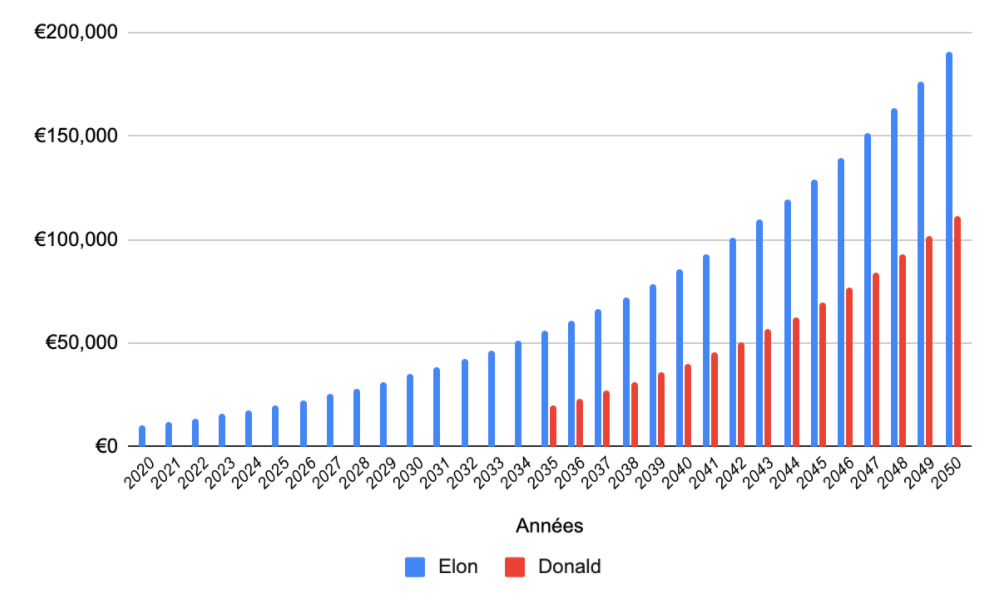
Let's compare the wealth trajectory of two friends, Elon and Donald (names chosen at random). They both decide to start invest in the stock market in order to retire in 2050. They choose the same medium, a ETF which replicates the MSCI World Index, which includes the largest companies in the world. This index has shown an annual performance of 7.5% per year since its creation.
Elon wants to make the most of the power of compound interest: he therefore starts by investing €10,000 in 2020. Each following year, he invests an additional €1,000.
donald prefers to spend his money on wigs and only starts investing in 2035. With more capital, he invested €20,000 in 2035 and €2,000 in each following year.
Conclusion on the calculation of compound interest
Elon is a big winner! Thanks to compound interest, he will have accumulated more than €190,000 for a total investment of €40,000, or 4.75 more than at the start. This is proof that the compound interest calculation is a great tool for wealth management that everyone can benefit from.
Donald will only have €111,000, despite an initial investment of €50,000, which is 25% more than Elon. Not great, Donald.
Note that even if the CW8 ETF replicating the MSCI World shows an average performance of 7.5%, annual variations could be very strong. From one year to the next, the performance may be catastrophic (up to - 50%), or exceptional (+ 20% or more). Elon and Donald are long-term investors, they are not interested in these market changes. They know that the biggest mistake would be to sell when the performance is poor, and to buy back during a good year.
Compound interest is therefore perfectly compatible with long-term investing. In order to optimize your taxation, it is strongly recommended to invest via a fiscal envelope such as PEA or life insurance. If you meet the criteria for holding these tax envelopes, you will be exempt from tax (12.8%) on your capital gains after 5 years (PEA) and 8 years (Life Insurance). Compared to a traditional securities account, the tax savings will be 43%. Your compound interest investments will be protected by these tax envelopes and you will be able to make the most of them when you decide to sell your investments.
FAQ
What is compound interest? Compound interest is calculated when you reinvest the amounts received as a result of an investment. In fact, compound interest is calculated on the initial amount invested as well as on the previous interest. Compound interest is part of a long-term investment strategy, the longer you invest, the more important the compound interest rate will be, the more the sum received in the end will be as well.
How does compound interest work? Unlike simple interest, compound interest is a calculation that takes into account the initial amount invested as well as the previous interest accumulated over a given period of time. In fact, each year the initial capital invested generates interest, and if this interest is reinvested, it is transformed into capital and increases the total amount on which the interest for the following period will be calculated, and so on.
How do you calculate compound interest? The formula for calculating compound interest is as follows: Vf = Vi (1+p) a. Here are the details of the components of the formula: Vf: final investment, Vi: initial investment, p (rho): the return on your investment over a given period (%), a: the number of periods.
Does the compound interest calculation also apply to fees? Indeed, whether on a loan for real estate or for the calculation of investment costs in an active fund, the calculation of compound interest will allow you to visualize the amount of the sum of interest that you will pay back to the bank or fund.


