


What pension on a €10,000 net salary in France?

Updated on 4 August 2026
On a net salary of €10,000 a month (an executive-level profile), the retirement pension in France works out at around €5,640 net per month, a replacement rate of about 56.4% of the final net salary, an order of magnitude consistent with the projections of the Conseil d'orientation des retraites (COR) and the DREES for this profile. The theoretical calculation at a constant salary gives a higher maximum, about €6,765 net per month, rarely reached in practice.

- The basic pension is capped at 50% of the PASS (the annual French social-security earnings ceiling), i.e. €2,002.50 gross per month in 2026, whatever the salary above it.
- The Agirc-Arrco point value has been frozen at €1.4386 since November 2025, for want of an agreement between the social partners.
- The realistic estimate of 56.4% is based on a progressive career rebuilt year by year, consistent with the COR and DREES projections, and far more reliable than a theoretical calculation at a frozen salary.
- The PER (France's retirement savings plan) and life insurance let you deduct part of your savings from taxable income, or benefit from lighter taxation after 8 years.
- Retirement pensions remain subject to the CSG (France's general social-security contribution), to the CRDS and sometimes to the CASA, which cuts into the gross amount announced.
How is the retirement pension calculated on a €10,000 net salary?
The calculation combines the basic pension, capped by the annual French social-security ceiling (PASS), and the Agirc-Arrco supplementary pension, calculated in points, for a theoretical maximum of about €7,442 gross per month at a constant salary over the whole career. Here is the detail of the calculation for a net salary of €10,000 a month.
What basic pension on a €10,000 net salary?
As a rule, net salary is about 77% of gross salary. So a net salary of €10,000 corresponds to roughly €12,987 gross.
What supplementary pension on a €10,000 net salary?
The Agirc-Arrco supplementary pension depends on the number of points accumulated over the career and on the point value at the time of retirement. On 1 November 2025, the Agirc-Arrco point value stood at €1.4386, frozen until 31 October 2026 following the failure of the negotiations between the social partners in the autumn of 2025.
The number of points earned each year follows a fixed formula: annual points = (gross annual salary up to the PASS × 6.20% + the share of gross annual salary above the PASS × 17%) / 20.1877 (€20.1877 being the reference salary, i.e. the purchase price of one point, in 2026). For a constant gross salary of €12,987 a month, i.e. €155,844 gross a year: annual points = (48,060 × 6.20% + 107,784 × 17%) / 20.1877 = (2,980 + 18,323) / 20.1877 ≈ 1,055 points a year. Over a 43-year career (contractual contribution, excluding the 127% call rate, which builds no rights): career points = 1,055 × 43 ≈ 45,400 points. The gross annual supplementary pension is that total multiplied by the point value: annual supplementary pension = 45,400 × 1.4386 ≈ €65,300 gross, i.e. about €5,440 gross per month once divided by 12 (theoretical maximum, full career at a constant salary, before any early-retirement reduction and any survivor's pension adjustment).
Goals
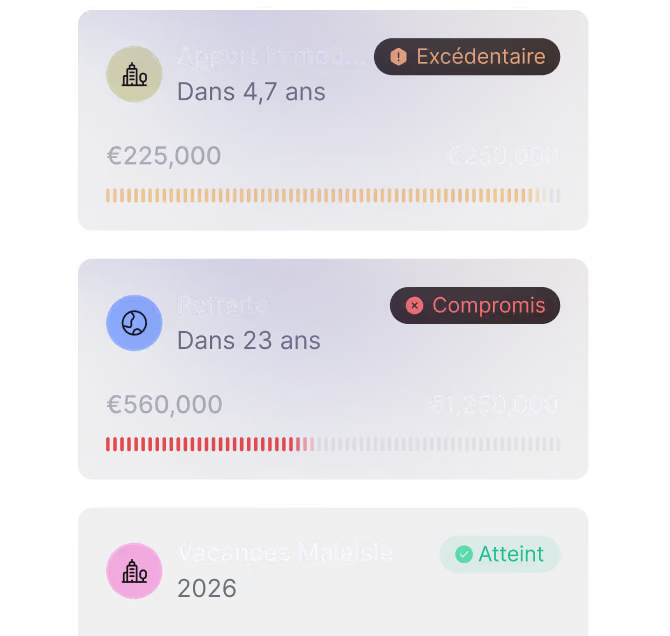
The factors that shape the pension amount
Contribution period
The contribution period is a key factor in the pension amount. In France, the insurance period required for a full-rate pension depends on the employee's year of birth. The quarters of contribution paid over a working career count towards that insurance period.
Average salary
The pension amount is also driven by the average salary earned over the employee's career. For the basic pension, the 25 best years of salary are taken into account. Note that on a net salary of €10,000, the pension will differ depending on the other salary years and on the contribution period.
Career path
An employee's career path has a significant impact on the pension. Spells of unemployment, parental leave or sick leave can affect the number of quarters of contribution, and therefore the insurance period. Employees who have held several jobs or worked in different sectors may also see their contribution period and their pension shaped by that variety of experience.
What retirement schemes exist in France?
Retirement in France rests mainly on two types of scheme: the general scheme and the special schemes. Both are topped up by supplementary pension arrangements, chiefly Agirc-Arrco.
The general scheme
The general scheme is the basic scheme for all private-sector employees. It is run by the Sécurité Sociale and works on a pay-as-you-go, contributory basis. The pension amount depends mainly on earned income, on the number of quarters of contribution and on the age at retirement.
As part of the pension reform, changes are under way, such as the rise in the legal retirement age. The "Estimer le montant de ma retraite" service lets employees simulate their pension at different retirement ages, taking those reforms into account.
Special schemes
The special schemes cover certain occupations or sectors (the civil service, public companies, and so on). They also work on a pay-as-you-go, contributory basis, with specific rules for calculating the pension, the retirement age and contributions. The pension reform also aims to harmonise the rules between these schemes and the general scheme.
Supplementary pension schemes such as Agirc-Arrco come on top of the basic and special schemes, to give retirees a higher level of income. They work on a similar principle of contributions and pay-as-you-go funding, with rights built up according to salary and contribution period.
Pension simulator
A pension simulator is a tool for estimating your future pension from factors such as salary, retirement age and quarters of contribution. On a net salary of €10,000, you can use a pension simulator to get an estimate of the basic and supplementary pension.
The simulation takes earned income, the number of quarters of contribution and the retirement age into account to estimate the pension. It also includes the forecasts of the compulsory retirement schemes. To refine the results, it is worth entering details of your life insurance where relevant. Tools such as Finary also let you track your net worth over time, PER and life insurance contributions included, alongside the official pension simulators.
Once the simulation is run, the results are usually shown gross. To convert that amount into net, you can use a gross-to-net pension converter. That gives a better idea of the amount actually received in retirement.
Bear in mind that the results from a pension simulator are estimates and do not guarantee a precise amount. Even so, the tool helps you prepare for the future and make informed decisions about retirement.
Which savings options can top up a retirement pension?
The PER, life insurance and buy-to-let property investment can all build extra income to offset the drop in earnings at retirement.
The PER (France's retirement savings plan) is a savings product dedicated to preparing for retirement. It lets you save throughout your working life to obtain, at retirement, either a lump sum or an annuity. The contribution rate can be adjusted to your needs and savings capacity. Payments into a PER are generally deductible from income tax, which can give a tax deduction within the statutory ceilings. The savings are locked until retirement, apart from the early-release cases set out in law. On a high salary, the choice of PER also depends on its taxation and on the contracts available on the market.
Life insurance is another way to build retirement savings by investing in the financial markets. It offers great flexibility in managing capital, with a choice of investment options according to the saver's risk profile. Life insurance also allows extra income through withdrawals, partly exempt from tax after an annual allowance (see life insurance taxation and the life insurance tax simulator). To compare the two wrappers, see also our PER or life insurance comparison.
Building a property portfolio is another effective way to top up a pension and secure a regular source of income. Investing in buy-to-let property can generate rent on top of the basic and supplementary pensions, subject to rental risks (vacancy, unpaid rent, market shifts). Bear in mind, though, the tax due, the CSG and the CRDS and the CASA when assessing the net income received.
In short, to top up a retirement pension on a €10,000 net salary, it is worth reviewing the various savings and investment options to build extra income suited to your own situation and objectives.

Non-contractual document for promotional purposes. Finary One is Finary's private wealth management offering, reserved for investors with at least €500,000 in investable assets. Investing carries risks, in particular a risk of partial or total capital loss. Finary SAS - 58 rue de Monceau 75380 Paris 8 - ORIAS no. 21001279, supervised by the AMF and the ACPR.
Retirement pensions by age and gender
Since the 2023 reform, the legal retirement age has been rising gradually from 62 to 64 depending on year of birth. The insurance period required for a full-rate pension also depends on the generation: 166 quarters of contribution for people born in 1957, and 172 quarters from the 1965 generation onwards (against the 1973 generation under the 2014 Touraine reform, the timetable having been brought forward by the 2023 reform).
Civil servants have specific retirement rules. Those with an early-start career, for instance, can retire before the legal age. Some categories of civil servants classed as "catégorie active" (police officers, gendarmes, prison officers, professional firefighters, air traffic controllers) also benefit from more favourable retirement terms.
A pension increase can apply in certain situations, such as having children or being unable to work because of a disability. Retirement age can also be influenced by gender. Women who have had children benefit from an increase in their insurance period, which can let them retire earlier.
Finally, some people can be exempted from pension contributions, for instance in the event of illness or unemployment. These exemptions let them validate quarters of contribution without paying in.
Specifics and final key points
On a net monthly salary of €10,000, the retirement pension comes to about 56.4% of the final net earned income on the realistic estimate, i.e. around €5,640 net per month, against a theoretical maximum close to 68% (€6,765 net per month) for a flat career at a constant salary. The capping of the basic scheme at the PASS and the freeze on the Agirc-Arrco point value make extra savings (PER, life insurance, buy-to-let property) strategic for maintaining a standard of living. The exact figure depends on the generation, the career and individual choices: the same mechanisms apply at other salary levels, see also our calculations for a net salary of €8,000 or €5,000 net.
Frequently asked questions
How is the pension calculated on a high salary?
The pension depends mainly on earned income, on the number of quarters of contribution and on the age at retirement. On a high salary, the basic pension takes the 25 best years of salary into account, but so do the supplementary schemes that apply to the employee. The basic and supplementary pension funds offer simulators for estimating the pension against those criteria.
Is there a cap on the pension relative to salary?
Yes, there is a cap on the pension relative to salary. The basic pension is capped at a level set by the social-security ceiling. Supplementary schemes, though, let employees on high incomes receive a further pension on top of the basic one. Those supplementary schemes follow specific rules, and the total pension will depend on the contributions made to those schemes over the employee's career.
What is the difference between the gross and the net pension on a €10,000 net salary?
The gross pension is the total before social levies. For a senior executive, the CSG, the CRDS and the CASA apply at the full rate of 9.1% above €26,472 of reference taxable income, which brings the theoretical maximum of about €7,442 gross down to about €6,765 net per month.
Why does the replacement rate fall on high salaries?
The basic pension is capped at 50% of the annual French social-security ceiling (PASS), i.e. €2,002.50 gross per month in 2026, whatever the salary above it. Only the Agirc-Arrco supplementary pension keeps growing with salary, which mechanically reduces the replacement rate on high incomes.
How can a €10,000 net salary offset the drop in income at retirement?
The PER, life insurance and buy-to-let property investment can build extra income suited to this salary level, depending on the investment horizon and the tax treatment sought.
Sources
L'Assurance retraite, the pension amount
Service-public.fr, pension simulator
Info-retraite.fr, gross-to-net pension converter
Service-public.fr, the Plan d'épargne retraite (PER)
Service-public.gouv.fr, the CSG and the CRDS on replacement income
Service-public.gouv.fr, the CASA
Retraitesdeletat.gouv.fr, social levies and exemptions
L'Assurance retraite, estimating the pension amount
Legisocial.fr, the 2026 social-security ceiling
Legisocial.fr, the 2026 Agirc-Arrco supplementary pension point value
Legisocial.fr, 2026 Agirc-Arrco contribution rates
Conseil d'orientation des retraites (COR)
Regulatory disclaimers: Marketing communication. Investing carries a risk of partial or total capital loss. Past performance is not a reliable indicator of future performance. This article is provided for information and educational purposes only; it does not constitute personalised investment advice, a buy or sell recommendation, or tax advice.
Before investing, read the Key Information Document (KID) and, where relevant, consult an authorised adviser.
Finary SAS, an investment firm authorised by the ACPR (no. 19283), member of AMAFI. Insurance broker registered with ORIAS (no. 21001279), member of the CNCGP (association approved by the AMF). Crypto-Asset Service Provider (CASP) authorised by the AMF under the MiCA regime, references no. A2026-026 and no. N2026-008.