Hedge Funds: Definition, Strategies and How to Invest

Updated on 23 July 2026
A hedge fund is a private investment fund that seeks an absolute return: making money whether markets rise or fall.
To achieve that, its manager has freedoms that retail funds don't: short selling, derivatives, leverage. In exchange, fees are high, transparency is limited and access is restricted to sophisticated investors.
Long reserved for an elite, hedge funds make up an average of 7% of the wealth of high-net-worth individuals (HNWI, short for High Net Worth Individual), who use them to diversify and cushion market shocks.
Here is what they are, which strategies they use, and how to access them.

- A hedge fund is a private fund that seeks an absolute return, meaning it aims to perform whether the market rises or falls, thanks to broad management freedom.
- Unlike a retail fund (UCITS), it has no leverage or concentration limits, discloses little, and imposes lock-up periods on withdrawals.
- Its fee model often follows the “two and twenty” rule: 2% in annual management fees plus 20% of positive performance.
- Its strategies range from global macro to event-driven, long/short equity, and AI-driven quantitative models.
- Access is restricted to professional or sophisticated investors: in France, the minimum ticket for a Fonds Professionnel Spécialisé (FPS), a French professional investment fund, is €50,000, though in practice it is often €500,000 to €1 million.
What is a hedge fund?
A hedge fund is a private fund designed to hedge against market swings and seek an absolute return, whichever way the market moves. The word hedge refers to a form of protection, and fund means a pool of capital.
It all started in 1949 in New York, when Alfred Winslow Jones combined long positions with short sales to protect his capital while still seeking growth. His partnership was widely imitated and gave rise to the hedge fund industry.
The objective remains the same today: making money whether the stock market rises or falls.
To govern this pursuit of performance, every fund drafts a mandate, the contract binding investors (the Limited Partners) to the manager (the General Partner). It sets out:
- the return objectives,
- the risk limits,
- the permitted assets (equities, derivatives, credit),
- the use of leverage,
- the liquidity and reporting rules.
Within that framework, the manager has wide latitude: they can buy, short-sell, hedge or arbitrage with agility, and access a broad range of asset classes. This freedom fuels a laboratory-like culture built on testing, innovation and fast execution.
What is the difference between a hedge fund and a traditional investment fund?
The difference comes down to one word: regulation. A hedge fund is a lightly regulated private vehicle, whereas a retail fund (UCITS) is strictly regulated to protect savers.
In a traditional fund, the management company is separate from the unit holders, the prospectus is approved by the regulator (the AMF in France), and the use of leverage and derivatives is tightly restricted.
A UCITS fund can borrow no more than 10% of its assets and cannot invest more than 10% of its portfolio in a single security. It publishes its portfolio holdings every day and continuously complies with Value at Risk (the maximum probable loss), diversification and liquidity ratios.
A hedge fund has none of these limits. It can take on heavy debt and concentrate its positions, at its own risk.
When the strategy fails, the consequences can be severe, as with LTCM in 1998, a fund founded by two Nobel laureates in economics. These funds often avoid public registration and are domiciled in the Cayman Islands, Delaware or Luxembourg, jurisdictions with lighter taxation and regulation.
Another difference is liquidity. Hedge funds impose lock-up periods: redemptions are often only open once a quarter, with notice.
They can also trigger a gate clause: if withdrawal requests exceed, say, 15% of capital, redemptions are capped. This mechanism protects the fund against a bank run (a panic in which every investor tries to withdraw their money at the same time) and lets it hold illiquid assets, such as private loans.
Finally, fees. The hedge fund model often follows the “two and twenty” rule: 2% in annual management fees plus 20% of positive performance. Traditional funds charge around 2% and rarely levy a performance fee.
| Criterion | Hedge fund | Traditional fund (UCITS) |
|---|---|---|
| Regulation | Private vehicle, lightly regulated | Regulated, prospectus approved by the AMF |
| Leverage | No regulatory limit | Borrowing capped at 10% of assets |
| Concentration | Concentrated positions allowed | 10% maximum in a single holding |
| Transparency | Limited, periodic reporting | Holdings published daily |
| Liquidity | Lock-up, quarterly redemptions, gate clause | Regular redemptions |
| Fees | “Two and twenty” (2% + 20% of profits) | About 2%, rarely a performance fee |
| Access | Professional or sophisticated investors | Open to the public |

What strategies do hedge funds use?
Hedge fund strategies fall into two families: fundamental (analysing the economy, companies and balance sheets) and quantitative (a mathematical approach).
In both cases, a long position is a bet that prices will rise, and a short position is a bet that they will fall.
Global macro
The manager first takes a top-down view of the economy: interest rates and central bank announcements (the Fed, the ECB), currencies, commodities, major indices. They build scenarios, then position accordingly, for example by buying the debt of a fast-growing country or shorting the debt of a country in crisis.
In September 1992, George Soros sold the pound sterling on a massive scale: the Bank of England was forced to leave the European exchange rate mechanism and devalue, and Soros made close to $1 billion in profit on “Black Wednesday”.
Event-driven
This strategy tracks major corporate events: takeover bids, mergers and acquisitions, restructurings or bankruptcies. When a company announces a bid for another, the target's share price rises: if the stock is worth €48 before the bid and rises to €50 afterwards, the fund gains €2 per share.
An activist fund goes further: it buys enough shares to influence decisions, force a vote or sway the board, in order to push a deal forward and lock in the profit.
Long/short equity
This is one of the oldest methods. The principle: buy stocks judged undervalued and sell those judged overvalued.
A fund might buy Hermès and short LVMH, for example. If Hermès outperforms LVMH, the strategy wins, even if the overall market falls. The bet isn't on market direction, but on the spread between two stocks.
Pair trading
A quantitative variant of long/short equity: two stocks that usually move together often converge again once the gap between them grows too wide.
Take Coca-Cola and Pepsi, whose share prices are usually only $2 apart. If Coca rises from $100 to $108 while Pepsi stays at $98, the gap widens to $10.
The fund then sells 1,000 Coca shares at $108 and buys 1,000 Pepsi shares at $98. A few days later, the gap narrows back to $2 (Coca at $102, Pepsi at $100): the fund gains $6,000 on Coca and $2,000 on Pepsi, for $8,000 in gross profit.
The bet isn't on the market, but on two related stocks reverting to their normal relationship.
Quantitative models and artificial intelligence
Some hedge funds deploy AI models that decide on buys and sells systematically. These models ingest massive amounts of information (real-time prices, volumes, economic news, social media posts), learn from years of historical data, are tested on unseen data, and are then connected live to the market.
They also protect themselves automatically, with position-size limits and automatic stop-losses: if a model starts losing money or becomes less reliable, it is shut down.
The Medallion Fund (Renaissance Technologies) follows this approach: more than 150,000 micro-trades per day and, over many years, close to 60% in gross annual returns, compared with roughly 14% average annual returns for the Nasdaq 100. Past performance is not a reliable indicator of future performance.
One other fund even trained an algorithm to detect emotion in the voice of the Fed chair to fine-tune its bets on interest rates.
What returns can you expect from a hedge fund?
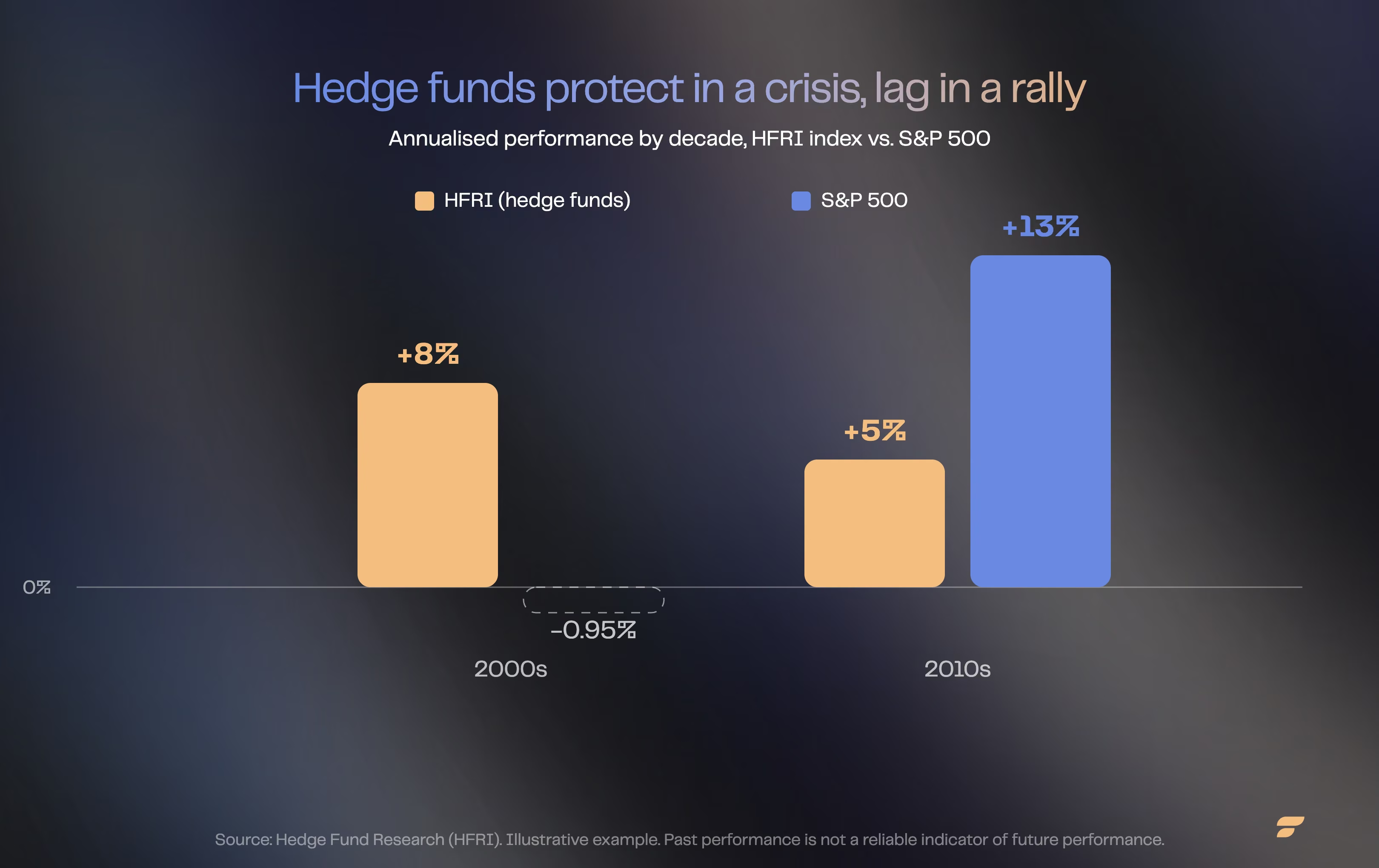
Hedge fund returns vary widely with market cycles: they rarely beat equity indices when markets rise, but they cushion crises better. Past performance is not a reliable indicator of future performance.
Their global performance is tracked month by month via the HFRI index from Hedge Fund Research.
- 2000s (dot-com bubble and financial crisis): the HFRI index delivered about 8% a year, while the S&P 500 returned -0.95% in total return, earning it the nickname “the lost decade”. Between 2000 and 2002, hedge funds gained a total of 9% while the equity index fell 37%. Even in 2008, their 19% decline was far smaller than the S&P 500's -37%.
- 2010s (markets propped up by central banks): with no major crisis, hedge funds captured only about 5% a year, far short of the S&P 500's 13% annual return. Hedging costs, and fees above all, eat into any potential outperformance.
- Since 2020 (a choppy regime): +11.6% in 2020 after the Covid crash, +10.3% in 2021, -4.25% in 2022 (against -18% for the S&P 500, with macro funds standing out at +9.3%), +7.5% in 2023, for about 7% a year over the period.
Dispersion remains extreme: in 2022, Citadel posted +38% while Tiger Global Management plunged 52%. Past performance is not a reliable indicator of future performance.
In short, hedge funds don't always beat equity indices, but they protect better in bad years and shine when volatility returns. It's this asymmetric profile that appeals to some investors, and disappoints others, depending on the cycle.
Within the wealth of high-net-worth individuals (HNWI), they make up an average of 7%.
Who can invest in a hedge fund, and why?
Access to hedge funds is restricted to professional or sophisticated investors: in France, the minimum ticket for a Fonds Professionnel Spécialisé (FPS) is €50,000, though in practice the threshold tends to sit closer to €500,000 to €1 million.
In the United States, only “accredited” investors can get in: net financial wealth above $1 million (excluding the primary residence) or annual income of $200,000 ($300,000 for a couple).
Beyond 100 subscribers, the fund must limit its investor base to “qualified purchasers”, whose financial assets exceed $5 million. Capital is often raised privately, through private banks, family offices or consultants.
In Europe, the AIFM Directive restricts the marketing of hedge funds classified as “AIFs” to professional investors.
Why invest despite these constraints? Three reasons stand out:
- Diversification. Hedge funds move differently from equities. In 2008, the HFRI index lost 19% while the S&P 500 fell 37%.
- Protection. These funds can short-sell and use derivatives and leverage, and sometimes profit from falling markets. In 2022, the HFRI Macro index gained 9.3% against -18% for the S&P 500.
- Access to rare opportunities. Mergers and acquisitions, distressed credit, satellite data: opportunities invisible to a conventional investor. Past performance is not a reliable indicator of future performance.
The downside is clear: “two and twenty” fees, limited transparency, restricted liquidity and a risk of loss amplified by leverage.
Regulators therefore require investors to have wealth, sophistication and written acceptance of the risks. For those who meet these conditions, a hedge fund remains a specialised tool: it doesn't always beat the index, but it can smooth out a portfolio and deliver gains when traditional markets stumble.

Non-contractual document for promotional purposes. Finary One is Finary's private wealth management offer, reserved for investors with at least €1,000,000 in investable assets. Investing carries risks, including partial or total loss of capital. Finary SAS, an investment firm authorised by the ACPR under no. 19283, member of AMAFI. Insurance broker registered with ORIAS under no. 21001279, member of the CNCGP (association approved by the AMF).
Frequently asked questions
What is the “two and twenty” rule?
It's the most common hedge fund fee model: 2% in annual management fees on assets, plus 20% of the fund's positive performance. By comparison, a traditional fund charges around 2% and rarely levies a performance fee.
Is a hedge fund riskier than a traditional fund?
It's structurally riskier, since it doesn't have a UCITS fund's leverage and concentration limits and can take on heavy debt. The collapse of LTCM in 1998, a fund founded by two Nobel laureates, illustrated this. In exchange, some strategies aim to cushion market downturns.
How much money do you need to invest in a hedge fund?
In France, a Fonds Professionnel Spécialisé (FPS) requires a minimum ticket of €50,000, but in practice the entry threshold tends to sit between €500,000 and €1 million. In the United States, access is restricted to accredited investors (more than $1 million in financial wealth, or $200,000 in annual income).
Do hedge funds beat the stock market?
Not always. In the 2010s, the HFRI index captured only about 5% a year against 13% for the S&P 500. But during crises, they often decline less: -19% in 2008 against -37% for the S&P 500. Past performance is not a reliable indicator of future performance.
What is a gate clause?
It's a mechanism that limits a fund's withdrawals: if redemption requests exceed a threshold (for example 15% of capital), outflows are capped for the period. It protects the fund against a rush of investor withdrawals and lets it hold illiquid assets.
Sources
Hedge Fund Research - HFRI and HFRX indices
Autorité des marchés financiers (AMF)
Regulatory disclaimers: Marketing communication. Investing carries a risk of partial or total capital loss. Past performance is not a reliable indicator of future performance. This article is provided for information and educational purposes only; it does not constitute personalised investment advice, a buy or sell recommendation, or tax advice. Before investing, read the Key Information Document (KID) and, where relevant, consult an authorised adviser. This investment carries a liquidity risk (resale not guaranteed, long horizon) and a risk of capital loss. Income and valuations are not guaranteed. Finary SAS, an investment firm authorised by the ACPR (no. 19283), member of AMAFI. Insurance broker registered with ORIAS (no. 21001279), member of the CNCGP (association approved by the AMF). Crypto-Asset Service Provider (CASP) authorised by the AMF under the MiCA regime, references no. A2026-026 and no. N2026-008.