What Portfolio for €1,000 of Passive Income per Month in France?

Updated on 28 July 2026
Getting paid without lifting a finger: that's the promise of dividend investing in France, and one of the goals that comes up most often in the wealth reviews Finary conducts.
How much do you need to invest to bring in €1,000 a month? Depending on the investment vehicle and the account you choose, the answer ranges from about €337,000 to nearly €1.3 million. The principle stays the same if you are aiming for a different amount.
This article breaks down the calculations, the taxation, and the limits of an all-dividend strategy. For a broader overview, see our 6 passive income ideas.

- For €1,000 net a month, expect anywhere from about €337,000 (a high-yield dividend ETF) to nearly €1.3 million (the S&P 500 index).
- Always think in net terms: on a securities account, the 31.4% flat tax (PFU) means targeting about €17,500 gross a year.
- The PEA (a French tax-advantaged equity savings account) reduces the bill (18.6% in social security contributions after 5 years), but its contributions are capped at €150,000.
- A dividend does not create value: the share price drops by the same amount on the ex-dividend date.
- A recognised alternative: aim for portfolio growth first, then sell off a fraction of the capital each year (the 4% rule, often lowered to 3%).
What is a dividend?
A dividend is income paid by a company to its shareholders, decided by its board of directors. Payments can be annual, quarterly or monthly.
Its main appeal: generating income without having to sell assets. Selling is a difficult decision for many investors; receiving a dividend, by contrast, feels very satisfying.
But keep one thing in mind: receiving a dividend does not create value. If your share is worth €100 and pays a €10 dividend, its price drops to €90: that's the ex-dividend adjustment. It's like withdrawing €10 from a cash machine: you still have €100, just split differently.
How much do you need to invest for €1,000 of dividends per month?
It all depends on the dividend yield of the investment vehicle and the taxation of the account: you need to target €12,000 net a year, so more than that gross.
The classic mistake is reasoning in gross yield. On a securities account, dividends are subject to the flat tax (PFU) of 31.4%: you need to collect about €17,493 gross to keep €12,000 net. In a PEA (a French tax-advantaged equity savings account) over 5 years old, only the 18.6% social security contributions apply on withdrawal, so the gross target is €14,742.
| Account | Dividend taxation | Annual gross needed for €12,000 net |
|---|---|---|
| Securities account (CTO) | Flat tax (PFU) of 31.4% | €17,493 |
| PEA over 5 years old | Social security contributions of 18.6% on withdrawal | €14,742 (contributions capped at €150,000) |
Rates in effect since 1 January 2026. Finary calculations.
Foreign dividends deserve extra caution: they are first subject to withholding tax in the company's home country, then to French taxation, both deducted by your broker. Out of €100 of US dividends, €85 remains after withholding tax, then about €58 after French taxation.
Once you know the gross target, the capital required follows from the dividend yield of the investment vehicle. The gaps are considerable:
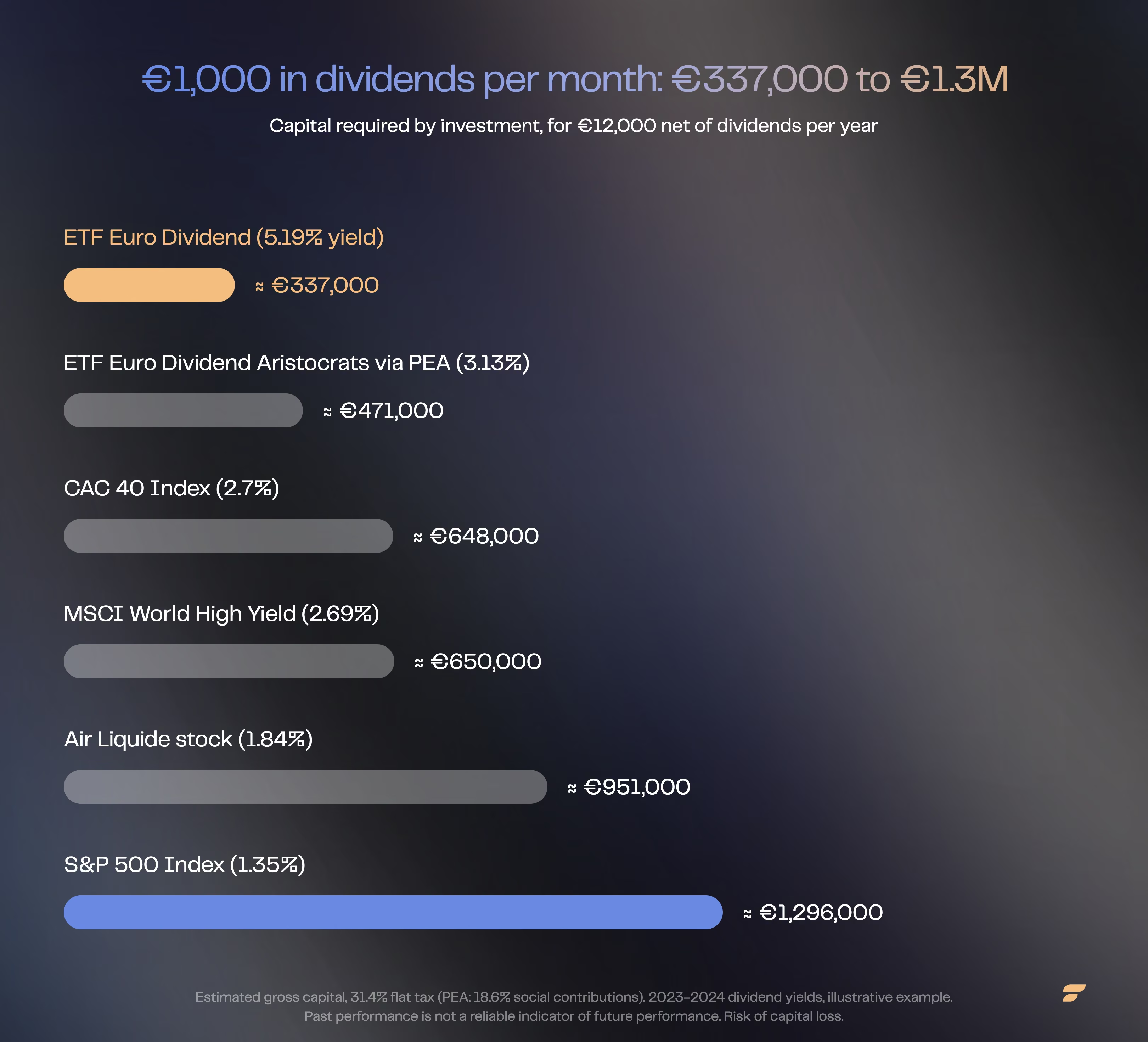
A few intermediate benchmarks, based on dividend yields observed in 2023-2024: an iconic French stock like Air Liquide (an estimated 1.84% for 2024) requires about €951,000 via a securities account; the CAC 40 (2.7%) about €648,000; the MSCI World High Yield (2.69% in 2023) about €650,000.
The PEA scenario remains partly theoretical: with a €150,000 contribution cap, you need to let compound interest grow the portfolio before reaching the target capital.
A concrete example of what these vehicles pay out: €10,000 invested in the Euro Dividend ETF on 1 January 2023 produced €513 of dividends over the year, plus €380 of portfolio growth, for 8.93% in 2023. Past performance is not a reliable indicator of future performance.
Tracking dividends line by line quickly becomes time-consuming: the Finary app includes a dividend tracker, with a calendar of income received and upcoming across stocks, funds and SCPI (SCPI: a French non-listed real-estate investment fund, comparable to a REIT), across every account type.

Why aren't dividends free money?
Because a high dividend yield says nothing about the quality of a stock: the S&P 500, one of the best-performing indices, pays out very few dividends.
For a company, paying a dividend is actually the last resort in capital allocation:
- fund a new internal project more profitable than what the market expects;
- pay down its debt;
- buy back its own shares if they are undervalued;
- acquire a competitor;
- and only then, finally, return cash to shareholders through a dividend.
Companies that pay large dividends have therefore already gone through their growth phase: they are now mature businesses.
The clearest comparison: the classic S&P 500, dividends reinvested, has outperformed the S&P 500 Dividend Aristocrats, dividends reinvested, even though the latter groups companies that have raised their dividend every year for at least 25 years running. Past performance is not a reliable indicator of future performance.
“Dividends should not be an investment criterion.”
Xavier Delmas, in the Finary Talk on dividends
What are the alternatives to dividends for €1,000 a month?
The first alternative is to sell capital: offload shares whenever you choose, for whatever amount you need, without limiting yourself to dividend-paying companies.
This is the principle behind the 4% rule, often lowered to 3% today as a precaution: withdrawing 4% of a stock market portfolio every year, historically, never emptied a retirement portfolio in under 33 years, based on US stock market returns. Be careful: this finding rests on historical returns and inflation that may not repeat.
The second alternative, if you are young or still building your wealth: aim for growth first, then switch.
In practice, you invest in a broad growth index. According to the scenario simulation, the portfolio reaches €501,000 after 18 years. You then sell the position (about €343,700 remains after the 31.4% flat tax) and reinvest it in a high-yield dividend ETF at 5.19%: about €1,020 net a month. Staying on the dividend ETF from the start would have taken 22 years.
Reaching €1,000 a month in two phases is therefore possible, and often faster: putting everything directly into a dividend ETF from the start means giving up the overall return of a growth index. It pays to go step by step.
In short: don't chase dividends first. Focus on growing your wealth first; the income will come later, once you actually need it.
Goals
Frequently asked questions
How much capital do you need for €1,000 a month in dividends?
From about €337,000 with a high-yield dividend ETF (5.19% in 2023) to nearly €1.3 million with a broad index like the S&P 500 (1.35%), taxation included. The investment vehicle and account you choose can make the required capital vary by a factor of four.
How are dividends taxed?
On a securities account, at the 31.4% flat tax since 2026. In a PEA over 5 years old, they are exempt from income tax: only the 18.6% social security contributions apply on withdrawal. Foreign dividends are also subject to withholding tax.
What is a dividend aristocrat?
An S&P 500 company that has raised its dividend every year for at least 25 years running. Specialised ETFs track these stocks, some of them PEA-eligible, such as the SPDR Euro Dividend Aristocrats.
What is the 4% rule?
Withdrawing 4% of a stock market portfolio every year to live on. Based on historical US returns, no case of a portfolio being exhausted in under 33 years has been observed at that rate. Many now favour 3% as a precaution, since these past returns may not repeat.
Why isn't a high dividend yield always a good sign?
Because paying a dividend is a company's last choice for allocating capital, after investment, debt reduction or share buybacks. Classic indices, dividends reinvested, have outperformed the “aristocrat” indices. Past performance is not a reliable indicator of future performance.
Sources
impots.gouv.fr - How are securities taxed?
Service-Public - Equity savings plan (PEA)
impots.gouv.fr - Taxation of foreign-source income
Regulatory disclaimers: Marketing communication. Investing carries a risk of partial or total capital loss. Past performance is not a reliable indicator of future performance. This article is provided for information and educational purposes only; it does not constitute personalised investment advice, a buy or sell recommendation, or tax advice. Before investing, read the Key Information Document (KID) and, where relevant, consult an authorised adviser. Finary SAS, an investment firm authorised by the ACPR (no. 19283), member of AMAFI. Insurance broker registered with ORIAS (no. 21001279), member of the CNCGP (association approved by the AMF). Crypto-Asset Service Provider (CASP) authorised by the AMF under the MiCA regime, references no. A2026-026 and no. N2026-008.