How to Invest €1 Million in France?

Updated on 24 July 2026.
The moment you find yourself with more than €1 million to invest in France, anything seems possible: quit a job you no longer want, pay off a loan, retire to the Maldives. In reality, that is not the end of all your problems.
One bad decision, and a lot of it can disappear. Here is how to invest €1 million and more wisely, through three typical situations: selling a business, an inheritance, and a holding company.
If your question is mainly about the first steps after an inheritance, start with our guide on what to do with an inheritance: this article focuses on allocating a portfolio of €1 million and more.

- At €1 million and more in France, the question is not "where to invest" but "what to protect, for which needs": wealth-planning levers matter more than products.
- Before investing, set aside what is not investment: your home, life projects, and what you want to pass on to your children.
- A bucket structure (cash, protection, income, growth) funds your lifestyle without forcing a sale at the worst possible time.
- Allocation depends on your risk profile and time horizon, not the amount: two €1 million portfolios can be invested in opposite ways.
- A mixed equity-bond portfolio sees average annual volatility of 8% to 10%: on €3.5 million, €350,000 can disappear in a bad year.
Why doesn't €1 million get invested like €10,000?
Because at this level of wealth, a sum this size has to cover income needs, life projects and inheritance planning, not just "perform".
Contrary to popular belief, the goal is rarely to look for where to invest to maximise returns. It comes down to answering three questions: what should I protect, what do I need, and what do I want?
Only then can the right wealth-planning levers be chosen. The three cases below, inspired by the day-to-day work of Finary One's private wealth managers, show the method in action. These are illustrative examples, not personalised recommendations.
Case 1: how to invest €5 million after selling your business?
By first setting aside life projects, then structuring the balance into four complementary buckets. In 2024, around 37,000 businesses were sold in France. And by 2032, close to 500,000 business owners will retire: an unprecedented generational wave, in which nearly half of those still working say they want to sell.
Take Thomas, 51, founder of an industrial SME. After 18 years running the company, he is about to receive €5 million after tax, and retire.
His household needs €200,000 net per year. His wife's salary brings in €80,000: his wealth therefore needs to generate about €120,000 net per year. He also wants to help his two children buy their first home, and treat himself to a second home.
First step: setting aside what is not investment
Before even discussing investments, about €1.5 million is taken out of the equation: €800,000 for the second home, €700,000 to pass on to the children.
The tools used: an SCI (société civile immobilière, a French non-trading property-holding company) for the second home, a split of bare ownership in favour of the children, and the use of tax allowances. No business owner does this alone.
Worth noting: met before the sale, an adviser could have gone even further (a pre-sale gift, a contribution to a wealth-holding company before the sale). Our guide on what to do after selling a business details these optimisation windows.
The remaining €3.5 million, organised into four buckets
Like many entrepreneurs, Thomas would be tempted to invest everything in equities. But a mixed equity-bond portfolio sees average annual volatility of 8% to 10%: on €3.5 million, €350,000 can disappear in a bad year, more than 4 times his wife's annual salary.
A friend of Thomas, also a former executive, had convinced himself to put most of his sale proceeds into "solid" company stocks. He squandered a good part of it.
The answer: a structure of complementary buckets.
Bucket 1, cash (€750,000). Held in euro funds within a life insurance policy, it covers 3 years of living expenses in complete autonomy. Gains compound with no annual tax; partial withdrawals fund day-to-day life, with very favourable exit taxation after 8 years.
Bucket 2, protection (€1 million). Still within a life insurance policy, invested in fixed-maturity bond funds (fonds obligataires de portage): baskets of debt securities that pay regular coupons, at a rate set at subscription, provided the issuers do not default. That caveat calls for careful selection of the funds chosen, calibrated to risk tolerance. When the cash bucket runs low, the coupons refill it.
Bucket 3, income (€750,000). This bucket combines structured products with a recurring coupon and partial capital protection, SCPI (a French non-listed real-estate investment fund, comparable to a REIT) paying quarterly rental income, and income-distributing infrastructure funds (energy, transport). Everything flows into the cash bucket: coupons, rent and dividends land throughout the year, keeping the reserve continuously topped up and paying out cash.
Bucket 4, growth (€1 million). €600,000 in diversified equity ETFs split across life insurance, a PEA (a French tax-advantaged equity savings account) and a securities account, and €400,000 in private equity, investing in unlisted companies, which make up 99% of the world's companies.
This bucket also prepares for a known milestone: in 12 to 15 years, when Thomas's wife retires, the portfolio's income needs will rise from €120,000 to €150,000 net per year.
This last bucket is riskier. But even if it loses 30% in a crash year, Thomas is not forced to sell at the worst possible time: his living expenses are funded elsewhere.
For purely illustrative purposes, assuming an annualised return of 6% to 7% after inflation, this bucket could double in 12 years. Nothing is guaranteed: past performance is not indicative of future performance, and such a scenario assumes accepting significant interim losses.
In summary, the €3.5 million to invest breaks down as follows:
| Bucket | Amount | Vehicle | Role |
|---|---|---|---|
| Cash | €750,000 | Euro funds within life insurance | 3 years of living expenses available |
| Protection | €1,000,000 | Fixed-maturity bond funds | Coupons that refill the cash bucket |
| Income | €750,000 | Structured products, SCPI, infrastructure funds | Regular rental income and coupons |
| Growth | €1,000,000 | Equity ETFs and private equity | Long-term capital growth |
Illustrative example of an allocation, which does not constitute personalised advice.
Three months later, Thomas tracks everything from his Finary app: his wealth has become a well-oiled machine.

Case 2: growing a €1.2 million inheritance at 34
Hugo, 34, a dental surgeon in Lyon, earns about €100,000 net per year. When his grandfather dies, his parents waive their inheritance in favour of the grandchildren: a generation-skipping transfer. Hugo inherits €1.2 million net, after inheritance tax.
His goal: financial independence at 45. Not to stop practising, he loves his job, but to be able to go part-time if his body demands it, take a year off with his family if needed, and no longer depend 100% on his practice to live. He has 11 years ahead of him.
First, the primary residence
First piece of advice: set aside €200,000 for the down payment on his primary residence, topped up with a mortgage. To live off his returns at 45, he needs to have eliminated his biggest fixed expense: housing. The mortgage becomes a wealth-planning lever.
Then, a growth-oriented allocation
€1 million remains. The goal is not immediate living expenses (the practice is running), but maximum growth over 11 years, suited to an aggressive risk profile:
- €150,000 in euro funds, within a life insurance policy, to absorb the unexpected.
- €600,000 in diversified equity ETFs, mostly held within a life insurance policy, with a PEA capped at €150,000 and a securities account for ETFs that aren't PEA-eligible. This is the compounding engine.
- €250,000 in private equity, or 25% of the allocation, drawing on the allocation used by the wealthiest American families. No more, because fund exit windows are spread over 7 to 10 years and the allocation would become too illiquid; no less, to avoid missing out on long-term value creation.
For illustrative purposes, with a real weighted average return of 6% to 7% per year over the period, Hugo could find himself at 45 with a portfolio close to €2 million. Again, nothing is guaranteed: past performance is not indicative of future performance.
Over the years, this allocation will need to shift toward less risky assets, so that by 45 it covers part of his living expenses. That is the whole point of long-term guidance.

Non-contractual document for promotional purposes. Finary One is Finary's private wealth management offering, reserved for investors with at least €1,000,000 in investable assets. Investing carries risks, including partial or total loss of capital. Finary SAS, an investment firm authorised by the ACPR under no. 19283, member of AMAFI. Insurance broker registered with ORIAS under no. 21001279, member of the CNCGP (association approved by the AMF). Crypto-Asset Service Provider (CASP) authorised by the AMF under the MiCA regime under references no. A2026-026 and no. N2026-008.
Case 3: should you take €1 million out of your holding company to invest it?
No: withdrawing it would trigger close to 40% in tax, whereas the sum can be invested from within the holding company. Camille, 30, a content creator followed by 850,000 subscribers, set up her holding company 2 years ago. The structure absorbs her business's surplus cash; she pays herself a salary of about €80,000 gross per year.
Result: €1 million in surplus cash sits in a low-interest current account. Her goal: secure life after her career, with a simple, clear and effective allocation, since her business could stop in 2 years or in 10.
Don't take the money out of the holding company
First instinct: leave the money in the holding company and invest it through a capitalization contract held by a legal entity. The holding company compounds returns under corporate tax (IS) rules, which limits immediate taxation.
Withdrawing the million directly into her personal account would be treated as a dividend. Between the flat tax (PFU), the CEHR (the exceptional contribution on high incomes) and the CDHR (the differential contribution on high incomes), Camille would lose a little under 40% of the sum, close to €400,000 in tax. Our comparison of a securities account versus a capitalization contract for holding-company cash covers this mechanic in detail.
A defensive allocation, built to absorb hard knocks
Unlike Hugo, Camille doesn't have income guaranteed by a running practice: 4 employees depend on her audience. Her allocation therefore favours regularity:
- €200,000 in euro funds, about a year of team salaries and operating costs, available at any time.
- €250,000 in structured products, for a regular return known in advance.
- €150,000 in bond funds, for a balanced risk-return profile.
- €300,000 in diversified equity ETFs, half as much as Hugo, since Camille takes on greater caution.
- €100,000 in private equity, in less risky assets than Hugo's.
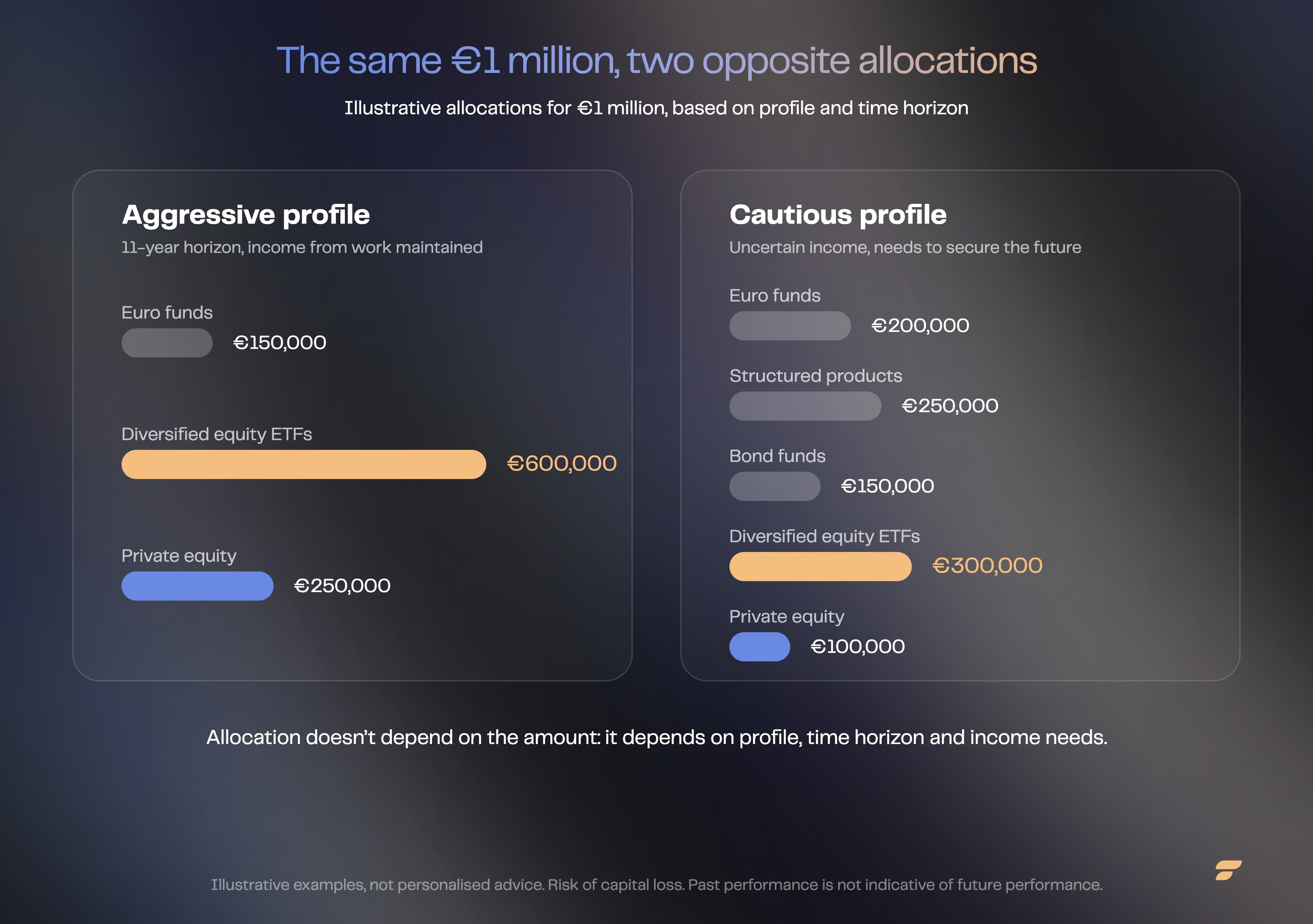
For the same €1 million invested, the recommended allocation is completely different: €600,000 in equity ETFs for an aggressive profile with an 11-year horizon, versus €300,000 for a cautious profile that secures income first. Illustrative examples, which do not constitute personalised advice.
One day, when Camille decides to slow down, this capital may fund her life. When that day comes, it won't be out of necessity: it will be because she chose it.
What to remember before investing €1 million?
That the real work isn't "investing", but calibrating cash flows and managing your wealth over time: meeting today's income needs while preparing for tomorrow's.
The three cases show it: same amount, radically different allocations. What decides is risk profile, time horizon, income needs and tax situation, never the amount alone.
For a portfolio closer to half a million, the logic still adapts: see our guide on how to invest €500,000.
Finally, at this level of wealth, get professional guidance. Structuring, inheritance, taxation: each poorly used lever costs more than years of advisory fees.

Frequently asked questions
What is the first step to investing €1 million?
Set aside what is not investment: primary or second home, life projects, sums to pass on to your children. The balance is then structured into complementary buckets (cash, protection, income, growth) based on your income needs and time horizon.
How much can €1 million invested earn?
It depends entirely on the allocation and the risk accepted. For purely illustrative purposes, assuming an annualised return of 6% to 7% after inflation, capital invested in growth assets could double in 12 years. Nothing is guaranteed: past performance is not indicative of future performance.
Should you take the money out of your holding company to invest it?
Not necessarily. A capitalization contract held by a legal entity allows investing from within the holding company, under corporate tax (IS) rules. Withdrawing the sum as a dividend would cost a little under 40% between the flat tax, the CEHR and the CDHR, close to €400,000 on €1 million.
What share of private equity in a €1 million portfolio?
Up to about 25% for an aggressive profile with a long horizon, drawing on the allocation used by wealthy American families. Fund exit windows are spread over 7 to 10 years: beyond that, the allocation becomes too illiquid. A cautious profile stays well below that.
What should you do before selling your business?
Meet an adviser before the sale, not after. A pre-sale gift or a contribution to a wealth-holding company before the sale can optimise things far more than the same tools used after signing.
Sources
- Service-Public, Plan d'épargne en actions (PEA).
- AMF, SCPI : un autre moyen d'investir dans l'immobilier.
- AMF, Les placements à formule : ce qu'il faut savoir avant d'investir.
Regulatory disclaimers: Marketing communication. Investing carries a risk of partial or total capital loss. Past performance is not a reliable indicator of future performance. This article is provided for information and educational purposes only; it does not constitute personalised investment advice, a buy or sell recommendation, or tax advice. Before investing, read the Key Information Document (KID) and, where relevant, consult an authorised adviser. Finary SAS, an investment firm authorised by the ACPR (no. 19283), member of AMAFI. Insurance broker registered with ORIAS (no. 21001279), member of the CNCGP (association approved by the AMF). Crypto-Asset Service Provider (CASP) authorised by the AMF under the MiCA regime, references no. A2026-026 and no. N2026-008.
Regulatory disclaimers:
Marketing communication. Investing carries a risk of partial or total capital loss. Past performance is not a reliable indicator of future performance. This article is provided for information and educational purposes only; it does not constitute personalised investment advice, a buy or sell recommendation, or tax advice.
Before investing, read the Key Information Document (KID) and, where relevant, consult an authorised adviser.
Finary SAS, an investment firm authorised by the ACPR (no. 19283), member of AMAFI. Insurance broker registered with ORIAS (no. 21001279), member of the CNCGP (association approved by the AMF). Crypto-Asset Service Provider (CASP) authorised by the AMF under the MiCA regime, references no. A2026-026 and no. N2026-008.