


How to invest €300,000 in France in 2026?

Updated on 28 July 2026
To invest €300,000 in France, the rule is to diversify across three pillars: cash, real estate and financial assets (equities, bonds). Depending on your profile and goals, you could split this amount between a PEA (a French tax-advantaged equity savings account), life insurance, a securities account and SCPI (a French non-listed real-estate investment fund, comparable to a REIT) or real estate. This guide covers each option for allocating €300,000.

- Diversifying €300,000 across several asset classes remains the most effective way to reduce the risk of capital loss.
- The PEA is capped at €150,000 and becomes exempt from income tax after five years, with only social security contributions still due.
- The securities account has no cap, but its gains are subject to the flat tax (PFU) of 31.4% since 2026.
- Life insurance combines euro funds (capital protected by the insurer) and unit-linked funds (risk of capital loss), and also works as an estate-planning tool.
- SCPI distributed an average of 4.91% in 2025 according to ASPIM, with an entry ticket of a few hundred to around a thousand euros.
Why diversify your investment options when investing €300,000?
Want to invest €300,000 while minimising the risk of loss? There is one solution: diversifying your investment options. Granted, spreading money across different options takes some effort, if only to research the terms and potential returns of each one. But this strategy can pay off over the medium to long term. Diversifying your investments remains the most effective way to reduce the risk of loss and increase your potential returns.
But what does that mean in practice? It is simple: diversifying your investments means putting your money into several different options. With a diversified portfolio, a decline in one asset is not damaging, since it is offset by growth in another. As a rule of thumb, base your diversification on 3 pillars: cash, real estate, and financial assets (equities and bonds).
Watch out for a beginner's mistake: for instance, spreading your life insurance policy across several funds invested in European securities. This strategy is not effective, since the performance of these funds tends to be similar.
goals
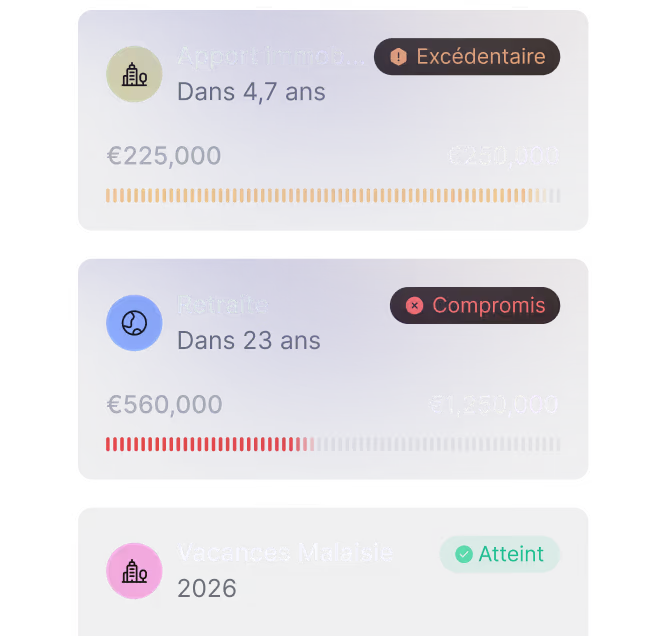
How do you set your goals before investing €300,000?
For an investor, allocating such a sum cannot happen without first defining your goals. Above all, it matters to know yourself, and to know why you want to invest €300,000. Simply investing on the stock market is not an end in itself, you need a roadmap! Are you pursuing an estate-transfer goal? Do you want to prepare for retirement? Do you have a specific goal, such as funding your children's or grandchildren's education? And also: are you comfortable with risk, or would you rather bet on safety, even at the cost of missing out on potential returns?
To determine your investor profile, you could factor in 5 different criteria:
- Your age and/or your personal situation (are you single with no children, or married with a family to support? Is your net worth significant? What is your professional situation?).
- The level of risk you can reasonably take on, which follows from your situation.
- Your personal goals (preparing for retirement, supplementing your income, and so on).
- Your investment horizon (will you need this money in the near future?)
- Your risk sensitivity (your tolerance for the risk of losing part of your savings).
Don't forget to factor in the emergency savings, or safety net, you want to keep. This emergency savings should be liquid, meaning immediately available.
Have you reviewed your goals as an investor? Two broad types of goals should now be clear to you:
- Emergency savings, to cope with unexpected events and life's setbacks.
- Building capital over the medium or long term, to grow your savings.
Emergency savings
Emergency savings, or a safety net, is money you can access immediately. It is a sum set aside to cope with the unexpected or to fund short-term plans. It should therefore be kept in liquid options, such as bank savings accounts. As a rule, a good wealth management advisor will recommend setting aside the equivalent of 3 to 6 months of income, though this amount should above all be assessed based on your age and your personal situation.
As a result, a small share of the €300,000 you want to invest should ideally go into your emergency savings. The rest of that sum can be allocated to investment options offering better potential returns, but also a higher risk of loss.
Building capital over the medium or long term
When you invest a sum of money over the medium or long term, your goal is generally to grow it. As such, you could invest in financial products offering better potential returns (PEA, unit-linked life insurance...), but also a higher level of risk. There is indeed a link between return and risk, since return is, in a sense, the reward for risk. Whether your goal is to invest €300,000 or invest €500,000, you will need to find the balance between risk and potential return that suits you.

Investment options for investing €300,000
A capital of €300,000 gives you a choice of investment options. It also gives you access to real estate investments, notably thanks to the leverage effect of borrowing. This mechanism lets you build your net worth faster: for example, by investing in a €600,000 property while only committing “only” €200,000 of your own savings.
We therefore present two attractive options for investing €300,000: tax-advantaged wrappers and property-backed investments. Note that a tax-advantaged wrapper should not be confused with a tax-relief product such as the Girardin Industriel scheme.
As mentioned above, it is essential to vary your investment options. So you should not put all of your €300,000 into a single tax-advantaged wrapper.
Tax-advantaged wrappers: simplicity first
A tax-advantaged wrapper is a savings product that lets you make financial investments while benefiting from tax advantages. There are 3 of them: the PEA (Plan d'Épargne en Actions), the securities account, and life insurance. Let's review the 3 most popular ones.
The PEA, for building a European equity portfolio
The PEA is a savings product that lets you build a portfolio of European equities, and generate supplementary income taxed at a low rate.
Its advantage: attractive long-term performance, and a favourable tax framework (after 5 years of holding, income, proceeds and capital gains are no longer taxable: only social security contributions remain due on the gains).
Its drawback: a fairly limited cap, since the standard PEA is capped at €150,000. It is possible to go up to €225,000 by combining a PEA and a PEA-PME.
The securities account, for investing in global markets
The securities account lets you invest on the stock market and thereby acquire securities such as bonds, equities, investment funds and derivatives.
Its advantage: contributions are not capped. The range of eligible investment options is very broad.
Its drawback: an unfavourable tax treatment (the flat tax at 31.4% since 2026), and a way of working that suits informed investors better.
Life insurance, for investing and/or passing on your wealth
The French people's favourite savings product, life insurance is a savings product offering several investment options: euro funds, whose capital is protected by the insurer (before fees), or unit-linked funds, which offer higher long-term returns with a risk of capital loss. It is also an excellent estate-planning tool.
Its advantage: contributions are not capped, and the tax framework becomes favourable after 8 years: an annual tax allowance of €4,600 (€9,200 for a couple) applies to gains, then taxed at 7.5% for the portion corresponding to contributions below €150,000, and at 12.8% above that.
Its drawback: an average return on euro funds of around 2.6% in 2025 according to France Assureurs, below inflation in some years. In that case, it is better to turn to unit-linked life insurance.
Worth trying : to estimate the tax due on a withdrawal from your policy, use the Finary life insurance simulator. As mentioned above, it is essential to vary your investment options. So you should not put all of your €300,000 into a single tax-advantaged wrapper.
Investing €300,000 with an aggressive profile
An aggressive profile will mainly focus on maximising returns, even at the cost of higher short-term risk of loss. Their portfolio will therefore be made up mostly of equities and real estate. For example, a good strategy for an aggressive profile could be to put €150,000 into a standard PEA to invest over the medium or long term in European equities and/or PEA-eligible ETFs giving access to a large part of the global equity market.
If you want to invest in Private Equity, you could also open a PEA-PME and allocate, for example, €50,000 to it (the PEA-PME is capped at €225,000, a cap shared with the standard PEA). Another interesting option is crowdfunding, which lets you take stakes in growing companies and receive potential dividends, while benefiting from tax advantages (see for example Tudigo and Lita). Naturally, since the risk of loss is real, we recommend investing only the amounts you are prepared to lose, and investing only a small share of your €300,000 (€50,000 maximum).
The rest of your allocation can be put into real estate (owned directly or via an SCPI, a French non-listed real-estate investment company), or into a life insurance policy with a good selection of unit-linked funds. It can also be worth looking into alternative investments such as collectibles. Investing in watches can offer variable and uncertain returns, and requires specific expertise.
Worth knowing : the most dynamic options (Private Equity via PEA-PME, crowdfunding, collectibles) carry a high risk of capital loss. Limit them to the share of your €300,000 that you are prepared to lock up for the long term, or even to lose. Investing €300,000 in real estate
Watch out for investment pitches promising overly attractive returns (wine, farmland...)! They often conceal scams. So stay alert and do your research before investing. The Finary community can be a space to exchange with other investors (contributions do not constitute investment advice).
Should you invest €300,000 in real estate?
Yes, real estate can be a solid pillar of a €300,000 investment, provided you diversify it with financial assets. You could aim for a directly owned property (using credit leverage), SCPI units or a real estate ETF.
Historically popular with French households, property remains a sought-after option, though it is not free of risk (vacancy, falling prices). It is true that investing in real estate lets you build wealth that grows in value over the long term, provided of course that you make the right choice and factor in the (significant) management fees involved.
With a sum of €300,000, you can choose between buying a property in your own name (for rental purposes, or to acquire a second home you can later pass on to your children) or paper property, by buying, for example, SCPI units (sociétés civiles de placement immobilier). These are companies that invest directly in real estate assets (hospitals, offices, shopping centres...). By investing in an SCPI, you subscribe to shares that let you receive rental income and capital gains in proportion to the amount invested. The advantage: no management hassle, an entry ticket starting at €1,000 and an attractive distribution rate (in 2025, it averaged 4.91% according to ASPIM).
If you prefer ETFs for their liquidity and diversification, you can also invest in a real estate ETF, an under-the-radar alternative to SCPI.
Also worth remembering: the option of furnished rental investment, which grants Non-Professional Furnished Lettor status (LMNP), taxed under a specific framework, either under the French Industrial and Commercial Profits regime (BIC) or on an actual-expenses basis, at your choice. It can offer an attractive return.

Frequently asked questions
How can you invest €300,000 in real estate?
Several options exist: buying SCPI units, investing in rental property (for example a studio in a student city) or buying a second home using credit leverage. What matters most is not concentrating the whole sum in a single investment.
How should you invest €300,000 in 2026?
Diversification comes first. For example, you could split €100,000 into a PEA, €100,000 into a life insurance policy and €100,000 into SCPI units or a rental property. This split should be adjusted to your goals and your investor profile.
Where should you invest €300,000 for 6 months?
For a short horizon, favour liquid, low-risk options: life insurance euro funds or regulated savings accounts. The trade-off for this safety is a moderate return, generally close to prevailing interest rates.
What tax treatment applies to a €300,000 investment?
It depends on the wrapper: gains from a securities account are subject to the flat tax (PFU) of 31.4% since 2026, the PEA is exempt from income tax after five years (excluding social security contributions), and life insurance benefits from an annual tax allowance after eight years.
Is it better to invest €300,000 all at once or gradually?
For the portion invested in equities or ETFs, investing gradually (regular contributions) smooths out the entry price and reduces the risk of poor timing. For real estate or savings accounts, investing all at once remains sensible depending on your plan.
Sources
France Assureurs: average return on euro funds in 2025
ASPIM: average SCPI distribution rate in 2025
Service-public.gouv.fr: social security contributions and the flat tax (PFU)
Service-public.gouv.fr: taxation of life insurance gains
Service-public.gouv.fr: PEA and PEA-PME caps
Regulatory disclaimers: Marketing communication. Investing carries a risk of partial or total capital loss. Past performance is not a reliable indicator of future performance. This article is provided for information and educational purposes only; it does not constitute personalised investment advice, a buy or sell recommendation, or tax advice. Before investing, read the Key Information Document (KID) and, where relevant, consult an authorised adviser. Finary SAS, an investment firm authorised by the ACPR (no. 19283), member of AMAFI. Insurance broker registered with ORIAS (no. 21001279), member of the CNCGP (association approved by the AMF). Crypto-Asset Service Provider (CASP) authorised by the AMF under the MiCA regime, references no. A2026-026 and no. N2026-008.