PER: a 2026 guide to choosing your assets in France

Updated on 7 August 2026
A PER (France's retirement savings plan) lets you invest far beyond the default euro fund: ETFs, unit-linked funds, SCPIs, OPCIs (French non-listed real-estate funds, comparable to REITs) and private equity are all available. Yet a large majority of savers stay in the secure investment option, capping the potential of their retirement savings. Picking the right assets, for your time horizon and risk profile, is what makes the difference over several decades.

- The PER comes in three versions, individual (PERIN), collective (PERCOL) and mandatory (PERO), all transferable to another provider at any time.
- The euro fund returned around 2.6% on average in 2025, with capital protected by the insurer under the terms of the policy.
- SCPIs and OPCIs delivered an average distribution rate of 4.91% in 2025, but their capital is not guaranteed.
- The private equity available inside a PER (FCPR, FPCI) targets a high return, at the cost of a significant risk of capital loss.
- The further away retirement is, the more the share of growth assets (ETFs, unit-linked funds) can be raised without endangering the savings already built up.
| Asset | Main risk | Potential return | Liquidity |
|---|---|---|---|
| Euro fund | Insurer default | Low to medium | High |
| ETF | Market volatility | Medium to high | High |
| SCPI/OPCI | Property market | Medium | Low |
| Private equity | Company failure | High | Very low |
Which assets can you hold in a PER?
A PER can hold euro funds, unit-linked funds, ETFs, property SCPIs and OPCIs, plus private equity (FCPR, FPCI), depending on the options offered by the policy you take out.
The three types of PER and what sets them apart
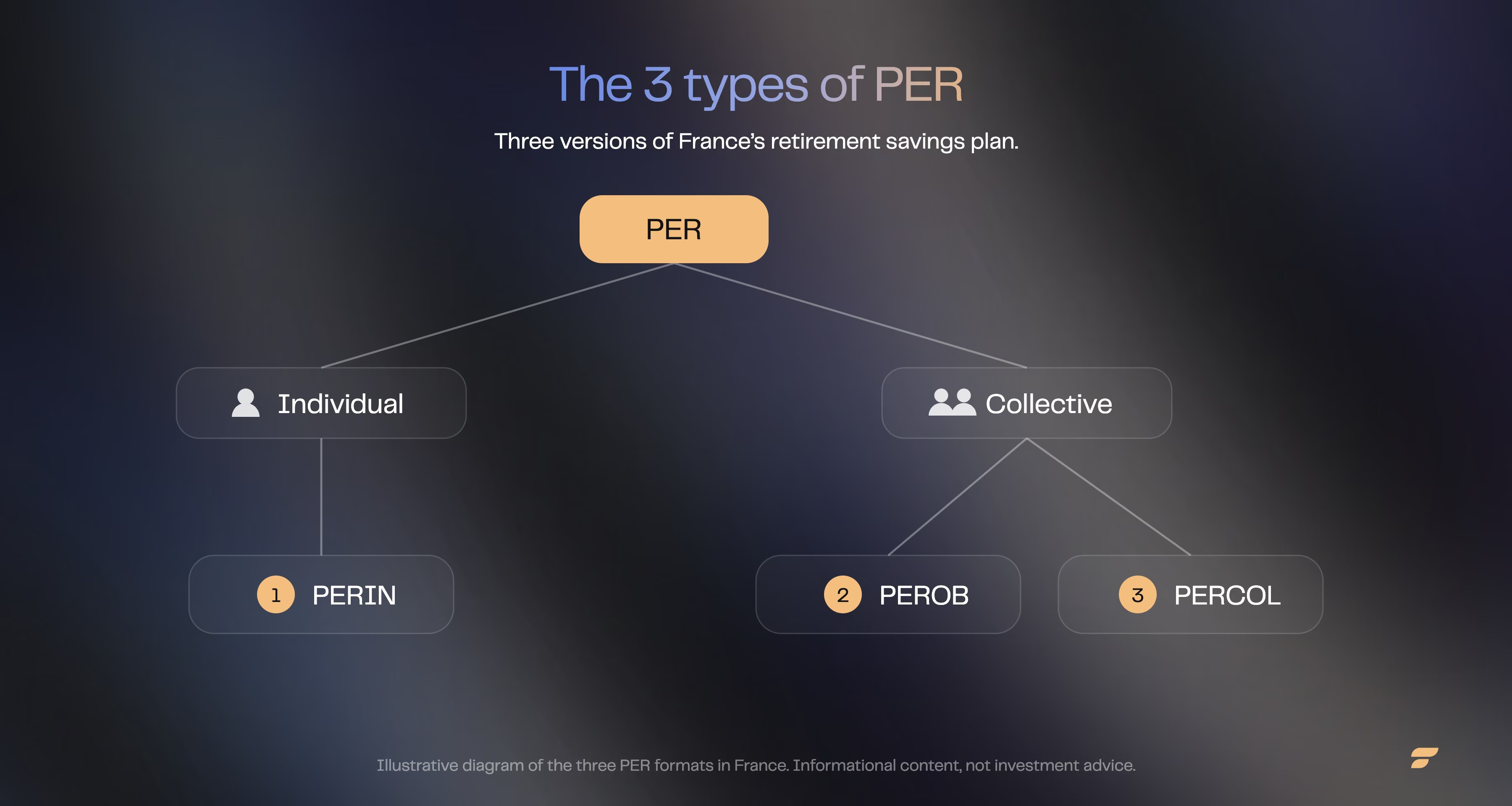
The Plan d'Épargne Retraite (PER) comes in three versions, each with its own rules: the individual PER (PERIN), the collective PER (PERCOL) and the mandatory PER (PERO).
The PERIN is open to everyone and works like a personal account dedicated to retirement. The PERCOL sits in the workplace, often funded by employee profit-sharing schemes. The PERO applies to certain categories of employee, with mandatory contributions.
These three PERs offer similar assets, but differ in how you access them, how flexible contributions are and their portability. Being able to transfer a PER from one provider to another avoids getting stuck with a frozen offer. That mobility means you can look for the best investment options over time.
Euro funds: security and protected capital
The euro fund is the secure core of a PER. It guarantees that every euro contributed will be available at retirement, whatever the markets do. Capital stays protected, unless the insurer defaults, a rare risk but one to bear in mind.
According to the ACPR, euro funds returned around 2.6% on average in 2025, and a few mutual insurers even topped 4%. That moderate return puts security first.
The make-up of a euro fund changes over time. It mainly holds government bonds and corporate debt, and sometimes a slice of property or equities to lift the return. The larger the share of growth assets, the higher the potential return; the insurer's capital protection applies under the terms of the policy. As retirement approaches, the euro fund naturally shields the portfolio from market volatility.
Unit-linked funds: diversification and return potential
Unit-linked funds carry no capital guarantee. Their value moves with the markets, sometimes sharply. That risk is also what makes a higher return possible.
They cover several types of fund:
- equities,
- bonds,
- mixed funds,
- thematic funds,
- funds invested in emerging markets or in specific sectors.
The range of unit-linked funds makes it possible to combine several regions and sectors. For example, you can mix European funds, Asian funds, US technology funds or energy transition funds. Cautious investors get a diversification tool, while bolder ones can express their convictions. The trade-off is accepting volatility, above all in a crisis.
ETFs: a passive, low-cost option
Known as trackers, ETFs track a stock market index faithfully (CAC 40, S&P 500, MSCI World…) with very low fees, often below 0.3%. They involve no active management and no excessive risk-taking.
ETFs stand out for their transparency: the exact composition of the portfolio is known at all times. They give access to whole markets, to specific themes (renewable energy, robotics, healthcare) or to international bonds.
ETFs are a low-fee route into the markets. Their recent arrival in PERs adds flexibility to steer retirement savings precisely.
SCPIs and OPCIs: exposure to property
Property fits into a PER through SCPIs and OPCIs, an alternative to buying directly.
- With SCPIs, you hold units in a property portfolio (offices, retail, healthcare) without managing tenants. The rent collected is added to the PER: the average distribution rate reached 4.91% in 2025, but total return (unit price included) fell back to around 1.46% as valuations declined in some segments. Liquidity is limited, though, and the risk depends on the property market.
- OPCIs combine property with financial assets. A slice of equities or bonds adds diversification and smooths performance.
Torn between the two wrappers? First compare the PER and life insurance, then see how to hold SCPIs in a life insurance policy to get the most out of your property savings strategy.
Private equity: for experienced investors
The private equity option is more complex and riskier inside a PER. It covers funds such as FCPRs and FPCIs, which invest in unlisted companies, often in a growth or innovation phase.
This type of investment can target a potentially high return, but carries a significant risk of capital loss. It calls for a long-term view and a tolerance for illiquidity, since the money stays locked up for several years with no early withdrawal.
How do you choose the right assets for your PER?
The right assets depend above all on the time left to retirement, on risk tolerance and on the saver's wealth objectives.
Define your investor profile and your objectives
The starting point is your financial situation, your ambitions and your priorities. Some see a PER as a safe, others as a lever for their projects. The key question is not only "what return?", but "why invest?".
Plan your retirement around your projects: travelling, passing on wealth, starting a business or simply securing peace of mind.
Your risk tolerance changes with age, experience and the events you live through. A 30-year-old investor who has just been through a first market crisis does not view risk the same way as someone in their forties who has already seen several crashes.
Review your profile regularly.
Finary's tools show the impact of your choices on your overall net worth. That makes it easier to adjust your strategy without getting lost in technical detail.
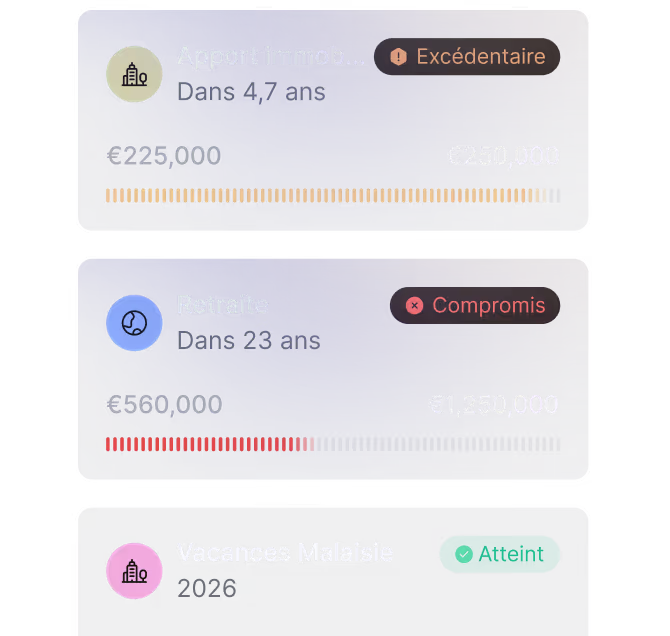
Goals
Understanding the risk/return trade-off of each asset
Building a PER is like picking a team in which each asset plays a defined role, with its strengths and its weaknesses.
- Euro funds play defence: solid, but low-performing.
- Unit-linked funds are exposed to the markets: their value moves up and down.
Risk should not frighten you, but you do have to control it. Global ETFs, for instance, give instant diversification, which limits single-company and single-sector risk. SCPIs give property exposure while pooling rental risk.
Here is a summary of the main features of each asset:
| Asset | Main risk | Potential return | Liquidity |
|---|---|---|---|
| Euro fund | Insurer default | Low to medium | High |
| ETF | Market volatility | Medium to high | High |
| SCPI/OPCI | Property market | Medium | Low |
| Private equity | Company failure | High | Very low |
| Direct equities | Company risk | High | High |
Volatility is not what should worry you; the absence of a clear strategy is.
Why fees matter and how they hit performance
Fees cut into your gains every year. A percentage that looks small can, over 20 years, shrink your capital considerably.
- Euro funds charge management fees of between 0.6% and 1%.
- Unit-linked funds can reach 2% or more depending on the investment option.
- ETFs stand out with low fees, usually between 0.1% and 0.4%.
A fee gap, even a tiny one, can mean thousands of euros less at retirement. Cutting fees can, at an equal return, materially improve the final capital (a theoretical assumption, for illustration only).
Watch out for hidden fees too: switching, contribution, exit. Read the terms carefully, compare offers and negotiate where you can. Modern policies, often 100% online, are more transparent.

Allocation strategies by age and investment horizon
Asset allocation is about balancing risk and return against your age and your horizon.
- At 30, you can absorb market swings, favour growth and let compound interest work.
- At 55, the capital built up needs securing while keeping some return potential.
The horizon-based managed-portfolio service, offered by most PERs, adjusts the split automatically. The closer retirement gets, the larger the share of secure assets.
You can still choose to keep a growth allocation until you draw the plan down, to catch a possible rebound. Others prefer stability, even at the cost of a lower return.
Sample asset splits for different profiles
Here are three illustrative examples (not personalised, and not investment advice):
- The cautious profile (30 years old, risk-averse): 70% euro funds, 20% bond ETFs, 10% SCPIs.
- The balanced profile (40 years old, 20-year horizon): 40% euro funds, 40% global equity ETFs, 10% SCPIs, 10% private equity.
- The growth profile (35 years old, appetite for growth): 20% euro funds, 60% equity ETFs, 10% SCPIs, 10% direct equities.
These splits stay flexible. What matters is staying consistent with your objectives and reviewing them regularly. A PER is not a product to forget about, but a tool to steer with care and adaptability. The best investors keep adapting.
Optimising and managing your PER over time
When and how to rebalance your portfolio
Retirement savings are not set up once and for all. A PER evolves with your life and with the markets. Letting your asset allocation drift is like sailing without a compass, and it makes your objectives harder to reach.
Rebalancing means returning to the target split. If you held 60% equities and 40% euro funds, a strong year can push the equity share to 75%. That raises risk without you asking for it. Rebalancing means selling part of the overweight equities to top up the underweight assets.
How often to rebalance varies from one investor to another. Some do it once a year, others as soon as a gap of 5% to 10% appears. The point is to keep emotion out of your decisions. Some PERs offer automatic rebalancing, a useful tool for containing volatility.
Case study: a 20-year performance simulation
A hypothetical simulation, purely for illustration (the returns used are theoretical assumptions and are not guaranteed):
- Alice, 35, invests €5,000 a year in her PER, split 70% global equity ETFs, 20% euro funds, 10% SCPIs.
- Bruno, 35, prefers safety, with 80% euro funds and 20% SCPIs.
Assuming an average annual return of 6% for the ETFs, 2.6% for the euro funds and 4.5% for the SCPIs, with annual rebalancing, the results are:
| Profile | Gross final capital | Gain versus total contributions | Estimated annual volatility |
|---|---|---|---|
| Alice | €168,000 | +€68,000 | 10% |
| Bruno | €134,000 | +€34,000 | 3% |
In this hypothetical simulation, Alice's profile ends with more capital, at the cost of higher volatility. Past performance is not a reliable indicator of future performance. Bruno, for his part, chooses stability and peace of mind, even when markets are volatile.
The simulation does not reflect life's surprises: redundancy, a property project, a tax change… all reasons to review your strategy regularly.
In short, managing a PER is like flying a plane: you watch the instruments, correct the course and ride out the turbulence. With the right method and the right tools, regular monitoring of your PER is recommended.
Building your PER: a long-term wealth strategy
The assets you pick inside a PER decide whether your retirement savings strategy works over several decades.
Between secure euro funds, diversified unit-linked funds and property investment options, each asset class plays a specific role in optimising the return/risk trade-off.
Support from a wealth adviser and regular monitoring of your allocation will let you adjust your strategy over the years. Also review the tax treatment of your PER to keep track of how your retirement capital develops.

Frequently asked questions
Which assets can be held in a PER?
A PER holds euro funds (capital protected by the insurer under the terms of the policy), unit-linked funds, ETFs, property SCPIs and OPCIs, plus private equity (FCPR, FPCI). The range depends on the policy: 100% online PERs generally offer the widest choice.
What is the difference between euro funds and unit-linked funds?
The euro fund protects capital, with a moderate return (around 2.6% in 2025). Unit-linked funds carry no guarantee: their value moves with the markets, in exchange for higher return potential over the long term.
Can you invest in ETFs inside a PER?
Yes, more and more PERs give access to ETFs. These trackers replicate an index (CAC 40, S&P 500, MSCI World) with fees often below 0.3%, which makes them an efficient way to diversify at low cost.
Can a PER be used to invest in property?
Yes, through SCPIs and OPCIs. SCPIs give access to a property portfolio (offices, retail, healthcare) with no rental management. Their average distribution rate reached 4.91% in 2025, but their total return still depends on movements in the unit price. In exchange, liquidity is lower than for the other investment options.
How should you split your assets by age?
The further away retirement is, the higher the share of growth assets (ETFs, equities) can be. As the date approaches, you gradually shift into euro funds. The horizon-based managed-portfolio service, offered by most PERs, automates that rebalancing.
Which fees should you watch in a PER?
Management fees (0.6% to 1% on euro funds, up to 2% on some unit-linked funds) and hidden fees: contribution, switching, exit. Over 20 years, a small gap can add up to thousands of euros. Online policies are generally the most transparent. If you need the money before retirement, some exit fees also depend on the reason for early release from the PER.
Sources
ACPR, Publications and statistics no. 179, L'assurance vie en 2025 (in French)
ASPIM/IEIF, 2025 inflows and performance of retail property funds (in French)
Regulatory disclaimers: Marketing communication. Investing carries a risk of partial or total capital loss. Past performance is not a reliable indicator of future performance. This article is provided for information and educational purposes only; it does not constitute personalised investment advice, a buy or sell recommendation, or tax advice. The capital guarantee on euro funds is provided by the insurer and depends on its financial strength. In a severe systemic crisis, the French "Sapin 2" law allows withdrawals to be temporarily restricted (liquidity), without affecting the guaranteed capital. Unit-linked funds are not guaranteed and carry a risk of capital loss. Before investing, read the Key Information Document (KID) and, where relevant, consult an authorised adviser. Finary SAS, an investment firm authorised by the ACPR (no. 19283), member of AMAFI. Insurance broker registered with ORIAS (no. 21001279), member of the CNCGP (association approved by the AMF). Crypto-Asset Service Provider (CASP, "PSCA" in French) authorised by the AMF under the MiCA regime, references no. A2026-026 and no. N2026-008.