Active ETFs: how to choose them and invest in 2026

Updated on 27 July 2026
An active ETF is an exchange-traded fund whose manager actively selects the holdings in an attempt to outperform the market, unlike a conventional ETF that simply tracks an index. Its fees are higher (0.20% to 0.70% against less than 0.10%). This article presents the best active ETFs of 2026 and the criteria for choosing them well.

- Active ETFs remain rare in a PEA (a French tax-advantaged equity savings account): the eligibility rules (75% EU/EEA equities) favour passive management and synthetic replication.
- According to the SPIVA study, around 93% of US large-cap equity funds underperform the S&P 500 over 20 years: outperformance remains the exception.
- Active management is most justified in less efficient markets: bonds, small caps, emerging markets or niche sectors.
- Some sectors lend themselves better to active management: healthcare, the energy transition and European financials, where managers exploit market inefficiencies.
What is an active ETF and how does it differ from a passive ETF?
An active ETF is an exchange-traded fund managed actively by professionals who seek to outperform a benchmark index, unlike a passive ETF that merely replicates it.
Active ETFs are growing and attracting more investors. These funds, once unpopular, now use advanced strategies in the search for outperformance. Asset managers such as JPMorgan and Fidelity are betting on innovation. They no longer simply copy an index. Their "Research Enhanced Index" strategy combines quantitative analysis, the integration of ESG criteria and rigorous stock selection. This method makes it possible to anticipate market moves and seize opportunities ahead of other players.
Today, active ETFs rely on several levers to improve their performance:
- The use of artificial intelligence to analyse data in real time.
- Human expertise to adjust portfolios quickly.
- The integration of ESG criteria to meet new investor expectations.
This shift positions active ETFs as an alternative to traditional funds, while keeping the flexibility and transparency specific to ETFs.
Active vs passive ETFs: advantages and drawbacks
Passive ETFs track a benchmark index. Their objective is to reproduce the performance of the market, without human intervention.
Fees stay low, transparency high, and performance predictable.
This type of ETF appeals to investors who want stability and simplicity.
Active ETFs work differently. Managers adjust the composition of the portfolio according to their analysis of markets and companies.
They seek to outperform the market, not merely to track it. This approach appeals to investors who want to beat the average return and who accept a degree of uncertainty.
This flexibility, however, comes with higher fees. Active ETFs often charge two to three times the fees of passive ETFs.
Outperformance is never guaranteed. Some managers succeed, others do not. Investing in an active ETF means accepting the risk of underperformance, but also the possibility of better results.
The SPIVA study is a reminder, however, of how hard it is for active management to beat major indices such as the S&P 500 over the long term. Over 20 years, around 93% of US large-cap funds underperformed it (SPIVA U.S. Scorecard, year-end 2025). Only rare periods (such as 2022) end up more favourable to active management.
Goals
Management fees and their impact on performance
Management fees strongly influence long-term performance. Even a difference of 0.2% a year can significantly reduce capital over ten or twenty years.
To better understand the impact of your active ETF returns over the long term, use our compound interest calculator and visualise the growth potential of your portfolio.
Passive ETFs often show annual fees (TER) below 0.10%. Active ETFs generally sit between 0.20% and 0.70%, or higher for some strategies.
This extra cost can be justified by observable added value, such as consistent outperformance or more effective risk management.
Strengths of active ETF managers
Active ETF managers enjoy two main strengths:
- Privileged access to advanced resources such as in-depth analysis (data, proprietary models, meetings with executives and boards, teams of computer science and mathematics engineers).
- Considerable freedom of action allowing them to deviate from the benchmark index in order to take quick advantage of less visible market opportunities and anomalies.
In some markets, such as complex bonds or small caps, active management can be relevant. In US large caps, beating the index remains rare.
An attentive investor does not look only at headline fees. They analyse the return net of fees, volatility, the consistency of the strategy, as well as hidden fees and transaction costs. Every additional cost reduces the final return.
What are the main active ETFs available in 2026 (outside the PEA)?
Among the most representative active ETFs in 2026 are the JPMorgan US REI ESG, the Fidelity Global Equity Research Enhanced, the Jupiter Global Government Bond Active and the Invesco Global Active ESG Equity.
JPMorgan Research Enhanced Index Equity (REI) ESG
The JPMorgan REI range takes a nuanced approach.
These ETFs stay close to their benchmark index but incorporate adjustments derived from in-house research.
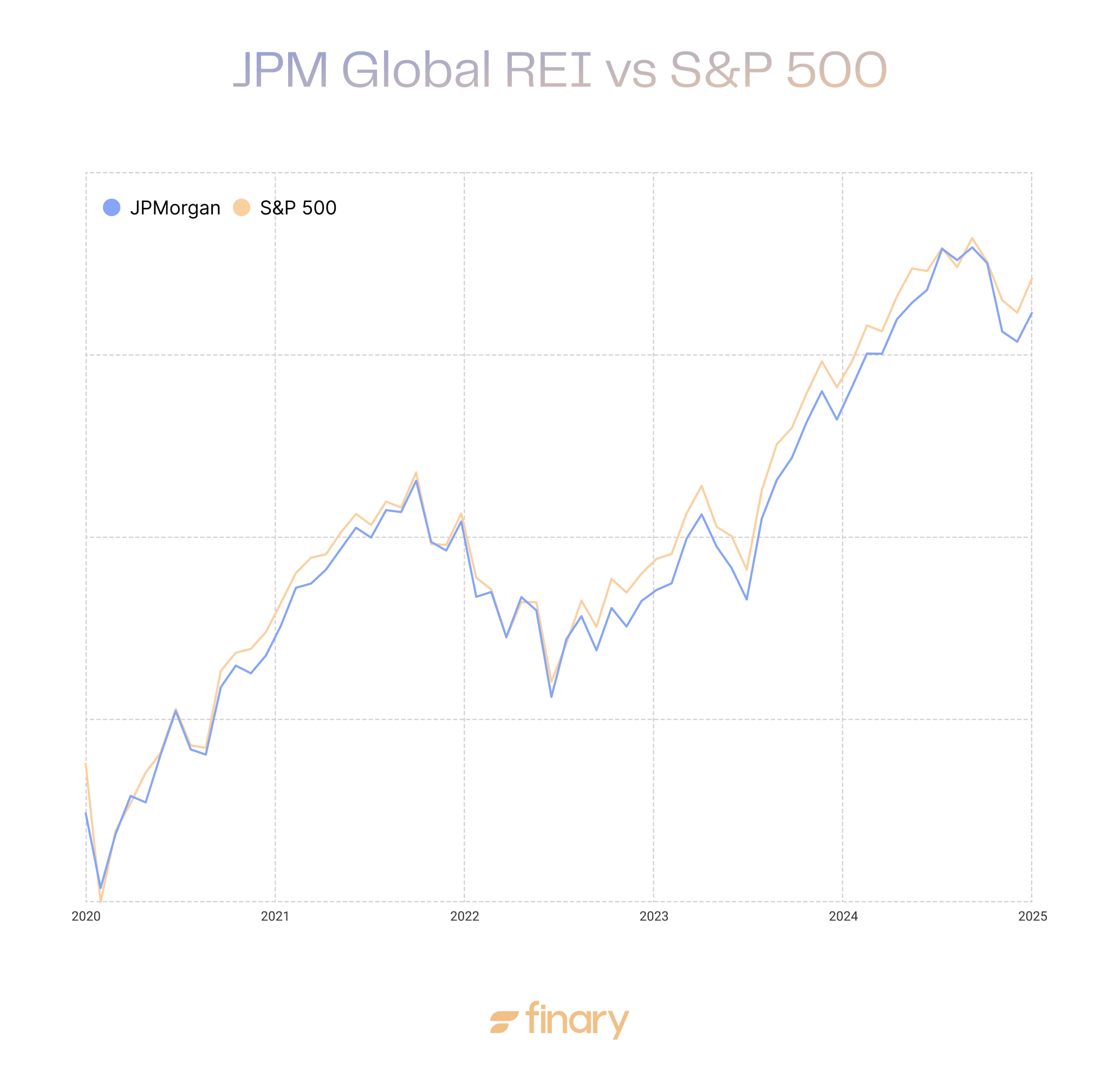
Their main strength lies in the balance between rigour and measured risk-taking. The JPMorgan US REI ESG portfolio, for example, closely resembles the S&P 500, but it overweights certain technology giants and excludes targeted companies.
The integration of ESG criteria influences every investment choice, systematically excluding companies that do not respect sustainability principles.
Management fees remain low (0.20% to 0.25%), at the bottom of the range for active ETFs. Assets under management exceed one billion euros, which shows the appeal of this approach to a broad audience.
Fidelity Global Equity Research Enhanced ETF
Fidelity offers "Research Enhanced" ETFs built on active management, within a broadly diversified framework kept close to the index.
The Fidelity Global Equity Research Enhanced illustrates the approach. The team relies mainly on proprietary analysis to apply slight over- or underweights according to conviction, while maintaining a low tracking error against the MSCI World.

Fees remain attractive (0.25%). The main promise is to attempt to generate moderate and consistent outperformance, even if the gaps with the index, up or down, remain limited.
| Holding | Weight |
|---|---|
| NVIDIA Corp. | 6.20% |
| Apple | 5.80% |
| Microsoft | 4.26% |
| Amazon.com | 3.68% |
| Broadcom | 3.02% |
| Alphabet A | 2.91% |
| Alphabet C | 2.28% |
| Meta Platforms | 2.14% |
| JPMorgan Chase | 1.36% |
| AMD | 1.32% |
Fidelity offers a wide range of Research Enhanced ETFs, combining the advantages of ETFs built on proprietary research with active management. These products aim for outperformance with controlled fees, without any guarantee of results.
Jupiter Global Government Bond Active UCITS ETF
The bond market is particularly attractive to active managers.
Indices, often weighted by debt outstanding, create many inefficiencies. Jupiter has understood this well.
Its global bond ETF does not stop at tracking the yield curve. It invests in different types of government bonds, adjusts the duration of its holdings, manages foreign currencies and seizes the best opportunities in high-yield bonds.
| Issuer | Weight |
|---|---|
| US Treasury (US91282CHU80) | 9.04% |
| International bond (XS2872164160) | 5.61% |
| Hong Kong (HK0001042289) | 5.01% |
| Japan (JP1201231AC0) | 4.96% |
| 4.125% NTS 31/01/2027 USD | 4.95% |
| Spain (ES0000012P33) | 4.63% |
| Germany, Bund (DE000BU25059) | 4.45% |
| Germany, Bund (DE0001102408) | 4.43% |
| Mexico (MX0MGO0000R8) | 4.01% |
| France, OAT (FR0014003513) | 3.33% |
This recently launched fund offers an alternative to bond funds in their traditional form, while providing the transparency and liquidity of an ETF. Its 0.30% fees exceed those of passive ETFs. However, the agility of the management can, depending on the period, offset this extra cost for investors wishing to avoid the limits of conventional bond indices.
| Region | Weight |
|---|---|
| United States | 59.36% |
| Other | 10.05% |
| Brazil | 7.90% |
| Cash | 6.79% |
| Japan | 6.46% |
| Mexico | 2.51% |
| Argentina | 2.22% |
| Turkey | 1.71% |
| Morocco | 1.58% |
| Colombia | 1.46% |
Invesco Global Active ESG Equity UCITS ETF
Here, the human gives way to advanced quantitative models.
The Invesco ETF uses algorithms able to spot weak signals across financial data as a whole. Its multi-factor approach, combined with a rigorous ESG screen, builds a distinctive global portfolio.
| Holding | Weight |
|---|---|
| NVIDIA Corp. | 6.28% |
| Alphabet A | 4.84% |
| Cisco Systems | 2.78% |
| Broadcom | 2.34% |
| Lam Research | 2.25% |
| ASML Holding | 1.88% |
| Microsoft | 1.82% |
| Western Digital | 1.81% |
| BNY Mellon | 1.79% |
| Linde | 1.65% |
This fund does not seek to beat the index with big bets. It accumulates small statistical advantages every day. Its 0.30% fees reflect the complexity of the method.

The promise remains clear: to target risk-adjusted performance, with no guarantee of outperforming traditional indices, while respecting strict sustainability criteria.

What criteria should you use to choose a good active ETF?
Choosing an active ETF rests on four main criteria: the strategy and expertise of the manager, risk-adjusted performance, assets under management and the level of fees relative to the added value.
Investment strategy and manager expertise
Behind every high-performing active ETF, a management team makes decisions that go beyond simply tracking an index.
The best active ETF managers analyse companies in depth, use precise quantitative signals and draw on their experience to anticipate market moves.
The investment strategy remains essential. Some active ETFs take an “enhanced index” approach: they stay close to the index while taking tactical positions on certain holdings.
Others prefer exposure to specific sectors or geographic regions. The consistency of the investment process is an important element of analysis, as is the ability to justify every choice, even in periods of high volatility. An active ETF without a clear strategy quickly loses its relevance.
Risk-adjusted historical performance
Gross performance is not enough to assess an active ETF. Risk-adjusted performance gives a more faithful picture of the added value over the long term.
Experienced investors examine indicators such as the Sharpe ratio, volatility and the consistency of outperformance across several market cycles.
It is also important to check the ability of the ETF to limit losses during corrections. Some active ETFs, notably at JPMorgan, show a moderate “tracking error” while seeking to limit losses in falling markets (with no capital guarantee). It is in these periods that active management can, in some cases, stand out.
Assets under management (AUM) and liquidity
Assets under management reflect investor confidence. An active ETF with more than €500 million in assets generally offers better liquidity, which makes buying and selling units easier.
Assets that are too large, however, can limit the flexibility of the manager, especially in narrow markets or highly concentrated strategies.
Detailed analysis of the composition of a few flagship active ETFs
Examining the composition of an active ETF helps to understand its strategy. Take the JPMorgan US REI ESG: the top 10 of the portfolio accounts for more than a third of assets, with heavy exposure to US technology (Apple, Nvidia, Microsoft).
This positioning reflects the conviction of the manager: technological innovation remains the engine of US growth. It also exposes the portfolio to sector reversals.
Attentive investors also monitor how positions rotate: a portfolio that is too stable may indicate a lack of conviction. Excessive turnover, on the other hand, may signal opportunistic or jittery management.
Comparing management fees (TER) between active and passive ETFs
Management fees are often an obstacle for active management. A TER of 0.20% to 0.70% for an active ETF remains two to three times that of a passive ETF on the same index.
The main issue is not the absolute level of fees, but the ability of the manager to generate outperformance net of fees, consistently.
Competition has helped bring fees down, but vigilance is still needed. A “low cost” active ETF with no real added value amounts to paying for marketing.
Conversely, a slightly higher TER is justified if the strategy delivers solid alpha, notably in less efficient markets such as bonds, small caps or emerging markets.

The scarcity of PEA-eligible active ETFs
The French market faces a major constraint: the scarcity of active ETFs eligible for the PEA. The PEA rules (75% EU/EEA equities) favour passive ETFs, especially those using synthetic replication.
Active ETFs generally favour physical replication and complete geographic freedom. As a result, the supply of PEA-eligible active ETFs remains very limited, apart from a few money-market funds and rare European strategies whose eligibility varies with their weightings.
To invest in these active ETFs, you can choose between a PEA or a securities account depending on your investment strategy and the tax advantages you are looking for.
Sectors studied by active ETF managers
In 2026, the distinction between active and passive management is fading. Yet some sectors remain particularly suited to active management. Active ETFs seek to exploit market inefficiencies, where automation shows its limits.
The healthcare sector still attracts active managers. Medical innovation, biotechnology and the personalisation of treatments create a dynamic environment. Active ETFs specialising in healthcare often select mid-sized laboratories that are absent from the major indices. This approach lets them benefit from innovation cycles and limit the risks linked to concentration in a handful of large companies.
The energy transition is becoming a concrete field of action. Active ETFs analyse the whole value chain, from energy storage to industrial decarbonisation. Active managers engage with companies to spot weak signals, such as a technological advance or a regulatory change. Unlike conventional ESG indices, active ETFs can overweight companies in the middle of a transformation, even if that means moving away from the consensus.
Technology remains essential, but the heavy weight of Big Tech in passive indices is causing concern. Technology-focused active ETFs explore less exposed segments, such as next-generation semiconductors, cybersecurity and artificial intelligence applied to industry. This appeals to investors looking for sector diversification.
The European financial sector, long neglected, is regaining appeal. Active ETFs see an opportunity for fine selection there, between traditional banks in the midst of digital transformation and fast-growing fintechs. Rising rates and consolidation in the sector create a favourable environment for those who know how to analyse balance sheets in depth.
Do you want to broaden your investment strategy beyond ETFs? Find out which financial investments are the most profitable in this article: the most profitable financial investments.
Geographic regions
Europe, often seen as less dynamic, nonetheless offers opportunities to active managers. Pan-European active ETFs bet on the resilience of companies in the face of geopolitical shocks and the green transition.
Asia, excluding China, is attracting more and more interest. Active ETFs favour India, Indonesia and Vietnam, where population growth and digitalisation create opportunities that are barely visible in the major indices. Active management makes it possible to avoid the traps linked to governance or liquidity, which are frequent in these emerging markets.
The United States remains unavoidable, but US active ETFs in 2026 stand out for their ability to adapt to a more volatile market.
Active management also offers great responsiveness to external shocks. In 2026, geopolitics, trade tensions and diverging monetary policies are creating performance gaps between regions. Active ETFs can adjust their exposure quickly, where passive ETFs remain tied to their benchmark index.
Active ETFs, an alternative to reserve for inefficient markets
In 2026, active ETFs represent an approach different from passive management. They adapt to an environment where uncertainty dominates. For attentive investors, they rest on human analysis and discretionary selection, where the algorithm reaches its limits.
Sectors in transition and regions undergoing transformation are their favoured field of action. It remains essential to choose managers able to combine boldness and discipline.
Frequently asked questions
Can an active ETF lose money?
Yes. Like any investment in equities or bonds, an active ETF carries a risk of partial or total capital loss. Active management does not protect against market risk: it only aims to generate a return above the benchmark index, with no guarantee of results.
Is an active ETF eligible for the PEA (a French tax-advantaged equity savings account)?
Rarely. The PEA rules require at least 75% of equities or similar securities from the European Union or the EEA, a constraint that few active ETFs meet since they often favour physical replication and global geographic freedom. Only certain European strategies are eligible.
What is the difference between an active ETF and a conventional mutual fund?
An active ETF trades continuously on the stock market, like a share, with daily transparency of its portfolio. A conventional mutual fund is valued only once a day and publishes its composition with a longer delay, often quarterly.
Should you choose an active or a passive ETF to invest for the long term?
In US large caps, the SPIVA study shows that a large majority of active managers underperform their index over 20 years: the passive ETF often remains preferable. Active management can be justified in less efficient markets, such as bonds or small caps.
How do you assess whether an active ETF justifies its higher fees?
You have to compare the performance net of fees with that of the index over several market cycles, not just over one favourable year. An active ETF whose outperformance does not durably offset its extra management cost brings no real added value to the investor.
Sources
JustETF, JPMorgan US Research Enhanced Index Equity Active UCITS ETF profile (IE00BJ06C044)
JustETF, Fidelity Global Equity Research Enhanced UCITS ETF profile (IE00BKSBGV72)
JustETF, Jupiter Global Government Bond Active UCITS ETF profile (IE000GDU4WA8)
JustETF, Invesco Global Active ESG Equity UCITS ETF profile (IE00BJQRDN15)
Invesco, Key Information Document confirming the change of name of the fund on 4 April 2025
AMF, recommendation on the transparency of active ETF portfolios
Regulatory disclaimers: Marketing communication. Investing carries a risk of partial or total capital loss. Past performance is not a reliable indicator of future performance. This article is provided for information and educational purposes only; it does not constitute personalised investment advice, a buy or sell recommendation, or tax advice.
Before investing, read the Key Information Document (KID) and, where relevant, consult an authorised adviser.
Finary SAS, an investment firm authorised by the ACPR (no. 19283), member of AMAFI. Insurance broker registered with ORIAS (no. 21001279), member of the CNCGP (association approved by the AMF). Crypto-Asset Service Provider (CASP) authorised by the AMF under the MiCA regime, references no. A2026-026 and no. N2026-008.