


Should you invest in an oil ETF?

Updated on 31 July 2026
Investing in an oil ETF gives you exposure to the price of crude without holding a single barrel, but it is a speculative, volatile product with no intrinsic yield, meant for informed investors. This guide covers how it works, the cost of the roll-over, the right account to hold it in and the place it deserves in a portfolio.

- An oil ETF is in fact an ETC, a debt security backed by futures contracts, and it carries counterparty risk.
- In a contango market, rolling the contracts over erodes performance even when the price of a barrel does not move.
- Crude oil and energy sector ETFs are held in a securities account: none is eligible for the PEA (a French tax-advantaged equity savings account).
- Annual fees range from around 0.18% for an energy equity ETF to 0.49% for a crude oil ETC.
- This product belongs in a small satellite sleeve, never at the core of a portfolio: the risk of capital loss is high.
What is an oil ETF?
An oil ETF is an exchange-listed product that tracks the price of crude oil, or the performance of the companies in the sector, without holding any physical barrels. To use one properly you need two ideas: the tracker, and oil as a traded commodity.
What is an ETF?
An ETF (Exchange Traded Fund), or tracker, is an index fund whose purpose is to replicate the performance of a benchmark index. It lets investors buy, in a single order, a share of every company in that index. For example, a CAC 40 ETF replicates the performance of the French stock market index, without seeking to beat it, and gives you the option of investing in each company listed inside it.
Offered by asset managers, there are ETFs tracking just about every product traded on the markets.
What is exchange-traded oil?
The oil price tracks the price of crude oil, that is, oil extracted straight from the ground, before any processing, storage or distribution costs. It is quoted per barrel, which holds 159 litres. One tonne of oil therefore equals about 7.33 barrels.
An oil ETF is therefore a market-traded product that follows benchmark indices on crude oil.
Crude oil is not the same at every well. Its sulphur content and its density vary, which suits it to different uses: fuel oil, bitumen, petrol, diesel and so on. Three benchmarks coexist for crude, and therefore for oil ETFs:
- the Brent crude, whose complex serves as the price benchmark, directly or indirectly, for around 80% of the crude oil traded worldwide. It is drilled in the North Sea and is a light, sweet crude
- the WTI crude, for West Texas Intermediate, which is the benchmark in North America. It is easier to refine than Brent
- the Dubai Light crude. This is the benchmark for Asian and Middle Eastern countries. It is much heavier and more sour.
So there are Brent oil ETFs and WTI oil ETFs.

How does an oil ETF work?
First of all, as with a commodity ETF, an oil tracker is in fact an ETC (Exchange Traded Commodity). It gives you exposure to the movements of the underlyings it holds, with no storage to worry about. Unlike a conventional ETF, which is a fund, an ETC is legally a debt security issued by an institution: it therefore carries counterparty risk, even though it is usually collateralised to limit it.
Next, an oil tracker follows the performance of crude through futures contracts: an agreement to sell a given quantity of an asset at a future date, at a maturity and a price fixed in advance, regardless of the actual oil price on the day of delivery.
Two types of market coexist for this: contango, or backwardation.
In contango, the futures price is higher than the spot price of oil. At each maturity the ETF sells its cheap contract and buys back a dearer one: time works against the investor, who loses barrels with every roll. Backwardation is the reverse, with the forward price below the spot price: the roll then works in the holder's favour.
Several parameters go into the futures price: inflation, interest rates, shifts in supply and demand, storage costs, exchange rates and so on. It therefore differs from the physical price of the commodity, here oil.
Finally, to avoid actually taking delivery of barrels, the ETF sells its contract at maturity and enters another one with a later maturity, and so on. This roll is called the roll-over. This chain of futures contracts affects the performance of your oil tracker.
Example: you invest USD 10,000 in a WTI oil ETF through the nearest-maturity futures contract, at USD 80 a barrel. You therefore own 125 barrels. As maturity approaches, to avoid delivery, you roll your position into the next maturity, but that one trades at USD 88 (a contango market). You now hold only 114 barrels. Contango has cost you 11 barrels, or USD 8 a barrel, without the oil price falling at all.
Good to know : An oil ETF is a fast, cheap way to invest in crude. However, the various contract combinations make your tracker's performance more uncertain than that of some other ETFs. Like any commodity, oil produces neither dividends nor interest: it is a speculative asset with no intrinsic yield. An oil ETF is therefore better suited to short-term trading and to diversification. It can form part of a satellite allocation within a highly diversified wealth management strategy. What types of oil ETF are there?
Oil ETFs fall into two categories: pure crude oil ETFs, and oil company or energy ETFs, which are broader.
Pure crude oil ETFs
To invest in oil, you can invest... in crude oil itself. Very few ETFs track the price of crude alone. One of the best known, listed on Euronext Paris, is the WisdomTree Brent Crude Oil (ISIN JE00B78CGV99), backed by the Brent benchmark, the most widely used.
Internationally, the USO (United States Oil Fund) is one of the main WTI oil ETFs. One caveat: this US fund has no Key Information Document (KID) compliant with European regulation, so in practice it is not available to retail investors resident in the European Union. It also holds a portion of US Treasury bills.
Oil company ETFs
More numerous, oil company ETFs track the performance of the players in the oil sector: refiners, distributors, producers and so on. But not only those. These trackers usually also hold other energies such as gas or renewables. They give you exposure to the shares of the companies inside a benchmark index, for illustration only, non-exhaustive and without recommendation.
The main energy ETFs include the following funds:
- iShares STOXX Europe 600 Oil & Gas UCITS ETF (DE000A0H08M3)
- Amundi STOXX Europe 600 Energy Screened UCITS ETF (LU1834988278)
- iShares S&P 500 Energy Sector UCITS ETF (IE00B42NKQ00)
- Amundi S&P Global Energy Carbon Reduced UCITS ETF (IE000J0LN0R5)
Broad World ETFs already give you indirect exposure to oil through the majors they hold. For targeted global sector exposure, there are dedicated funds such as the Amundi S&P Global Energy Carbon Reduced UCITS ETF (IE000J0LN0R5), 63% of whose assets are invested in the United States.
What risk profile does an oil ETF have?
The risk profile of an oil ETF is high, even very high. Brent fell from 140 to 46 dollars a barrel within a few months in 2008, then dropped to 23 dollars at the peak of the 2020 Covid shock. More than an economic matter, oil is above all a major geopolitical one. So although the price of a barrel is supposed to reflect the balance of supply and demand like any other asset, OPEC (the Organization of the Petroleum Exporting Countries) keeps a close watch and plans oil output to serve the interests of its members first. The oil market is heavily influenced by OPEC's production decisions.
Price movements are therefore hard to predict, as the collapse in early 2020, after the coronavirus crisis went global, showed. Through the roll-over mechanism, the price even turned negative for a single session, triggering enormous panic on the financial markets.
The spectre of peak oil, the point of maximum global output beyond which extraction declines, also drives price swings as new drilling sites and new extraction methods are discovered.
Finally, rolling contracts exposes you to a real risk of loss and leaves you entirely dependent on the market, including in an oil or equity crash. The way a tracker is built also changes the level of risk: WTI or Brent, leverage, long or short, or a mix of all of these.
All of this puts oil ETFs in the risky, even very risky, category of investments.
Good to know : Although commodities have historically been seen as a kind of insurance against equity market swings, oil has a less defensive profile than other commodities. The oil market is closer to trading than to investing and, as such, carries a high level of risk. The risk of capital loss is high. Other commodity exposures, such as the gold ETF, have a different profile. What are the advantages of an oil ETF?
Risky though it is, an oil ETF still has a few advantages: low cost, and access to the oil market.
Low cost for ETFs
The main advantage of an ETF, apart from diversification, remains its low cost compared with other market products. A tracker is priced within reach of a wide range of investors, with low management fees, of the order of 0.2% to 0.5% on average. That makes it an attractive asset for risk-tolerant investors who want exposure to oil at low cost.

Easier access to an essential commodity
The oil market is generally the preserve of professional investors. They are the largest consumers of oil and the ones with the most at stake.
An oil ETF lets you into that market without having to buy and roll futures contracts yourself, which demands an excellent grasp of finance and of the markets.
How do you invest in oil ETFs?
To invest in an oil ETF you open a securities account with a broker, choose between crude oil and energy sector equities, then place an order on the fund you have picked. Three decisions shape the operation: the account you hold it in, the entry point and the choice of fund.
Choosing the right account
It is not possible to invest in crude oil ETFs inside a PEA. You have to go through a securities account and accept its taxation (the flat tax).
Energy sector ETFs are no gateway to the PEA either. A fund is only eligible for the plan if it invests at least 75% of its assets in securities of companies headquartered in the European Union or the European Economic Area. No oil and gas ETF meets that threshold: Shell and BP, both British, have not been eligible since Brexit, and Exxon and Chevron are American. The iShares STOXX Europe 600 Oil & Gas alone holds more than 25% in Shell. To get sector exposure inside a PEA, European shares held directly remain, such as TotalEnergies, Eni or Engie. Always check the eligibility stated in the fund's KID before investing.
Choosing the right moment
In a broadly speculative market, when should you buy an oil ETF? Many factors come into play, but historically some investors step in after a sharp fall, with no guarantee of a rebound. The chart below shows the price of a barrel tumbling after each major crisis, before recovering at varying speeds.
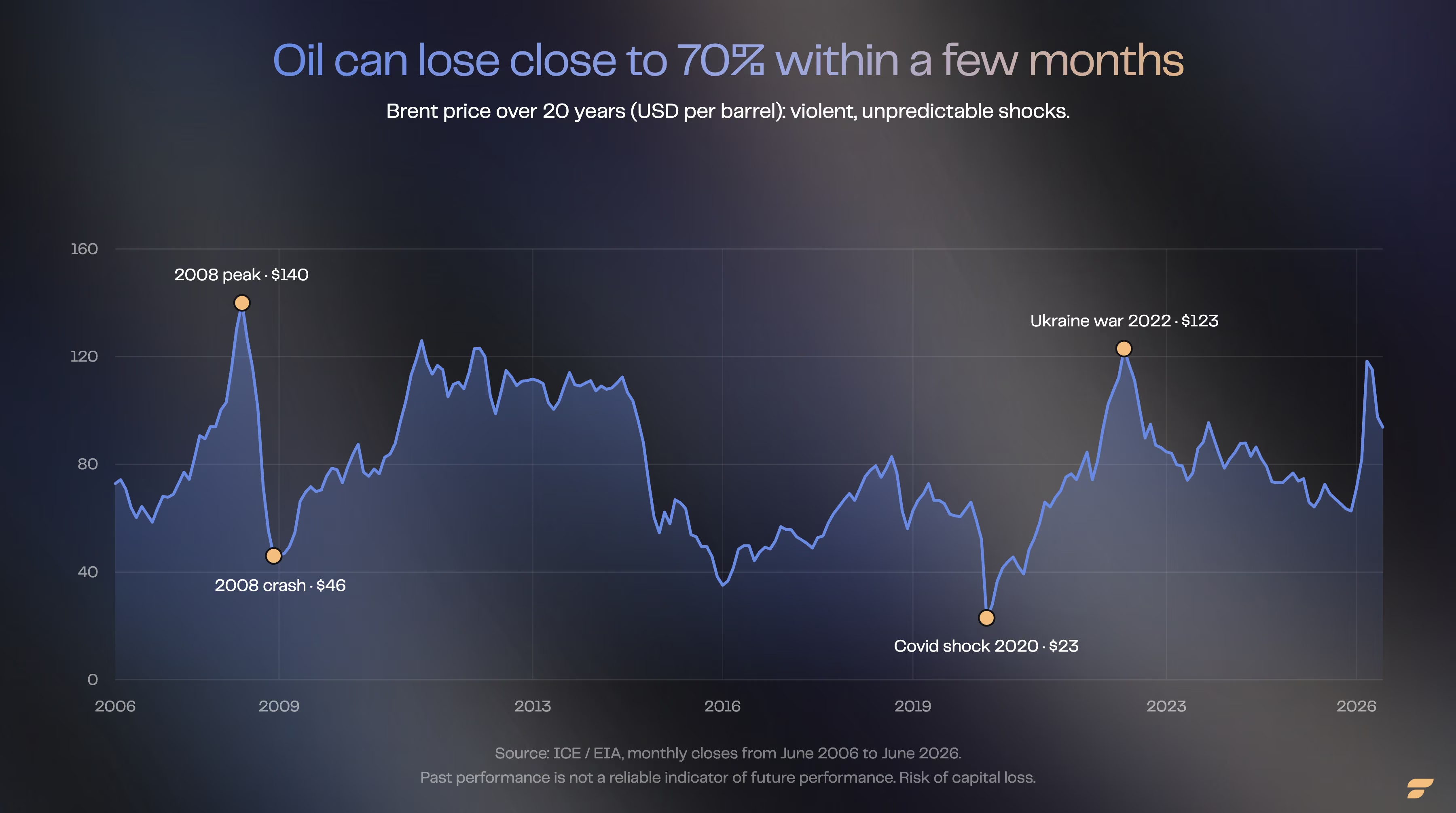
So it can make sense to take a position in an oil ETF according to your strategy and your risk tolerance, with no threshold amounting to a reliable buy signal.
Choosing the right oil ETF
As we have seen, an oil tracker is a high-risk product. Depending on your objective and your investor profile, you can turn to an energy ETF to soften the impact of oil's volatility and add diversification to your portfolio, or to a pure crude oil ETF for short-term trading.
WTI generally trades at a slight discount to Brent (the Brent-WTI spread), partly because WTI is stored inland at Cushing, whereas Brent, loaded in the North Sea, is easier to export. But for an ETF, what makes the difference to investors is above all the fund's composition and its roll-over policy. It is up to you to compare funds and pick the one that suits your strategy. It can also be worth discussing it with your wealth management adviser. Once the position is open, apps such as Finary let you track the weight of that satellite sleeve within the whole portfolio, across every broker.
To get your bearings, here are a few representative ETFs from the two main families, with their fees and their PEA eligibility:
| ETF (for illustration) | ISIN | Type of exposure | Annual fees (TER) | PEA eligible |
|---|---|---|---|---|
| WisdomTree Brent Crude Oil | JE00B78CGV99 | Brent crude oil (ETC) | 0.49% | No |
| WisdomTree WTI Crude Oil | GB00B15KXV33 | WTI crude oil (ETC) | 0.49% | No |
| iShares STOXX Europe 600 Oil & Gas | DE000A0H08M3 | Europe oil and gas equities | 0.47% | No |
| Amundi STOXX Europe 600 Energy Screened | LU1834988278 | Europe energy equities | 0.30% | No |
| Amundi S&P Global Energy Carbon Reduced | IE000J0LN0R5 | Global energy equities | 0.18% | No |
Annual fees (TER), source: justETF, data as at 31 July 2026. Non-exhaustive list, for illustration only and without recommendation. Crude oil ETFs (ETCs) are never eligible for the PEA; nor are energy sector equity ETFs, since they fall short of the 75% European securities threshold the plan requires.
Good to know : Much as an SCPI (a French non-listed real-estate investment fund, comparable to a REIT) is a "paper property" investment, an oil ETF is a "paper oil" investment. WTI and Brent futures alone trade more than 2 billion "paper" barrels a day, some twenty times actual world consumption: the International Energy Agency put that consumption at around 104 million barrels a day in its May 2026 report, before revising 2026 demand down by about 1 million barrels a day in its July 2026 report. When you buy an oil ETF the clock starts, and contango can erode performance over time even if the market alternates with phases of backwardation. Investing in an oil ETF is therefore an operation better suited to short and medium-term strategies, given how hard the market is to forecast.
Frequently asked questions
How do you invest in oil?
You can invest in oil by buying oil company shares, oil ETFs or oil-linked ETFs, or by betting on CFDs (Contracts For Difference) for short-term trading.
Which oil ETFs are available on the market?
On crude oil, the European range is limited to a few ETCs: WisdomTree Brent Crude Oil (JE00B78CGV99, 1-month maturity), WisdomTree Brent Crude Oil Longer Dated (JE00B78CP782, 3-month maturity) and WisdomTree WTI Crude Oil (GB00B15KXV33). On energy equities, the Amundi STOXX Europe 600 Energy Screened (LU1834988278) is the European reference. Non-exhaustive list, for illustration only.
What returns can you expect from an oil ETF?
Commodities are not there to create value, but to add diversification. Oil is no exception. Speculative trading is in fact a losing game for the vast majority of retail investors: according to the AMF, close to 9 in 10 lose money trading CFDs and Forex.
Does an oil ETF pay dividends?
No. Oil is a commodity that generates neither dividends nor interest. A pure oil ETF therefore distributes no income: only the movement in the price of a barrel, less the effects of the roll-over, changes its value. Oil company ETFs, on the other hand, can pass on the dividends of the companies they hold.
How is an oil ETF taxed?
Held in a securities account, an oil ETF falls under the flat tax (PFU). The PEA is not an option: neither crude oil ETCs nor energy sector ETFs meet the 75% European securities threshold the plan requires.
What share of your portfolio should go to an oil ETF?
Given its volatility, oil is usually treated as a small satellite sleeve of a diversified portfolio, not as a core holding. The amount depends on your risk tolerance and your time horizon: this speculative product carries a risk of capital loss that can be high.
Sources
justETF, WisdomTree Brent Crude Oil (JE00B78CGV99): fees, assets under management and index tracked
justETF, WisdomTree Brent Crude Oil Longer Dated (JE00B78CP782): 3-month maturity
justETF, WisdomTree WTI Crude Oil (GB00B15KXV33): fees and assets under management
justETF, iShares STOXX Europe 600 Oil & Gas UCITS ETF (DE000A0H08M3): fees and composition
justETF, Amundi STOXX Europe 600 Energy Screened UCITS ETF (LU1834988278): fees and composition
justETF, iShares S&P 500 Energy Sector UCITS ETF (IE00B42NKQ00): fees and assets under management
International Energy Agency, Oil Market Report, July 2026: world oil demand
ICE, Brent Crude: the Brent complex as a price benchmark
AMF, study of retail investor results in CFD and Forex trading in France
BOFiP, PEA: how the plan works and which securities are eligible, the 75% threshold
Service-public.gouv.fr, how the income of a PEA is taxed
La finance pour tous, why the oil price turned negative in April 2020
BP Statistical Review, approximate conversion factors: tonne of oil into barrels
Regulatory disclaimers: Marketing communication. Investing carries a risk of partial or total capital loss. Past performance is not a reliable indicator of future performance. This article is provided for information and educational purposes only; it does not constitute personalised investment advice, a buy or sell recommendation, or tax advice. Before investing, read the Key Information Document (KID) and, where relevant, consult an authorised adviser. Finary SAS, an investment firm authorised by the ACPR (no. 19283), member of AMAFI. Insurance broker registered with ORIAS (no. 21001279), member of the CNCGP (association approved by the AMF). Crypto-Asset Service Provider (CASP, "PSCA" in French) authorised by the AMF under the MiCA regime, references no. A2026-026 and no. N2026-008.