Best Latin America ETFs: 2026 Investment Guide

Updated on 28 July 2026
The best ETFs for investing in Latin America are the iShares MSCI EM Latin America UCITS ETF (physical, distributing), the Amundi MSCI EM Latin America (accumulating) and the Amundi PEA MSCI Emerging Latin America, the main one eligible for the PEA (a French tax-advantaged equity savings account). This guide compares their fees, their assets under management and their replication method, to help you diversify your portfolio across emerging markets.

- The iShares MSCI EM Latin America (IE00B27YCK28) replicates the index physically, with a TER of 0.20% and a dividend distribution twice a year.
- The Amundi MSCI EM Latin America (LU1681045024) is accumulating, listed in euros and synthetically replicated, for an identical TER of 0.20%.
- The Amundi PEA MSCI Emerging Latin America (FR0013412004) is the main ETF in the region that can be held in a PEA, with a TER of 0.30%.
- These ETFs are heavily concentrated in Brazil (around 54%) and Mexico (around 23%), with a clear dominance of the financial sector.
- Latin America remains highly volatile: investing exposes you to currency risk and to a risk of capital loss.
Why invest in Latin America with ETFs?
Investing in Latin America through ETFs gives you access, in a single line, to dozens of Brazilian, Mexican or Chilean companies, at a lower cost and without the constraints of buying local shares. In return, the region remains volatile and exposed to currency risk.
Why invest in Latin America?

Latin America is attracting more and more investors. The region is going through deep economic change. A young population, rapid urbanisation and abundant natural resources are fuelling growth.
Brazil, Mexico, Chile and Colombia are no longer limited to exporting commodities. These countries are now home to innovative banks, major mining companies, fast-growing fintechs and consumer businesses riding the rise of a middle class.
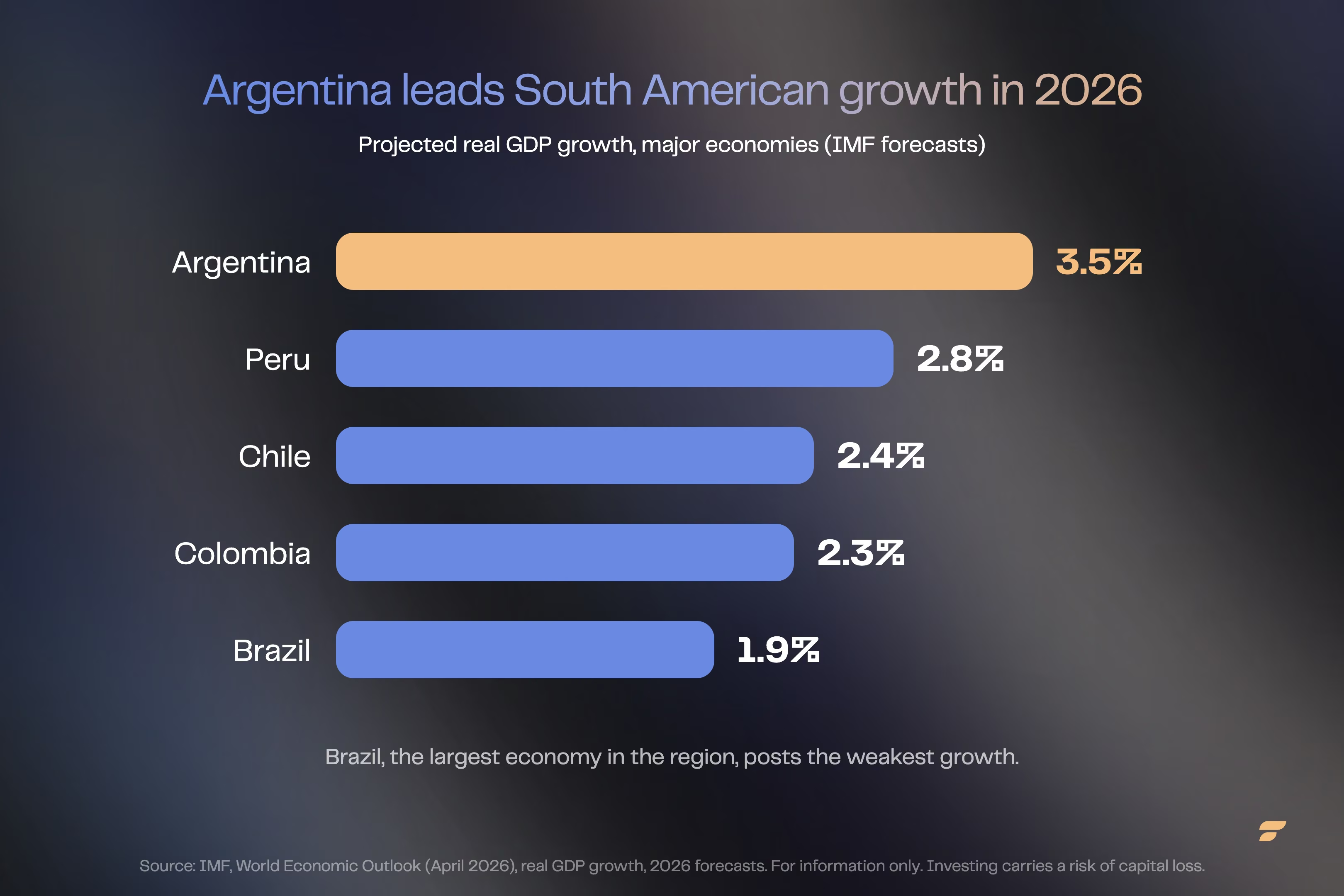
Investing in Latin America diversifies a portfolio that is often too exposed to Europe or the United States. Latin American markets sometimes move against developed markets. That decorrelation can protect a portfolio when traditional markets go through difficult periods.
ETFs: an investment vehicle suited to Latin America
Buying Brazilian or Mexican shares directly from France remains complex and expensive. ETFs simplify access to these markets. In a few clicks, they let you invest in a carefully selected basket of shares, without the constraints of local markets or high brokerage fees.
ETFs make international diversification easier. Rather than betting on a single company, the investor is exposed to dozens, even hundreds, of companies in the region. This approach reduces specific risk and captures the overall momentum of the market.
Risks of investing in Latin America
Investing in Latin America exposes you to high volatility. Several factors can move local markets:
- Local currencies, such as the Brazilian real or the Mexican peso, can swing quickly. These exchange rate moves can amplify or wipe out the gains made on the market.
- Political cycles remain unpredictable. An election, a tax reform or a political scandal can trigger sharp moves on the markets.
- The price of commodities plays a central role. Copper, oil and soy directly influence the economic health of the region. A reversal in global prices can weaken entire sectors.
- International capital flows are unstable. When risk appetite falls on the major financial centres, Latin America often suffers heavy capital outflows, which adds to the pressure on local markets.
Another risk concerns geographic and sector concentration. Latin America ETFs invest mostly in Brazil (around 54%) and Mexico (around 23%). The other countries remain thinly represented.
On top of that, a few sectors such as finance, commodities and consumer staples largely dominate the composition of these ETFs.
Which are the best ETFs for investing in Latin America?
Three ETFs stand out for investing in Latin America: the iShares MSCI EM Latin America (the largest assets under management, physical replication), the Amundi MSCI EM Latin America (accumulating, listed in euros) and the Amundi PEA MSCI Emerging Latin America, the only one that houses this exposure in a PEA. Here is how they differ.
| ETF | ISIN | TER | Assets under management | Replication | Dividends | PEA |
|---|---|---|---|---|---|---|
| iShares MSCI EM Latin America UCITS ETF (Dist) | IE00B27YCK28 | 0.20% | ~€1.8 billion | Physical | Distributing (twice yearly) | No |
| Amundi MSCI EM Latin America UCITS ETF EUR (C) | LU1681045024 | 0.20% | ~€950 million | Synthetic (swap) | Accumulating | No |
| Amundi PEA MSCI Emerging Latin America UCITS ETF | FR0013412004 | 0.30% | >€175 million | Synthetic (swap) | Accumulating | Yes |
iShares MSCI EM Latin America UCITS ETF (ISIN IE00B27YCK28)

This fund, run by iShares (BlackRock's ETF arm), is one of the vehicles available for reaching Latin American markets from Europe.
According to JustETF, its assets under management exceed €1.7 billion, which supports liquidity and makes trading easier, even during sharp market moves.
The ETF stands out for its physical replication. It directly holds the shares of the largest Brazilian and Mexican companies, such as Vale, Petrobras, Itau Unibanco and Nu Holdings. These businesses dominate the South American economy and weigh heavily on local markets.
A large share of the portfolio sits in the financial sector, because major banks and insurers dominate the listed market in Latin America. That means the ETF's performance depends heavily on the health of the local banking sector. If it runs into trouble, your investment can fall sharply.
To limit concentration risk, the ETF applies the 10/40 rule. That rule prevents any single company from taking an excessive share of the portfolio, which protects against the imbalances common in emerging markets.
Investors looking for regular income appreciate the twice-yearly distribution of dividends.
That said, the region's volatility can produce wide swings from one year to the next. With a TER (Total Expense Ratio, the annual management fee) of 0.20%, this fund is among the cheapest in its category, which reduces the drag of fees on net performance.
One point to watch: the Irish listing. That feature can affect the taxation of dividends depending on your situation, and is worth reviewing to optimise your return.
Amundi MSCI Emerging Markets Latin America (ISIN LU1681045024)

Amundi, a major player in passive management in Europe, offers a simple and flexible option. This fund, listed in euros, suits investors who want to avoid currency conversion and prefer dividends to be reinvested.
Here, dividends are automatically reinvested, which can support long-term compounding through the effect of compound interest.
Synthetic replication, often viewed with suspicion, is an advantage here. The fund uses a swap to reproduce the performance of the index, without directly holding Latin American shares. This method tracks the index closely, even when some securities are hard to trade.
In return, the investor takes on counterparty risk, even though UCITS rules frame that risk. This choice means weighing tracking accuracy against exposure to a banking risk.
For an experienced investor, it is a trade-off worth considering. Assets under management, while smaller than those of iShares, remain significant. At more than €900 million, that size ensures competitive spreads.
The TER, identical to that of iShares, shows that Amundi is prioritising structure and flexibility over a price war.
One aspect often overlooked: a dollar-denominated version (LU1681045297) also exists. This share class gives direct exposure to the US currency, which adds a further currency risk. That choice depends on your own expectations for the dollar/euro rate and carries a currency risk.
Amundi PEA MSCI Emerging Latin America ESG Leaders
This fund stands out as a niche product, designed to answer a specific demand from French investors: investing in Latin America while benefiting from the tax wrapper of the PEA (Plan d'Epargne en Actions).
It meets every regulatory requirement and follows an ESG approach. Rather than replicating the whole market, it selects the Latin American companies with the best environmental, social and governance ratings.
That positioning has concrete consequences. The fund excludes some oil and mining heavyweights and favours companies judged more responsible.
For the investor, this means a different exposure, often less cyclical and sometimes less dependent on commodities.
The TER reaches 0.30%, a higher level explained by the complexity of ESG selection and by the synthetic structure required for PEA eligibility.
Assets under management now exceed €175 million, a sign that this product has found its audience among French investors looking for Latin American exposure they can hold in a PEA. For anyone who wants to use the PEA tax framework on this region, it is one of the very few options available.

Latin America ETF holdings: the main positions
Forget diversification S&P 500 style. Here, a handful of large caps make up a major share of the index.
Whether you go through a standard ETF or the only eligible PEA ETF, you will always find the same big names: Brazil's Vale (iron ore), Petrobras (oil), Itau Unibanco (banking), Nu Holdings (fintech), and on the Mexican side Banorte, FEMSA (retail) and Grupo Mexico (mining).
Their combined weight, often above 40%, is no accident: these heavyweights sit at the heart of the regional economy, giving targeted exposure to energy, finance and commodities.
Moves in the real and the peso, and commodity cycles, therefore feed through to your ETF very quickly. The ESG filter on the PEA option reshuffles the pack a little, but the base of large companies remains, as does the dominant exposure to Brazil and Mexico.
Country and sector allocation of Latin America ETFs
Brazil comes first, with around 54% of the allocation. Mexico follows, at around 23%. Chile, Peru and Colombia stay well behind. This split reflects regional market capitalisation. If Brazil wobbles, the ETF feels it immediately.
Tracking the real weight of this exposure within your overall wealth helps you avoid overweighting it without realising: apps such as Finary bring the monitoring of all your positions together, across every broker.
On the sector side, finance dominates (up to 38%), followed by:
- commodities (16%)
- consumer staples (15%)
- industrials and energy, which make up the rest
This structure does not match textbook diversification. It offers instead a faithful picture of the Latin American economy, with its strengths and its weaknesses.
Investors often notice how little technology or healthcare is present.
Big Tech and big pharma are conspicuously absent. Innovation exists, but it stays marginal in the indices. Latin America ETFs are above all a bet on population growth, mass consumption and global demand for commodities.
Want to diversify your portfolio beyond Latin America ETFs? See how to invest in bonds to round out your strategy with less volatile assets.
Which Latin America ETF should you choose for your profile?
Choosing the best Latin America ETF comes down to picking the one that matches your convictions, your tax situation, your risk tolerance and your investment horizon.
That choice stays personal and depends on your own trade-offs. Investing in the best Latin America ETFs calls for a careful reading of the opportunities and the risks. It also means taking your own goals and risk tolerance into account.
Goals
Frequently asked questions
Can you hold a Latin America ETF in a PEA?
Yes, but the choice is limited. The Amundi PEA MSCI Emerging Latin America (FR0013412004) is the main ETF in the region eligible for the PEA. It uses synthetic swap-based replication to meet PEA constraints, with a TER of 0.30%.
What fees do Latin America ETFs charge?
Annual management fees (TER) run from around 0.20% for the broad iShares and Amundi ETFs to 0.30% for the PEA-eligible ETF. On top of that come brokerage fees and the tracking difference specific to each fund.
What are the main risks of a Latin America ETF?
The region is highly volatile: currency risk on the Brazilian real and the Mexican peso, dependence on commodities, unpredictable political cycles and heavy concentration in Brazil and Mexico. The risk of capital loss is real and can be substantial.
Should you prefer physical or synthetic replication?
Physical replication (iShares) actually holds the shares and avoids counterparty risk. Synthetic replication (Amundi) tracks the index through a swap, with a counterparty risk framed by UCITS rules, but it allows PEA eligibility.
Accumulating or distributing for a Latin America ETF?
An accumulating ETF (Amundi) automatically reinvests dividends and favours long-term compounding. A distributing ETF (iShares) pays the dividends out, here twice a year, which suits investors looking for regular income.
Sources
JustETF, factsheet for the iShares MSCI EM Latin America UCITS ETF (Dist), IE00B27YCK28
JustETF, factsheet for the Amundi PEA MSCI Emerging Latin America UCITS ETF, FR0013412004
iShares (BlackRock), product page for the MSCI EM Latin America UCITS ETF
Regulatory disclaimers: Marketing communication. Investing carries a risk of partial or total capital loss. Past performance is not a reliable indicator of future performance. This article is provided for information and educational purposes only; it does not constitute personalised investment advice, a buy or sell recommendation, or tax advice. Before investing, read the Key Information Document (KID) and, where relevant, consult an authorised adviser. Finary SAS, an investment firm authorised by the ACPR (no. 19283), member of AMAFI. Insurance broker registered with ORIAS (no. 21001279), member of the CNCGP (association approved by the AMF). Crypto-Asset Service Provider (CASP, "PSCA" in French) authorised by the AMF under the MiCA regime, references no. A2026-026 and no. N2026-008.