Best China ETFs: The Complete 2026 Guide

Updated on 16 July 2026
The best China ETFs available to French investors are UCITS trackers domiciled in Ireland or Luxembourg, such as the iShares MSCI China UCITS ETF (IE00BJ5JPG56) for broad exposure, or the Amundi PEA Chine UCITS ETF (FR0011871078) to hold the theme inside a PEA (a French tax-advantaged equity savings account). This article covers the categories, the best options for 2026 and the selection criteria.

- Greater China (mainland China, Hong Kong, Taiwan) generated 71% of Asia-Pacific ETF growth in 2024 (BBH Greater China ETF Survey 2025).
- US-domiciled ETFs such as MCHI, FXI or KWEB cannot be marketed to French retail investors: they have no PRIIPS KID and no UCITS prospectus.
- The Amundi PEA Chine (MSCI China) Screened UCITS ETF (FR0011871078, PASI) is the only PEA-eligible fund among the China ETFs available in Europe.
- Chinese A-shares (CSI 300) and H-shares listed in Hong Kong give different exposures: neither is structurally superior.
- Yuan currency risk and Chinese regulatory volatility remain the two main risk factors specific to these ETFs.
This article covers only China ETFs domiciled in the European Union, holding UCITS status and a Key Information Document (KID) compliant with the PRIIPS regulation. US-domiciled ETFs (such as MCHI, FXI or KWEB) cannot be marketed to European Union retail investors.
The Chinese ETF market in 2026: opportunities and investment context
In China, ETFs have become essential tools thanks to their flexibility, liquidity and transparency. They suit tactical strategies as well as long-term approaches. Money is shifting massively out of traditional funds and into these instruments, driven by:
- lower costs,
- the wish to keep control of one’s investment choices,
- the search for new opportunities.
Key economic and geopolitical factors shaping the Chinese market in 2026
China’s economy in 2026 operates in a complex environment, where every political or economic decision weighs heavily on the market. Beijing keeps adding stimulus measures to support slowing growth, particularly in real estate, once a solid sector but now under pressure.
Second-hand housing transactions are picking up slowly, while household confidence remains fragile. Monetary policy stays accommodative, with rate cuts and liquidity injections, underlining the priority given to social stability.
Internationally, the new US tariffs on Chinese exports, applied in early 2026, weigh on the economic outlook. Yet the Chinese market (MSCI China, +31.07% over calendar year 2025 according to iShares) outperformed the S&P 500 last year, driven by monetary measures and rumours of fiscal stimulus.
This performance reflects China’s ability to adapt to a difficult environment. The country is betting on agile domestic policy and a gradual opening of its financial markets.
Why include Chinese ETFs in a wealth diversification strategy

Diversification is generally treated as an allocation principle. Chinese ETFs give unique exposure to different market segments, notably:
- large caps,
- mainland A-shares,
- specialised sectors such as internet or discretionary consumption.
China stands out for how fast underlying trends turn into concrete opportunities. The rise of the urban middle class, for instance, is redefining consumption and boosting several economic sectors.
Sector ETFs capture these dynamics without concentrating on a single stock. They also offer welcome liquidity and transparency.
What are the different categories of ETF for exposure to Chinese equities?
The main categories are A-share ETFs (the mainland domestic market), H-share ETFs (Chinese companies listed in Hong Kong), broad market ETFs (a wide combined universe) and sector ETFs (technology, internet).
Chinese A-share ETFs for immersion in the mainland economy
Chinese A-share ETFs let you invest easily in the country’s largest companies, right at the heart of the Chinese economy. These funds buy shares in companies listed in Shanghai or Shenzhen, once hard for foreign investors to reach.
These ETFs reflect domestic trends before they become visible internationally. The rise of the middle class, the digitalisation of financial services or the energy transition, for example, show up in these indices first.
Investing in an A-share ETF means sometimes high volatility, but gives access to growth drivers backed by the Chinese government.
Chinese H-share ETFs for access to companies listed in Hong Kong

H-share ETFs give access to Chinese companies listed in Hong Kong. These companies often operate in strategic sectors such as finance, energy or technology. They benefit from deep liquidity and transparency in line with international standards.
For the foreign investor, these ETFs offer a more familiar framework, while remaining complex. They include large banks, insurance giants and technology players that use dual listings to raise capital internationally.
Broad-spectrum Chinese ETFs for wide market coverage
Broad market ETFs combine several categories of Chinese shares. They include stocks listed in Shanghai, Shenzhen, Hong Kong, and even in New York as ADRs.
These ETFs offer a global view that spreads the risks specific to each segment. They capture the general momentum of the Chinese economy by adjusting their weightings towards growing sectors such as technology, finance or consumption.
These funds do, however, often remain concentrated in a few giants such as Tencent or Alibaba. That concentration sometimes limits diversification, despite apparently broad coverage.
Chinese sector ETFs for targeting specific growth drivers
Chinese sector ETFs allow a focus on key sectors of the economy, such as:
- Internet
- Consumption
- Technology
- Healthcare
- Clean energy
The KraneShares CSI China Internet UCITS ETF (the European share class of the US KWEB), for instance, focuses on the Chinese internet, giving exposure to local digital platforms. There is, however, no longer an active UCITS ETF in Europe specifically targeting Chinese discretionary consumption.
These ETFs target precise themes, but demand closer attention. Regulation moves fast and sector volatility can amplify with political announcements or innovation cycles.
In short, choosing the right category of Chinese ETF means balancing several criteria: the solidity of H-shares, the momentum of A-shares, the diversification of a broad market fund or the specificity of a growing sector.
Alternatives: emerging market ETFs and global companies exposed to China
You can also gain exposure to the Chinese market indirectly, through emerging market ETFs, which carry a weighting of Chinese equities in their portfolio (18.66% for the HSBC MSCI Emerging Markets as at 30 June 2026, China now the fund’s third country behind Taiwan at 27.12% and South Korea at 23.54%). This approach smooths volatility while benefiting from the overall momentum of emerging markets.
Another option: investing in large international companies with major interests in China. Luxury groups such as LVMH, or carmakers such as Volkswagen, generate a significant share of their revenue in China. These companies therefore offer partial exposure to Chinese economic growth, through the geographical diversification of large listed groups.

2026 overview of the main China ETFs: a non-exhaustive editorial selection
The best China ETFs for diversified market exposure: iShares MSCI China, iShares China Large Cap and Amundi MSCI China UCITS in detail
Three UCITS funds regularly stand out among Chinese ETFs: the iShares MSCI China UCITS ETF, the iShares China Large Cap UCITS ETF and the Amundi MSCI China UCITS ETF. Each takes a different approach to the Chinese market.
iShares MSCI China

The iShares MSCI China UCITS ETF (IE00BJ5JPG56), domiciled in Ireland, covers 582 holdings. That broad diversification masks heavy concentration: Tencent (13.13%) and Alibaba (10.10%) make up 23.23% of the fund. The setup resembles a team dominated by two key players, which can be an advantage when things go well but is risky if one of them runs into trouble. This concentration exposes the fund to the regulatory and competitive shifts affecting the Chinese tech giants.
iShares China Large Cap UCITS ETF
The iShares China Large Cap UCITS ETF (IE00B02KXK85) takes a more selective approach. It holds 50 stocks tracking the FTSE China 50, mostly large caps listed in Hong Kong. The fund posted a performance of -4.19% over one year as at 29 May 2026, illustrating the volatility of the Chinese market. It pays a quarterly dividend (distributing share class), unlike the other ETFs covered in this article. It brings together large state-owned banks, internet giants and carmakers, concentrating the strengths and weaknesses of the Chinese market in Hong Kong.
| Holding | Weight |
|---|---|
| Alibaba | 8.43% |
| China Construction Bank | 8.24% |
Amundi MSCI China UCITS ETF
The Amundi MSCI China UCITS ETF (LU1841731745), domiciled in Luxembourg, sits between these two extremes in method: it tracks the MSCI China index through synthetic replication (swap). Its appeal is low fees (0.29%). The precise detail of its holdings could not be confirmed during this review (official factsheet unavailable): the stated diversification therefore remains to be verified.
| ETF (ISIN) | Number of holdings | % in top 2 holdings | Fees (TER) | 1-yr perf. (29 May 2026) | AUM |
|---|---|---|---|---|---|
| iShares MSCI China UCITS ETF (IE00BJ5JPG56) | 582 | 23.23% | 0.28% | +0.41% | 2,189 M€ |
| iShares China Large Cap UCITS ETF (IE00B02KXK85) | 50 | 16.67% | 0.74% | -4.19% | 714 M€ |
| Amundi MSCI China UCITS ETF (LU1841731745) | n/a | n/a | 0.29% | +1.10% | 586 M€ |
Each ETF has its own specificity: the iShares MSCI China UCITS ETF for depth, the iShares China Large Cap UCITS ETF for power, the Amundi MSCI China UCITS ETF for balance. They require constant monitoring, because the Chinese market moves fast and certainties can change overnight.
Focus on A-share ETFs: the Xtrackers Harvest CSI 300 UCITS ETF as a gateway to the domestic market
Xtrackers Harvest CSI 300 UCITS ETF 1D

The Xtrackers Harvest CSI 300 UCITS ETF 1D (LU0875160326, distributing share class, domiciled in Luxembourg) gives access to A-shares, listed in Shanghai and Shenzhen and denominated in renminbi. This market reflects the real China, often out of international view. The 284 companies in the CSI 300 index react strongly to national economic policy.
Sector diversity is notable, with companies such as Zhongji Innolight (5.49% of the fund) and Contemporary Amperex Technology / CATL (3.74%). This fund illustrates the China of the middle classes, domestic consumption and industrial innovation. Volatility can rise with monetary policy announcements or changes in government.
The fund may suit investors with a long-term horizon. Its one-year performance shows a clear rebound (around +28% to +30% depending on the sources consulted at the end of June 2026), driven by the Chinese A-share rally, but above all it offers unique exposure to Chinese domestic momentum, often uncorrelated with global indices. It is a suitable tool for betting on growth in domestic demand.
A selection of the best Chinese sector ETFs
KraneShares CSI China Internet UCITS ETF

The KraneShares CSI China Internet UCITS ETF (IE00BFXR7892, domiciled in Ireland) bets on digital China. It holds 31 stocks, including the e-commerce, social media and cloud giants: Tencent (9.30%) and Alibaba (9.07%) at the top. That concentration leaves it heavily exposed to Chinese regulation.
A single decision in Beijing can tip the whole sector. The fund posted -16.50% over one year as at 29 May 2026, illustrating the sector’s high volatility following regulatory and market shifts.
iShares MSCI China Tech UCITS ETF
The iShares MSCI China Tech UCITS ETF (IE000NFR7C63, domiciled in Ireland) covers the Chinese technology sector in the broad sense: semiconductors, hardware, software and platforms, across 172 holdings. Its two largest positions are NetEase (7.11%) and Tencent (6.88%), a more measured concentration than on pure internet ETFs.
The fund posted +12.22% over one year as at 29 May 2026, a positive performance that contrasts with the decline of the KraneShares CSI China Internet UCITS ETF over the same period, illustrating the divergence between Chinese tech segments.
| ETF (ISIN) | Sector | 1-yr perf. (29 May 2026) | Fees (TER) | AUM |
|---|---|---|---|---|
| KraneShares CSI China Internet UCITS ETF (IE00BFXR7892) | Internet/Tech | -16.50% | 0.75% | 422 M€ |
| iShares MSCI China Tech UCITS ETF (IE000NFR7C63) | Broad technology | +12.22% | 0.45% | 2,007 M€ |
These sector ETFs suit investors who want to target precise themes and adapt quickly to political and economic shifts.
Each ETF offers a different perspective on China. None is universally better. The choice depends on your risk tolerance, your investment horizon and your view of the Chinese market.
How to choose the best China ETFs for your objectives?
The choice rests on five criteria: historical performance put in context, management fees (TER), assets under management and liquidity, the level of concentration versus diversification, and the benchmark index the fund tracks.
Assessing the historical performance and return potential of Chinese ETFs
The past performance of a Chinese ETF gives a valuable snapshot, but it is not enough. The iShares MSCI China UCITS ETF, for instance, posts +0.41% over one year as at 29 May 2026, while the iShares China Large Cap UCITS ETF posts -4.19% over the same period. These figures tell only part of the story.
What matters most is examining an ETF’s ability to withstand difficult periods, to rebound after regulatory shocks or to benefit from stimulus cycles.
An ETF performing well over twelve months but lagging over five years, like the iShares China Large Cap UCITS ETF, raises the question: is this a simple bounce or a genuine change of trend?
The volatility of the Chinese market, often amplified by political intervention, makes it essential to put performance in context. The analysis therefore never stops at the return curve: it starts there.
How expense ratios (TER) and other costs affect the returns of the best China ETFs
Fees play a key role in long-term returns. An expense ratio of 0.28% (iShares MSCI China UCITS ETF) looks low, but over ten years it noticeably reduces performance.
All costs need to be taken into account, notably:
- bid-ask spreads,
- taxation on dividends,
- currency conversion fees.
A UCITS ETF listed on a European venue (Xetra, Euronext Amsterdam) offers liquidity in euros and avoids the conversion fees of a US ETF. Returns therefore come from a combination of factors to assess carefully.
Why assets under management (AUM) and liquidity matter for investing in ETFs with peace of mind
An ETF with large assets under management inspires confidence and brings a degree of stability. The iShares MSCI China UCITS ETF (€2,189m in assets) and the iShares China Large Cap UCITS ETF (€714m) offer reassuring liquidity, more modest than their US equivalents but sufficient for a retail investor.
Tight spreads and high daily volumes make trading easier.
Liquidity also depends on context. An ETF that is very popular in Hong Kong can be thinly traded on a European venue. Sector ETFs, such as the KraneShares CSI China Internet UCITS ETF (€422m), show more modest volumes. That complicates trading for an investor in a hurry.
Size and liquidity make the difference between a smooth investment and a riskier one.
Analysing asset diversification and sector concentration risk in Chinese ETFs
Diversification remains a fundamental principle. Yet even “broad market” ETFs in China can show heavy concentration.
The iShares MSCI China UCITS ETF, for example, holds 582 stocks, but 23.23% of its assets are invested in two major companies: Tencent (13.13%) and Alibaba (10.10%). A regulatory crackdown on tech can therefore affect the whole ETF.
Sector ETFs, such as the KraneShares CSI China Internet UCITS ETF or the iShares MSCI China Tech UCITS ETF, embrace their specialisation. That choice offers opportunities, but also implies greater volatility.
To limit risk, combining several ETFs is often preferable, for example:
- a mix of A-shares (Xtrackers Harvest CSI 300 UCITS ETF),
- H-shares and broad market (iShares China Large Cap UCITS ETF, iShares MSCI China UCITS ETF),
- and sector themes.
This approach spreads risk and avoids depending on a single growth driver.
Understanding the benchmark index tracked and the ETF’s replication method
Every ETF relies on an index that determines its composition, its weightings and how often it rebalances.
For example:
- an ETF tracking the CSI 300 (Xtrackers Harvest CSI 300 UCITS ETF) offers immersion in the domestic economy,
- while an ETF based on the MSCI China (iShares MSCI China UCITS ETF) combines A-shares, H-shares, Red Chips and P Chips.
This distinction influences sensitivity to domestic policy, to the currency and to foreign flows.
The replication method, though less visible, plays a crucial role in a crisis.
- Physical replication (buying the securities directly) guarantees transparency, but can cause problems if some securities become inaccessible.
- Synthetic replication (via swaps) creates counterparty risk, but sometimes gives access to otherwise unreachable segments.
That choice determines how robust the ETF is when the unexpected happens.
Choosing a Chinese ETF takes more than technical analysis. It means factoring in volatility, regulation, taxation and sector dynamics.
In 2026, China remains a market where agility and vigilance support performance.
Yuan currency risk in an ETF investment strategy
The yuan reflects Chinese economic health and serves as a monetary policy tool. For a European or US investor, investing in an ETF in China also means taking a position on how the yuan moves against the euro or the dollar.
The People’s Bank of China regularly adjusts the value of its currency to suit economic needs.
This currency risk can turn a market gain into a loss, or the other way round. Some ETFs offer hedged versions, but that protection has a cost and is not always available on the most popular Chinese ETFs.
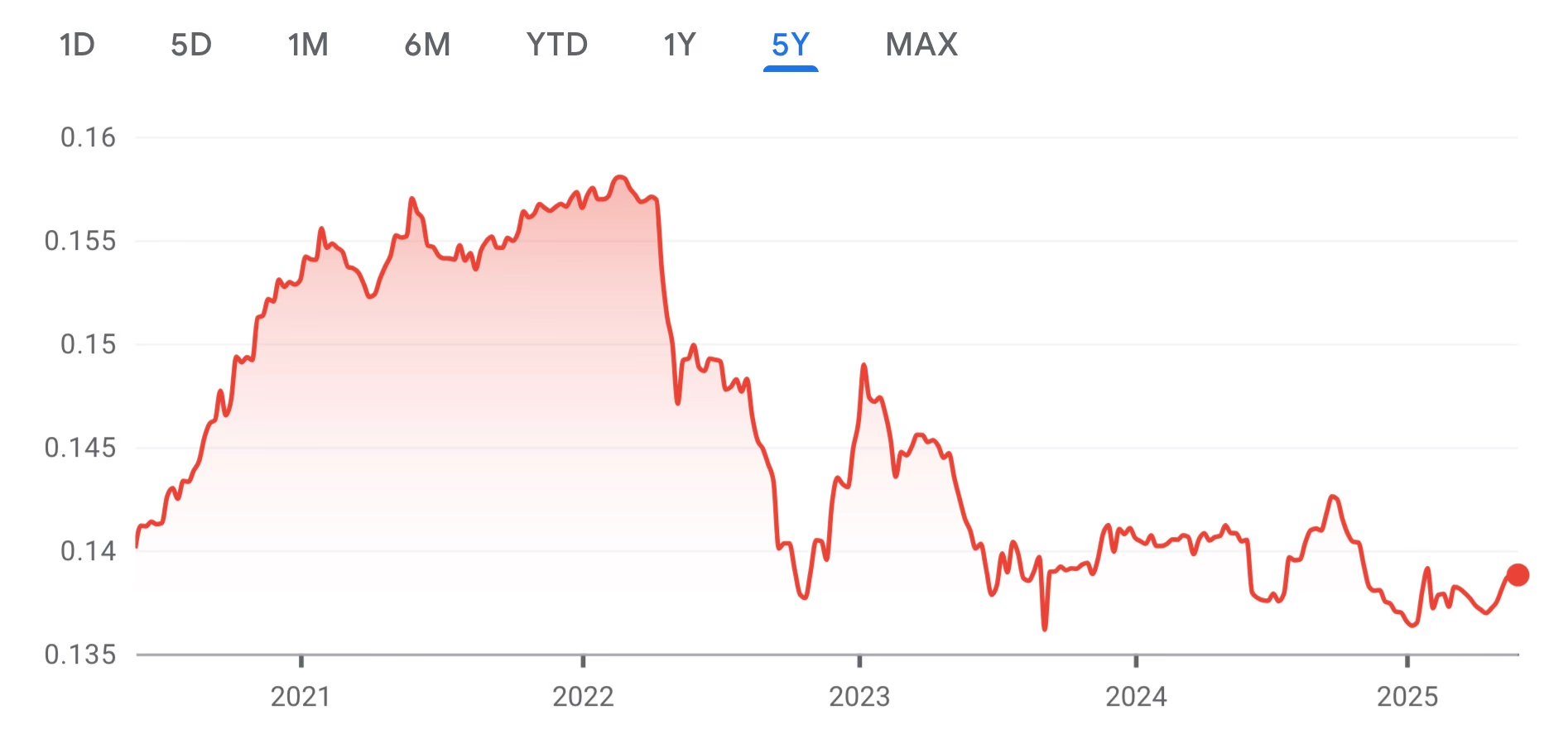
Experienced investors build this parameter into their overall allocation. They adjust position size or use derivatives to hedge.
Ignoring currency risk can be tempting, especially when equity markets are rising. Yet recent history shows the yuan can depreciate quickly under stress, amplifying the volatility of Chinese ETFs for non-resident investors.
Economic outlook for China in 2026 and the impact on ETFs
2026 looks decisive for the Chinese economy. The signals are mixed:
- Monetary policy stays accommodative, with rate cuts and stimulus measures targeted at consumption.
- The property sector continues to weigh on household confidence.
- The threat of deflation persists.
ETFs exposed to Chinese domestic consumption, through their indirect exposure via the KraneShares CSI China Internet UCITS ETF, could benefit from stimulus policies, particularly if voucher and appliance replacement programmes are stepped up.
Conversely, large-cap ETFs (iShares MSCI China UCITS ETF, iShares China Large Cap UCITS ETF) remain exposed to tech momentum and to the health of the banks, two sectors under regulatory scrutiny.
Both artificial intelligence and technology remain growth drivers, but US restrictions on semiconductors limit their potential to accelerate.
Investors need to follow Chinese industrial policy closely, along with the country’s ability to innovate despite external obstacles.
Before investing in China ETFs, discover 8 investments to grow your money to diversify your portfolio.

Key points for investing
ETFs offer an efficient way in, but they demand constant vigilance and adaptability. The China ETFs covered here offer opportunities for exposure to the Chinese market, but that growth comes with significant geopolitical and regulatory challenges.
Whether you favour broad exposure with the iShares MSCI China UCITS ETF, access to the domestic market via the Xtrackers Harvest CSI 300 UCITS ETF, or a targeted sector approach with the KraneShares CSI China Internet UCITS ETF or the iShares MSCI China Tech UCITS ETF, considered diversification and continuous monitoring of Chinese policy shifts can be a sensible approach.
2026 promises to be decisive for these investments, with domestic consumption stimulus policies that could fundamentally transform the performance of these funds.
Frequently asked questions
Can you invest in MCHI, FXI or KWEB from France?
No. These ETFs are domiciled in the United States and have no Key Information Document (KID) compliant with the PRIIPS regulation, which has prevented them from being marketed to European Union retail investors since 2018. A French investor has to turn to the UCITS equivalent, such as the iShares MSCI China UCITS ETF (IE00BJ5JPG56), for comparable exposure.
Which China ETF is PEA-eligible?
Only the Amundi PEA Chine (MSCI China) Screened UCITS ETF (FR0011871078, ticker PASI), domiciled in France and listed on Euronext Paris, is structured to be held in a PEA. The other China UCITS ETFs mentioned in this article are held in an ordinary securities account (compte-titres ordinaire).
What is the difference between Chinese A-shares and H-shares?
A-shares are listed in Shanghai and Shenzhen in renminbi and reflect the Chinese domestic economy; they are accessible through ETFs such as the Xtrackers Harvest CSI 300 UCITS ETF (LU0875160326). H-shares are Chinese companies listed in Hong Kong, closer to international governance and reporting standards.
What is the main risk of China ETFs for a European investor?
Yuan currency risk comes on top of equity market risk: a depreciation of the yuan against the euro can reduce performance in local currency, even if the underlying shares rise. Chinese regulatory risk, with a sudden crackdown on a sector, is the second volatility factor specific to watch.
Should you favour a broad China ETF or a sector ETF?
A broad ETF such as the iShares MSCI China UCITS ETF (IE00BJ5JPG56) spreads risk across the whole market, but remains concentrated in a few stocks such as Tencent and Alibaba. A sector ETF, such as the iShares MSCI China Tech UCITS ETF (IE000NFR7C63), targets a precise theme but with higher volatility.
Sources
BBH Greater China ETF Investor Survey 2025
Official iShares MSCI China ETF factsheet (US)
JustETF profile, iShares MSCI China UCITS ETF (IE00BJ5JPG56)
JustETF profile, iShares China Large Cap UCITS ETF (IE00B02KXK85)
JustETF profile, Amundi MSCI China UCITS ETF (LU1841731745)
Official DWS/Xtrackers factsheet, Harvest CSI 300 UCITS ETF 1D (LU0875160326)
JustETF profile, KraneShares CSI China Internet UCITS ETF (IE00BFXR7892)
JustETF profile, iShares MSCI China Tech UCITS ETF (IE000NFR7C63)
JustETF profile, Amundi PEA Chine (MSCI China) Screened UCITS ETF (FR0011871078)
AMF glossary, trackers or ETFs
AMF guide, understanding the Key Information Document (KID)
AMF white list, Finary SAS (PSCA/MiCA status)
Regulatory disclaimers: Marketing communication. Investing carries a risk of partial or total capital loss. Past performance is not a reliable indicator of future performance. This article is provided for information and educational purposes only; it does not constitute personalised investment advice, a buy or sell recommendation, or tax advice. Before investing, read the Key Information Document (KID) and, where relevant, consult an authorised adviser. Finary SAS, an investment firm authorised by the ACPR (no. 19283), member of AMAFI. Insurance broker registered with ORIAS (no. 21001279), member of the CNCGP (association approved by the AMF). Crypto-Asset Service Provider (CASP) authorised by the AMF under the MiCA regime, references no. A2026-026 and no. N2026-008.