


Renewable energy ETF: investing in green energy (2026)

Updated on 31 July 2026
To invest in renewable energy, thematic ETFs such as the iShares Global Clean Energy Transition or the Amundi MSCI New Energy offer the simplest exposure. Their ongoing charges range from 0.49% to 0.65% a year. This article sets out the main renewable energy ETFs of 2026, their fees and their tax treatment.

- Most of these ETFs are domiciled outside the euro area and are rarely eligible for the PEA (a French tax-advantaged equity savings account), which requires mostly European holdings.
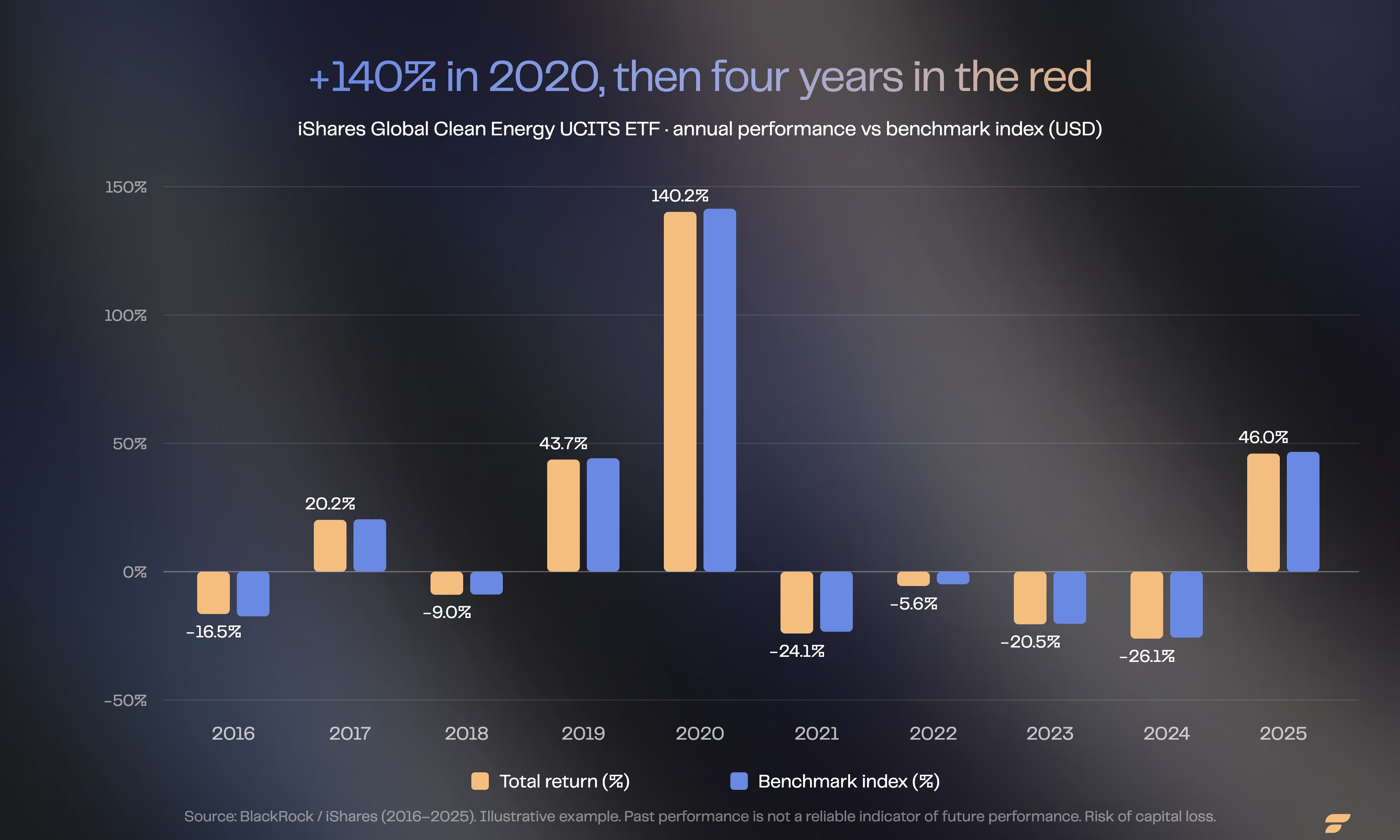
- The sector remains highly volatile: after a +140% peak in 2020, four years of decline preceded a rebound in 2025.
- A "climate" ETF (Paris-Aligned) is not the same as a renewable energy ETF: the first decarbonises a broad index, the second targets clean energy alone.
- Before investing, check each fund's KID to confirm its PEA eligibility, its actual fees and its current composition.
Why invest in renewable energy ETFs?
Investing in renewable energy ETFs can be one way to diversify a portfolio while making a positive contribution to the environment. These funds can go through growth phases, but also sharp corrections (past performance is not a reliable indicator of future performance).
The sector has gone through sharply contrasting cycles: a strong rise in 2020 (+140.2%), followed by four consecutive years of decline between 2021 and 2024 (down to −26.1% in 2024) as interest rates climbed, before a rebound of +46.0% in 2025. That history illustrates how volatile clean energy ETFs are, and nothing guarantees their future performance.
Renewable energy is also growing faster as the technology improves and demand rises. The world has seen a sharp fall in renewable energy production costs in recent years, while global energy demand has kept climbing. According to the International Energy Agency, global renewable electricity capacity is set to grow by 4,600 gigawatts by 2030, driven in particular by solar PV, a structural factor to weigh, with no guarantee of future performance.
Renewable energy investment also has a positive impact on the environment. Using renewable sources cuts greenhouse gas emissions and limits environmental damage. That contributes to the fight against climate change and to protecting the planet, a natural world worth learning to recognise day to day.
Renewable energy ETFs can also offer portfolio diversification, since these funds may hold companies from different segments such as solar, wind, hydroelectric and geothermal power. That spreads risk, without removing it or protecting against capital losses.
In short, investing in the green energy sector offers several advantages:
- Contributing to lower greenhouse gas emissions
- Supporting companies that drive the energy transition
- Exposure to a long-term structural theme (with no performance guarantee)
- Portfolio diversification through renewable energy ETFs
- A PEA or ordinary securities account framework to assess against your own situation

Examples of renewable energy ETFs available in 2026
Here are some of the main ETFs that give direct access to the clean energy sector. Assets under management and fees are indicative and change over time; always check the fund's KID (Key Information Document) before investing.
| ETF | ISIN | Index | Fees (TER) | AUM | Distribution | 1-year perf. | 5-year perf. |
| iShares Global Clean Energy Transition UCITS ETF (INRG) | IE00B1XNHC34 | S&P Global Clean Energy Transition | 0.65% per year | ~€2.625 billion | Distributing | +31.17% | −15.42% |
| Amundi MSCI New Energy UCITS ETF Dist (ex-Lyxor New Energy) | FR0010524777 | MSCI ACWI IMI New Energy Filtered | 0.60% per year | ~€844 million | Distributing | +43.90% | +0.15% |
| L&G Clean Energy UCITS ETF | IE00BK5BCH80 | Solactive Clean Energy | 0.49% per year | ~€627 million | Accumulating | +37.08% | +28.06% |
| Invesco Global Clean Energy UCITS ETF Acc | IE00BLRB0242 | WilderHill New Energy Global Innovation | 0.60% per year | ~€102 million | Accumulating | +29.34% | −34.92% |
Performance as at the end of May 2026, expressed in the fund's currency, source JustETF. Past performance is not a reliable indicator of future performance and investing carries a risk of capital loss.
How do you invest in renewable energy ETFs?
First, choose your benchmark index:
- The S&P Global Clean Energy index is a stock index created by Standard & Poor's that focuses on clean energy companies, from renewable power generation to the related technology and equipment.
- The World Alternative Energy Market Cap Adjusted Net Total Return (WAEXC) index is a global alternative energy index.
- The Ardour Global Extra Liquid index is a subset of the Ardour Global Index, made up of companies worldwide operating in alternative energy. The Extra Liquid index holds 30 companies selected from the Ardour Global Index.
- The Solactive Clean Energy index focuses on clean energy companies worldwide, including those involved in renewable power generation and in clean energy technology and equipment.
- The Solactive Hydrogen Economy index is more specialised, focused on the hydrogen economy.
Renewable energy ETF or "climate" ETF: what is the difference?
Be careful not to confuse two families of funds. Renewable energy ETFs (or clean energy, new energy) are sector bets: they invest in solar, wind, hydrogen or power-grid companies. "Climate" or "Paris-Aligned" ETFs (S&P 500 Paris-Aligned, MSCI World Climate and the like) are broad market indices that have simply been decarbonised: they still hold technology, financial or consumer names, with a carbon filter. The former are more concentrated and more volatile; the latter offer diversification close to a conventional index. The choice depends on your objective: pure exposure to the clean energy sector, or a global portfolio with a reduced carbon footprint.
Which tax wrapper: PEA or an ordinary securities account?
One important point is PEA eligibility. Most renewable energy ETFs hold a majority of non-EU securities, US ones in particular, so in the vast majority of cases they are not eligible for the PEA (a French tax-advantaged equity savings account), which requires the fund to hold at least 75% of its assets in shares of European companies (service-public.gouv.fr). An ordinary securities account then remains the default wrapper. Always check the PEA eligibility stated in the fund's KID before investing.
Conclusion
Faced with the challenges of climate change and the need to cut greenhouse gas emissions, the green energy sector offers interesting opportunities for investors looking to diversify their portfolio on the stock market in 2026. It is also a cyclical, volatile sector that demands a clear understanding of what you are buying.
The main strengths of this type of investment:
- Geographic diversification: investing on an international scale
- Sector diversification: coverage of the various renewable energy segments
- Transparency: access to information on the companies selected
Before investing in an ETF, carry out a thorough analysis: fund composition, management fees, assets under management, liquidity and tax treatment. You will then be better equipped to tap the potential of renewable energy while sizing the risk of capital loss.

Frequently asked questions
Which environmental ETF should you choose?
For pure sector exposure, clean energy ETFs such as the iShares Global Clean Energy Transition (INRG), the Amundi MSCI New Energy or the L&G Clean Energy are among the most representative. This list is not exhaustive and does not constitute an investment recommendation.
Are renewable energy ETFs eligible for the PEA?
Very few are: the PEA requires at least 75% of its assets in shares of European companies, a condition global clean energy funds rarely meet. For these ETFs, an ordinary securities account remains the default wrapper. Check eligibility in the fund's KID. This information does not constitute an investment recommendation.
Are renewable energy ETFs risky?
Yes. They are concentrated sector bets, more volatile than a diversified world ETF. They rose sharply in 2020 (+140.2%) then fell four years in a row, from 2021 to 2024, as interest rates climbed, before rebounding in 2025. Investing carries a risk of partial or total capital loss.
What fees apply to a renewable energy ETF?
Ongoing charges (TER) generally range from 0.49% to 0.65% a year depending on the index and the issuer. On top of those come your broker's trading fees, which vary from one provider to another.
What are some examples of renewable energy stocks?
Listed players in the sector include Neoen (NEOEN) and NextEra Energy (NEE). Most stocks in this sector are not eligible for the PEA. This list is informational and does not constitute an investment recommendation.
Sources
JustETF, iShares Global Clean Energy Transition UCITS ETF fund page (IE00B1XNHC34)
JustETF, Amundi MSCI New Energy UCITS ETF fund page (FR0010524777)
JustETF, L&G Clean Energy UCITS ETF fund page (IE00BK5BCH80)
JustETF, Invesco Global Clean Energy UCITS ETF fund page (IE00BLRB0242)
Service-public.fr, the plan d'épargne en actions (PEA): eligible securities
AMF, white list of crypto-asset service providers (PSCA), Finary SAS
International Energy Agency, Renewables 2025 press release
Regulatory disclaimers: Marketing communication. Investing carries a risk of partial or total capital loss. Past performance is not a reliable indicator of future performance. This article is provided for information and educational purposes only; it does not constitute personalised investment advice, a recommendation to buy or sell, nor tax advice. Before investing, read the Key Information Document (KID) and, where relevant, consult an authorised adviser. Finary SAS, an investment firm authorised by the ACPR under no. 19283, member of AMAFI. Insurance broker registered with ORIAS under no. 21001279, member of the CNCGP (association approved by the AMF). Crypto-Asset Service Provider (CASP) authorised by the AMF under the MiCA regime, references no. A2026-026 and no. N2026-008.