


Investing in bonds: the complete guide

Updated on 31 July 2026
Investing in bonds means lending money to a government or a company in exchange for regular interest payments (the coupons) and repayment of the principal at maturity. It is an asset class sought after to generate income and diversify a portfolio, and one that is back in the spotlight now that interest rates and inflation have risen.

- A bond's price moves inversely to interest rates: when rates rise, the value of bonds already issued falls.
- The issuer's credit rating separates Investment Grade (AAA to BBB-) from High Yield (BB+ and below), which pays more but is riskier.
- Three routes coexist: bond funds, bond ETFs traded continuously on an exchange, and bonds bought directly.
- In France, coupons are taxed under the flat tax (PFU) at 31.4% since 1 January 2026, unless the taxpayer opts for the income tax scale.
- The issuer's default risk, liquidity risk and reinvestment risk come on top of interest rate risk.
What is a bond?
A bond is a negotiable acknowledgement of debt. Three parameters define it: the coupon paid each year, the maturity at which the principal is repaid, and the issuer's credit rating, which measures its default risk.
Definition of a bond
A bond is a debt security issued by a company, a government or a local authority to finance itself on the financial markets. When an investor buys a bond, they lend money to the issuer, which in exchange undertakes to pay regular interest, called coupons, and to repay the principal at the security's maturity.
In this episode of Finary Talk, Thomas Veit explains why the rise in interest rates has renewed interest in the bond market.
Main characteristics of a bond
- Coupon: the income paid to bondholders, generally on an annual or semi-annual basis. The amount can be fixed or variable.
- Maturity (or redemption date): the life of the bond, at the end of which the issuer repays the principal borrowed. It can range from a few months to several decades.
- Face value: the amount of principal borrowed, representing a bond's value at issue.
What are the different types of bonds?
Among the various categories of bonds, we can distinguish:
- Government bonds: issued by governments to finance public spending. They are generally considered less risky than corporate bonds, without being risk-free.
- Corporate bonds: issued by companies to finance their investments and development projects, or to refinance existing debt.
- Convertible bonds: they give the investor the option to convert them into shares of the issuing company at a date or on terms set in advance.
- Perpetual bonds: these securities have no fixed maturity date, and the interest paid by the issuer is treated as income for life.
How does a bond work?
When an investor buys a bond, they lend money to the issuer in exchange for income in the form of coupons. Coupons are generally paid annually or semi-annually, at a fixed or variable interest rate. At the maturity date, the issuer repays the principal borrowed to bondholders.
Credit rating agencies and their criteria
Credit rating agencies assess the solvency of bond issuers by assigning ratings based on their ability to meet their financial commitments. Their role is to give investors an indication of the issuer's default risk. The main rating agencies are Standard & Poor's, Moody's and Fitch. Their assessments rest on many criteria, such as the quality of management, the company's financial health, its debt load and the economic environment.
Ratings fall into two broad families: Investment Grade (IG), from AAA to BBB-, and High Yield (HY), from BB+ to D. The boundary between the two is structural: many institutional investors, pension funds and insurance companies foremost among them, are barred by their own rules from holding High Yield.
High Yield, also called junk bond or high-yield bonds, carries a markedly higher default risk, offset by a higher coupon.
| Rating (S&P / Fitch) | Moody's equivalent | Category | Credit quality |
|---|---|---|---|
| AAA | Aaa | Investment Grade | The highest, extremely low default risk |
| AA | Aa | Investment Grade | Very high, very low default risk |
| A | A | Investment Grade | High, moderate default risk |
| BBB to BBB- | Baa to Baa3 | Investment Grade | Adequate, the last rung before High Yield |
| BB+ to B- | Ba1 to B3 | High Yield | Speculative, sensitive to the economic cycle |
| CCC to C | Caa to C | High Yield | Highly speculative, default likely |
| D | D | High Yield | Payment default recorded |
The factors that drive bond prices
Policy interest rates
The level of policy interest rates plays a key role in determining bond prices. These rates are set by central banks and serve as the benchmark for market interest rates. When policy rates rise, interest rates on the bond market generally rise with them.
The effect is to reduce the value of existing bonds relative to newly issued bonds carrying higher interest rates. Conversely, when policy rates fall, interest rates on the bond market fall too, existing bonds become more attractive and their value rises.
Risk premium
Bonds, which are debt securities issued by companies or governments, can be classified by their level of risk. Investors generally compare the yield on corporate bonds with that of the bonds regarded as among the least risky (so-called safe havens), such as those issued by the German state in Europe and by the federal government in the United States. Yield spreads reflect the risk premium, that is, the additional compensation investors demand for holding riskier bonds.
The factors driving the risk premium are varied: the issuer's financial health, the economic outlook, the bond's liquidity and market conditions. An issuer with weaker finances will offer a higher risk premium to attract investors, which raises the yield they demand and therefore lowers the bond's price.

The impact of central bank decisions
Monetary policy and its effects
The decisions of central banks, such as the European Central Bank (ECB) or the US Federal Reserve (Fed), have a significant impact on bond markets. One of their main tasks is to control the policy rates that drive market interest rates.
Interest rates rose sharply between 2022 and 2023: the European Central Bank (ECB) deposit facility rate went from -0.50% to 4.00%, its all-time high, reached on 20 September 2023. The ECB then cut it in eight steps to 2.00%, before raising it to 2.25% on 17 June 2026. According to the European Central Bank, the deposit facility rate has stood at 2.25% since 17 June 2026. These adjustments serve the institution's price stability mandate, which targets 2% inflation over the medium term.
Monetary policy can also involve bond purchases on the markets, which increases demand and influences bond yields. These policies also affect long-term interest rates, through a signalling effect and a rebalancing of investors' portfolios.
Central bank objectives
Controlling inflation and supporting economic growth are two major objectives of central banks. To achieve them, central banks adjust policy rates and put appropriate monetary policies in place, such as buying bonds on the markets.
By controlling inflation, central banks aim to preserve price stability and the real value of assets, including bonds. That supports investor confidence and makes bond returns more predictable.
Bond investment strategies
Active vs passive management
Active management means investors and portfolio managers select and actively manage bonds with the aim of outperforming a benchmark index. This is done by adjusting the composition and weighting of the various bonds in the portfolio, according to market conditions, the economic outlook and risk profiles.
Passive management, by contrast, simply tracks a given bond index, with the aim of replicating its performance. This approach is often cheaper and less complex than active management. Index funds and ETFs (exchange-traded funds) are common examples of passive management in bond investing.
Hedging against rising rates
Hedging involves using various financial instruments or tactics to reduce the risk of loss from adverse market moves, such as rising interest rates. A rise in rates can indeed push down the value of existing bonds in a portfolio. Investors can use futures, interest rate options or swaps to protect themselves against that risk.
The ladder strategy
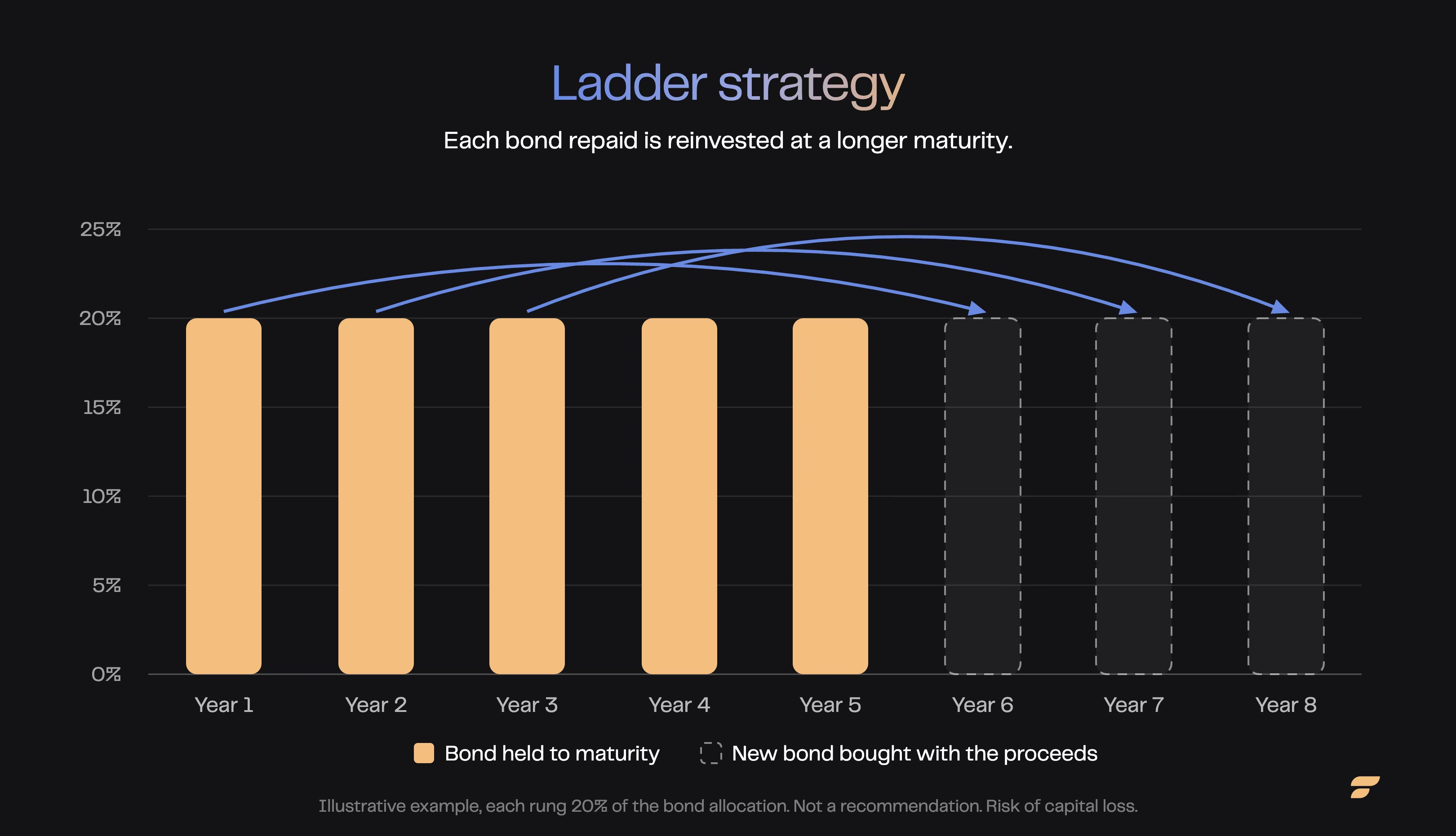
The so-called ladder strategy consists of building a bond portfolio with maturities spread over a period of time, generally several years. This approach reduces the impact of interest rate swings and increases portfolio diversification. Each time a bond matures, investors can reinvest the proceeds in a new bond with a longer maturity, so as to keep maturities evenly spread.
By investing in bonds with different maturities, investors gain protection against interest rate swings and a potentially stable return. This strategy can also offer some liquidity, since part of the portfolio matures regularly, providing funds that can be reinvested or used for other needs.
What are the risks in the bond market?
Four main risks weigh on a bond portfolio: interest rate risk, credit risk, liquidity risk and reinvestment risk. They stack up, and no bond investment is entirely free of them.
Interest rate risk
The interest rate risk stems from movements in market interest rates. When interest rates rise, the prices of outstanding bonds can fall, causing a capital loss for bondholders. Conversely, if interest rates fall, existing bonds become more attractive and their value rises.
Credit risk
The credit risk concerns the ability of a bond's issuer to repay the principal and pay the interest. If the issuer defaults or cannot pay its debts, bondholders can suffer losses. This risk generally depends on the issuer's credit quality and can vary considerably from one bond to another.
Liquidity risk
The liquidity risk refers to how easily a bond can be bought or sold on the market. If a bond is less liquid, it may be hard to sell at a fair price, especially in times of financial turbulence. Bonds issued by less well-known or less creditworthy companies or governments can carry a higher liquidity risk.
Reinvestment risk
The reinvestment risk arises when interest rates fall at the point where bondholders have to reinvest the interest received or the principal repaid at maturity. If interest rates are low, investors may be forced to reinvest at lower yields, which can weigh on their overall return.
Which bonds should you invest in?
There is no universal bond: the choice depends on the investment horizon and risk tolerance. A typical portfolio combines a yield sleeve in short-dated corporate credit and a hedging sleeve in long-dated sovereign debt.

It has two sleeves: the yield sleeve, which delivers the performance, and the tactical or hedging sleeve, which provides the hedge.
Yield sleeve: 70%
| Instrument | ISIN code | ETF name | Fees (TER) | Yield to maturity (YTM) | Duration |
|---|---|---|---|---|---|
| EBBB FP Equity | LU1525418643 | Amundi EUR Corporate Bond 1-5Y ESG UCITS ETF DR | 0.20% | 3.50% | 2.68 |
| EUNT GY Equity | IE00B4L60045 | iShares EUR Corporate Bond 1-5yr UCITS ETF | 0.20% | 3.27% | 2.76 |
| IHYG LN Equity | IE00B66F4759 | iShares EUR High Yield Corporate Bond UCITS ETF | 0.50% | 5.48% | 2.43 |
Ongoing charges (TER) taken from JustETF on 31 July 2026. Yield to maturity and duration: iShares EUR Corporate Bond 1-5yr as at 22 June 2026 and iShares EUR High Yield Corporate Bond as at 27 July 2026 (source BlackRock), Amundi EUR Corporate Bond 1-5Y ESG as at May 2026 (source Amundi). Indicative data, not guaranteed; past performance is not a reliable indicator of future performance.
Tactical / hedging sleeve: 30%
| Instrument | ISIN code | ETF name | Fees (TER) | Strategy and duration |
|---|---|---|---|---|
| LYX7 GY Equity | LU1407888053 | Amundi US Treasury Bond 7-10Y UCITS ETF Dist | 0.06% | long end, duration 7.34 |
| IBB1 GY Equity | IE00BGPP6697 | iShares USD Treasury Bond 7-10yr UCITS ETF EUR Hedged (Dist) | 0.10% | long end, dollar hedged against the euro |
| US10 FP Equity | LU1407890620 | Amundi US Treasury Bond Long Dated UCITS ETF Dist | 0.06% | ultra-long end, duration 15.84 |
| DTLE LN Equity | IE00BD8PGZ49 | iShares USD Treasury Bond 20+yr UCITS ETF EUR Hedged (Dist) | 0.10% | ultra-long end, effective duration 15.45 as at 5 January 2026, dollar hedged against the euro |
Ongoing charges (TER) taken from JustETF on 31 July 2026. Amundi durations observed in May 2026 (source Amundi). Example portfolio provided for illustrative and educational purposes. These ETFs carry a risk of capital loss and interest rate and currency risk; past performance is not a reliable indicator of future performance.
Which accounts and products give exposure to bonds?
Three products give access to the bond market: bond funds, bond ETFs and bonds held directly. On the account side, they sit in an ordinary securities account (CTO) or in a life insurance policy, never in a PEA (a French tax-advantaged equity savings account), which is reserved for European shares.
Bond funds
Bond funds are portfolios of bonds run by professionals, which let investors diversify their bond exposure without buying each bond individually. These funds can be active or passive, and generally invest in corporate or government bonds. To benefit from favourable taxation, it is important to choose the right tax wrapper.
Bond ETFs
A bond ETF is a basket of bonds listed on an exchange that replicates an index, just as equity ETFs do. Bond ETFs offer diversified exposure to bond markets, with management fees generally lower than those of traditional bond funds. One example is an ETF tracking the Bloomberg Barclays Global Aggregate Bond Index, which represents the global bond market as a whole.
Individual bonds
Investing in individual bonds lets investors buy bonds issued by companies or governments directly. That gives full control over the securities held in the portfolio, including the choice of duration and credit quality. It can, however, require more time and effort to research and manage the holdings, and a larger amount invested to ensure sufficient diversification. Before starting, it is essential to understand the bond market and to weigh the risks involved.
How are bonds taxed in France?
In an ordinary securities account, coupons and capital gains on disposal fall under the flat tax (PFU), at a rate of 31.4% since 1 January 2026: 12.8% income tax and 18.6% social security contributions. The taxpayer can waive the PFU and opt for the progressive income tax scale, a global election that then applies to all of their investment income for the year.
Holding bonds in a life insurance policy changes the logic: gains are taxed only when a withdrawal is made, and the policy gives entitlement to an annual tax allowance on gains after eight years. The PEA, for its part, is closed to bonds: it accepts only shares and funds invested mainly in European equities.
What overall portfolio allocation with bonds?
There is no ideal bond allocation. In practice, the share of bonds rises as the horizon shortens and risk tolerance falls, with the rest of the portfolio devoted to investing in the stock market and to other asset classes.
Why diversification matters
Broad diversification is a key part of portfolio management. It spreads risk across different types of assets and avoids swings in performance caused by concentration in a single category. Bonds are fixed-income instruments that can offer a more stable, less volatile return potential than equities, while generating regular income. So investing part of your portfolio in bonds can help diversify your holdings and reduce overall risk.
Allocation based on investment horizon and risk tolerance
The portfolio allocation to bonds depends on each investor's investment horizon and risk tolerance. For those with a long-term horizon and a high risk tolerance, a larger share has historically been directed towards riskier assets, such as equities. Conversely, investors who prefer to minimise risk or who have a short-term horizon are often seen to hold a larger allocation to bonds.
The bond allocation can be diversified further by splitting investments between government and corporate bonds, and across different regions.
Periodic portfolio rebalancing
Rebalancing is an essential step in maintaining the target portfolio allocation and managing risk effectively. It involves selling assets that have outperformed and buying assets that have underperformed, in order to return to the initial asset split. This keeps exposure to the various asset classes in line with the investor's original objectives and risk tolerance.
Periodic rebalancing matters particularly for bonds, because market conditions and interest rates can move and affect bond returns. So it is crucial to monitor and adjust the bond allocation regularly, in line with market developments and the investor's objectives.
Apps such as Finary let you centralise the tracking of your bond positions alongside the rest of your wealth, across all brokers, and see the real weight of each asset class.

Frequently asked questions
What is the point of buying bonds?
A bond provides income known in advance, the coupon, and repayment of the principal at maturity if the issuer does not default. It generally cushions the volatility of an equity portfolio, without any guarantee: its market value moves with interest rates.
Which factors should you analyse before buying a bond?
Four things matter: the issuer's credit rating, which measures default risk, the maturity, the duration, which indicates how sensitive the price is to rates, and the yield to maturity. They then have to be set against your investment horizon.
What is a bond ETF?
A bond ETF is an exchange-traded fund that replicates a bond index. It gives access to hundreds of securities in a single line, with low fees, and trades continuously like a share.
How are bonds taxed in France?
In an ordinary securities account, coupons and capital gains fall under the flat tax (PFU), 31.4% since 1 January 2026: 12.8% income tax and 18.6% social security contributions. Opting for the progressive income tax scale remains possible.
Can you hold bonds in a PEA?
No. The PEA (a French tax-advantaged equity savings account) is reserved for shares and funds invested mainly in European equities. To hold bonds, you need an ordinary securities account or the unit-linked funds of a life insurance policy.
Bonds or euro funds: what is the difference?
A life insurance euro fund is itself invested mainly in bonds, but its capital is protected by the insurer. Held directly, the investor bears the price swings and the issuer's default risk, in exchange for a potentially higher return.
Sources
Autorité des marchés financiers, understanding bonds before investing
European Central Bank, key ECB interest rates
Service-Public, change in the rate of the flat tax (PFU) on 1 January 2026
JustETF, factsheet Amundi EUR Corporate Bond 1-5Y ESG UCITS ETF DR (LU1525418643)
JustETF, factsheet iShares EUR Corporate Bond 1-5yr UCITS ETF (IE00B4L60045)
JustETF, factsheet iShares EUR High Yield Corporate Bond UCITS ETF (IE00B66F4759)
JustETF, factsheet Amundi US Treasury Bond 7-10Y UCITS ETF Dist (LU1407888053)
JustETF, factsheet iShares USD Treasury Bond 7-10yr UCITS ETF EUR Hedged (IE00BGPP6697)
JustETF, factsheet Amundi US Treasury Bond Long Dated UCITS ETF Dist (LU1407890620)
JustETF, factsheet iShares USD Treasury Bond 20+yr UCITS ETF EUR Hedged (IE00BD8PGZ49)
Regulatory disclaimers: Marketing communication. Investing carries a risk of partial or total capital loss. Past performance is not a reliable indicator of future performance. This article is provided for information and educational purposes only; it does not constitute personalised investment advice, a buy or sell recommendation, or tax advice. Before investing, read the Key Information Document (KID) and, where relevant, consult an authorised adviser. Finary SAS, an investment firm authorised by the ACPR (no. 19283), member of AMAFI. Insurance broker registered with ORIAS (no. 21001279), member of the CNCGP (association approved by the AMF). Crypto-Asset Service Provider (CASP) authorised by the AMF under the MiCA regime, references no. A2026-026 and no. N2026-008.

