What Is Cryptocurrency? A Beginner's Guide

Updated on 31 July 2026
A cryptocurrency is a decentralised digital currency, secured by cryptography and recorded on a blockchain, a public and tamper-proof ledger. It trades without a bank, 24 hours a day, anywhere in the world. This guide covers its definition, how it works, its uses, its risks and its French tax treatment in 2026.

- Bitcoin, created in 2009, remains the leading cryptocurrency: its supply is capped at 21 million units, hence its "digital gold" nickname.
- The blockchain relies on a network of thousands of computers that validate every transaction, with no central bank and no single supervisory authority.
- The market is worth about $2.28 trillion at the end of July 2026, after an all-time high above $4 trillion in October 2025.
- In France, gains on disposals are taxed under the flat tax (PFU) at 31.4% above €305 of annual disposals.
- Since 1 July 2026, only platforms authorised under the European MiCA Regulation (Markets in Crypto-Assets) may operate in France.
What is cryptocurrency?
A cryptocurrency is a digital asset traded peer to peer on a blockchain, without a bank or a central authority. Under French law it is not legal tender: it is classified as a digital asset and treated as movable property.
Definition of cryptocurrency
Cryptocurrency is a 100% digital form of money. It works without a central bank or a government. Unlike the euro or the dollar, it exists only as computer code, much like the money in an online bank account.
What makes cryptocurrency unique is that it is decentralised. Picture a public ledger in which every transaction is recorded and verified by thousands of computers around the world, rather than by a single bank. That is the blockchain, the technology that allows cryptocurrencies to exist.
The history and origins of cryptocurrencies
It all started in 2008, when a person (or a group) using the pseudonym Satoshi Nakamoto published a paper describing Bitcoin. It was the first time a digital currency had solved the "double spending" problem without needing a central authority.
Before Bitcoin, other attempts at digital currencies had appeared. DigiCash, created in the 1990s, was one of the first tries at anonymous electronic money. B-Money, proposed by Wei Dai in 1998, introduced concepts Bitcoin later took up.
Adoption has grown sharply since. In 2025, more than 740 million people worldwide owned cryptocurrencies, roughly 8% of the global population. In the United States, close to one adult in three (30%) owns cryptocurrencies in 2026, against 15% in 2021, a sign of growing acceptance of this new form of money.
State-level adoption remains marginal, and reversible. In 2021 El Salvador became the first country to make Bitcoin legal tender alongside the dollar, before reversing that status in January 2025: accepting Bitcoin became optional again for merchants there, at the request of the International Monetary Fund.
finally simple

Investing carries risks, including a risk of capital loss. Crypto-assets are highly volatile assets: you may lose all or part of your investment. Past performance is not a reliable indicator of future performance. Finary is authorised as a Crypto-Asset Service Provider (CASP) by the AMF under the MiCA regime.
What makes cryptocurrencies unique
Here are the three main features that set cryptocurrencies apart from traditional currencies:
- Decentralisation: no bank and no government controls cryptocurrencies.
- Transparency: every transaction is public and can be verified by anyone.
- Security: cryptography ensures only the owner can spend their funds.
These features make cryptocurrencies a major innovation in the history of money, comparable to the invention of the bank card in the 1950s.
How does cryptocurrency work?
A cryptocurrency rests on three building blocks: a blockchain that records transactions in chained blocks, cryptography that authenticates every instruction, and a consensus mechanism that validates blocks without a central authority.
Blockchain and transactions
The blockchain works like a large public, unalterable ledger. Picture a shared Excel file in which each row is a transaction. Once written, no one can change it. Each "block" holds several transactions and links to the previous one, forming a chain.
Transactions are validated by a network of computers called "nodes". When you send cryptocurrency to someone, your transaction waits in a queue known as the "mempool". Validators then check that you hold the necessary funds and that your transaction is legitimate.
Cryptography and security
The security of cryptocurrencies rests on two essentials:
- Public and private keys: your public key is like your email address, and can be shared. Your private key is like your password, and must be kept strictly secret.
- Digital signatures: every transaction is signed digitally, like a handwritten signature that cannot be forged.
The system uses advanced cryptographic algorithms, similar to those banks and government services use to protect sensitive data.
Mining and the creation of new units
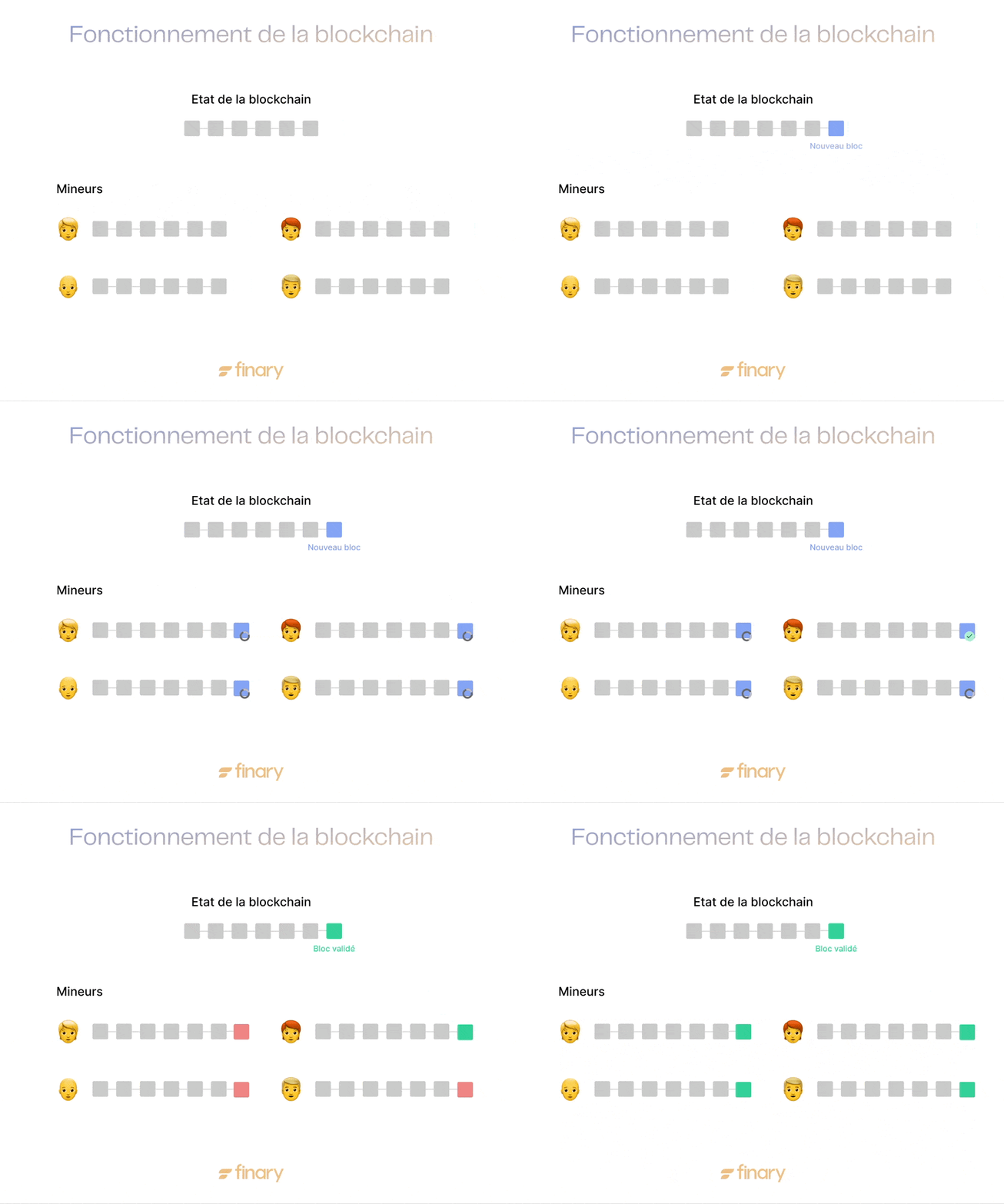
Mining is the process that creates new units of cryptocurrency. Here is how it works:
- Miners put their computing power at the service of the network.
- They solve complex mathematical problems.
- The first to find the solution validates a new block.
- That miner receives a cryptocurrency reward.
This process consumes a great deal of energy, which is why newer methods such as "Proof of Stake" are emerging. Instead of using computing power, validators lock up a certain amount of cryptocurrency as collateral.
Alternatives to traditional mining
Modern cryptocurrencies offer several validation methods:
- Proof of Stake (PoS): used by Ethereum, it consumes about 99.95% less energy than traditional mining since the switch in September 2022.
- Delegated Proof of Stake (DPoS): a delegation system in which users vote for their validators.
- Proof of Authority (PoA): used in private blockchains, where only certain entities can validate.
These alternatives allow faster and greener transactions than traditional Bitcoin mining.
at your own pace

Investing carries risks, including a risk of capital loss. Crypto-assets are highly volatile assets: you may lose all or part of your investment. Past performance is not a reliable indicator of future performance. Finary is authorised as a Crypto-Asset Service Provider (CASP) by the AMF under the MiCA regime.
What are the different types of cryptocurrency?
Cryptocurrencies fall into four broad families: payment currencies such as Bitcoin, smart-contract platforms such as Ethereum, stablecoins pegged to a currency, and utility tokens tied to a single platform.
The main cryptocurrencies
Here is an overview of the most significant cryptocurrencies:
| Cryptocurrency | Price (USD) | Market cap | Distinctive feature |
|---|---|---|---|
| Bitcoin (BTC) | 64,213 | 1.288 trillion | First crypto, "digital gold" |
| Ethereum (ETH) | 1,903 | 230 billion | Smart contracts, DeFi |
| Binance Coin (BNB) | 592 | 79 billion | Binance exchange token |
Data as at 31 July 2026 (source: CoinMarketCap). Crypto prices and market caps move constantly.
Bitcoin remains the pioneer and the benchmark of the sector. Created in 2009, it is often compared to "digital gold" because of its programmed scarcity: there will never be more than 21 million bitcoins.
Ethereum goes beyond simple monetary transactions. Its blockchain makes it possible to create "smart contracts", automated programs that carry out predefined actions with no intermediary.
It works like a digital vending machine: you put money in, and the contract automatically performs the agreed action.
Comparison with traditional currencies
The main differences between cryptocurrencies and conventional currencies are:
- Money creation: central banks can create as many euros or dollars as they wish, whereas Bitcoin issuance is capped and predictable.
- Transfers: an international euro transfer can take several days and cost a lot, whereas a crypto transfer takes a few minutes and often costs less than one euro.
- Accessibility: opening a bank account means supplying a stack of documents. Using crypto needs only a smartphone and an internet connection.
Categories of cryptocurrency
Cryptocurrencies split into several categories according to their use:
- Payment currencies: Bitcoin, Litecoin - designed for everyday transactions.
- Smart-contract platforms: Ethereum, Solana - used to build decentralised applications.
- Stablecoins: USDC, USDT - their value is pegged to a traditional currency (usually the dollar).
- Utility tokens: BNB, CRO - they grant specific benefits on certain platforms.
Each category answers a different need, much as the various types of bank account (current account, Livret A, PEA - a French tax-advantaged equity savings account) serve distinct purposes.
Cryptocurrency applications and uses
Everyday use
Cryptocurrencies are gradually working their way into everyday life. Several large retailers now accept some form of crypto payment. Microsoft accepts Bitcoin to top up a Microsoft account, Starbucks lets customers load their digital card with crypto through a payment partner, and Tesla accepts Dogecoin for some items in its online merchandise store (it has, however, suspended Bitcoin payments for its cars since 2021). In France, Carrefour uses the blockchain to trace the origin of certain food products.
For international money transfers, cryptocurrencies offer a compelling alternative. Sending €1,000 abroad can be expensive through a traditional bank and take several days. The same operation in crypto often costs less than €1 and takes a few minutes.
Trading and investing
Cryptocurrencies offer several investment approaches:
- Active trading: short-term buying and selling on price moves.
- Holding: long-term ownership (known as "HODL" in crypto jargon).
- Staking: locking up crypto in exchange for a variable reward (with no capital guarantee, unlike a savings account).
- Yield farming: lending crypto in exchange for rewards (riskier).
At the end of July 2026, the cryptocurrency market is worth about $2.28 trillion, after an all-time high above $4 trillion reached in October 2025. The sector offers investment opportunities, but it carries a risk of capital loss that can run to the whole of the amount invested.
Innovation in financial systems
Decentralised finance (DeFi) is reshaping traditional financial services. Here are a few concrete examples:
| Traditional service | DeFi equivalent | Main advantage |
|---|---|---|
| Bank loan | Aave | Access without a credit check (collateral required, liquidation risk) |
| Currency exchange | Uniswap | Instant 24/7 swaps |
| Savings | Curve | Potentially higher yields (greater risk, unregulated) |
Real-world blockchain applications
The blockchain extends well beyond cryptocurrencies:
- NFTs (non-fungible tokens): they let you own unique digital assets such as artworks or virtual collectibles.
- Smart contracts: they automate contracts and transactions, for example in real estate or insurance.
- Supply chain: tracing the origin and journey of products, particularly useful in food and luxury goods.
These innovations are gradually transforming many sectors by bringing more transparency and efficiency.
What are the advantages and risks of cryptocurrency?
Cryptocurrencies allow fast, low-cost transfers available 24 hours a day, but they expose you to extreme volatility, to the risk of a platform hack, and to the risk of losing all of your capital.
Advantages of cryptocurrencies
Cryptocurrencies bring several major benefits over traditional financial systems:
Accessibility and financial inclusion
- Access from a smartphone, subject to KYC procedures (Know Your Customer, mandatory identity verification).
- Available 24/7, anywhere in the world.
- Particularly useful in developing countries where access to banking is limited.
Cost and speed
- Near-instant international transfers.
- Transaction fees usually below 1%.
- Costs often lower than traditional financial services, excluding platform fees.
Control and transparency
- You manage your own holdings, and take on the responsibility of securing the private keys.
- Every transaction can be verified publicly.
- Held in a personal wallet (self-custody), your assets stay under your direct control, barring a court order or a seizure.
Risks associated with cryptocurrencies
Volatility and financial risk
The cryptocurrency market is extremely volatile. For example:
- Bitcoin reached $69,000 in November 2021.
- Then fell to $15,000 a year later.
- Climbed back to $100,000 in December 2024.
- Set an all-time high of $126,198 on 6 October 2025.
- Before easing back to around $64,000 at the end of July 2026, close to 50% below its peak.

That volatility can create opportunities, but also heavy losses.
Regulatory uncertainty
The regulatory framework remains unclear in many countries:
- Legal status varies between jurisdictions.
- Tax treatment can be complex.
- Risk of sudden regulatory change.
Security risks
The main security risks include:
- Exchange platform hacks
- In 2014, Mt. Gox lost 850,000 bitcoins.
- In 2022, FTX collapsed, with around $8 billion of losses for its customers.
- Common scams
- Fake ICOs (Initial Coin Offerings).
- Disguised Ponzi schemes.
- Price manipulation (pump and dump).
finally regulated
Investing carries risks, including a risk of capital loss. Crypto-assets are highly volatile assets: you may lose all or part of your investment. Past performance is not a reliable indicator of future performance. Finary is authorised as a Crypto-Asset Service Provider (CASP) by the AMF under the MiCA regime.
A practical guide to getting started with cryptocurrency
Here is a three-step path to buying, storing and declaring your first cryptocurrency. To go further on building a position, read our guide on how to start investing in cryptocurrency.
How to buy cryptocurrency
Buying your first cryptocurrency can feel intimidating, but it is simpler than you think.
- Choose an exchange platform that is authorised: since 1 July 2026, a platform must hold the CASP (Crypto-Asset Service Provider) authorisation issued under the European MiCA Regulation (Markets in Crypto-Assets) to operate in France. The earlier French registration regime, created by the PACTE law, is no longer sufficient: the AMF states that providers active before 30 December 2024 could "continue to provide them for a maximum period of 18 months, that is until 1 July 2026". You can consult the white list of authorised providers on the AMF website.
- Open an account: you will need to provide personal details and verify your identity (KYC). This step is mandatory on most regulated platforms.
- Deposit funds: use your bank card or a transfer to add money to your account. Start with a small amount to get used to the process.
- Place your first order: choose the crypto-asset you want to buy and the amount. Research every project before investing.
Remember: invest only what you can afford to lose. The cryptocurrency market is highly volatile.
Storing cryptocurrency securely
Once you have bought your cryptocurrency, it is critical to store it securely.
Types of wallet
- Software wallets:
- Easy to use and convenient for small amounts
- Examples: MetaMask (for Ethereum), Exodus (multi-crypto)
- Caution: stay alert to malware
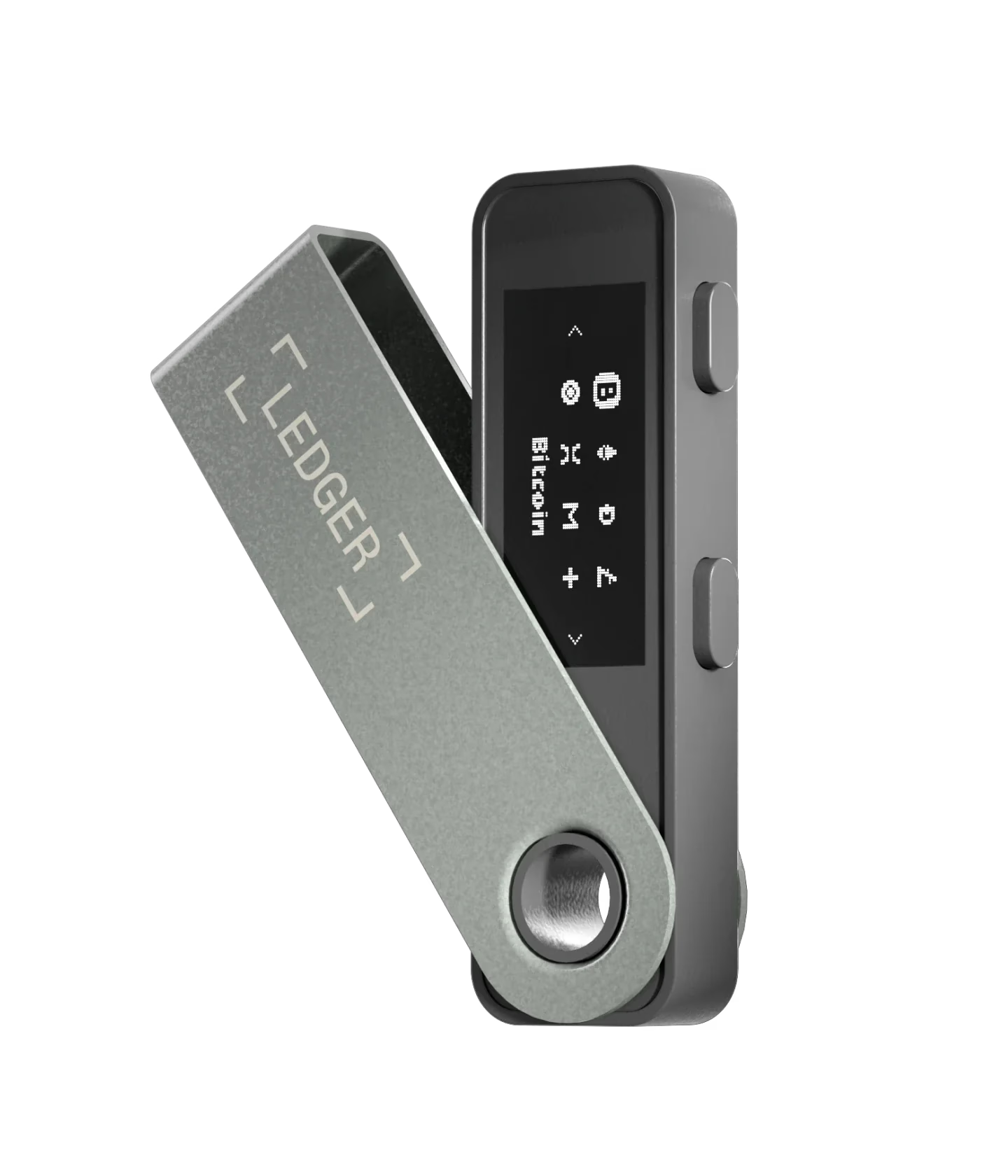
- Hardware wallets:
- More secure, ideal for storing larger amounts
- Popular options: Ledger Nano S Plus, Trezor
- Cost: around €50-100, a sensible outlay for security
- Paper wallets:
- Your private keys are printed on paper
- Very secure if properly generated and stored
- Impractical for regular transactions
Tip: a software wallet can be enough to start with. Consider a hardware wallet if your holdings grow substantial.
Legal and tax implications
In France, cryptocurrency regulation is moving fast. Here is what you need to know:
- Capital gains tax: since 1 January 2026, gains on disposals of digital assets are taxed under the flat tax (PFU) at 31.4% (12.8% income tax + 18.6% social levies). The increase comes from the LFSS 2026 (France's social security financing act), which raised the CSG (France's general social-security contribution) on capital income from 9.2% to 10.6%. You may elect for the progressive income tax scale instead if that is more favourable. For more detail, see the dedicated government page.
- Exemption threshold: gains are exempt if total digital-asset disposal proceeds for the year do not exceed €305. Above that, all gains are taxable.
- DAC8: since 1 January 2026, the European DAC8 directive requires platforms to report your transactions automatically to the tax authorities.
- Record keeping: keep a detailed history of your transactions. Specialist tools such as Koinly help reconstruct taxable operations, and apps such as Finary let you track the value of a crypto portfolio alongside your other assets.
- Regulation: France treats cryptocurrencies as movable property. Since 1 July 2026, exchange platforms must be authorised as CASPs under the MiCA Regulation to operate in France.
Follow this guidance and you will be well equipped to start out in the world of cryptocurrency. Keep reading up regularly on a sector that never stops changing.
Frequently asked questions
Do you have to declare cryptocurrency to the French tax authorities?
Yes. Digital-asset accounts opened with a platform established abroad must be declared every year on form 3916-bis, even if nothing has been sold. Realised gains are itemised separately on form 2086, filed with the income tax return.
How does the blockchain work?
The blockchain is a public ledger shared across thousands of computers. Each transaction is verified by the network, then added to a "block" linked to the previous one. That mechanism makes tampering all but impossible.
How are crypto capital gains taxed in 2026?
Crypto gains have been taxed under the flat tax (PFU) at 31.4% since 1 January 2026 (12.8% income tax + 18.6% social levies). An exemption applies below €305 of annual disposals.
What is the difference between Bitcoin and Ethereum?
Bitcoin is designed as a store of value ("digital gold") with a supply capped at 21 million units. Ethereum is a platform for running smart contracts and building decentralised applications (DeFi, NFTs).
How do you secure your cryptocurrency?
Use a software wallet (MetaMask, Exodus) for small amounts and a hardware wallet (Ledger, Trezor) for larger ones. Keep your private key offline and never share it.
Are crypto platforms regulated in France?
Since 1 July 2026, a platform must hold the CASP authorisation issued under the European MiCA Regulation to offer its services in France. The earlier French registration regime from the PACTE law is no longer enough. The AMF publishes the list of authorised providers on its website.
Sources
Impots.gouv.fr, how to declare digital-asset accounts held abroad (form 3916-bis)
AMF, white lists of authorised crypto-asset service providers
Ethereum.org, The Merge: around a 99.95% reduction in the network's energy consumption
CoinMarketCap, crypto-asset prices and market capitalisations as at 31 July 2026
Satoshi Nakamoto, Bitcoin: A Peer-to-Peer Electronic Cash System, 2008
Crypto.com, Global Cryptocurrency Ownership Reaches 741 Million in 2025
Security.org, Cryptocurrency Annual Consumer Report: ownership rates in the United States
Le Temps, why El Salvador abandoned bitcoin as legal tender
Regulatory disclaimers: Marketing communication. Investing carries a risk of partial or total capital loss. Past performance is not a reliable indicator of future performance. This article is provided for information and educational purposes only; it does not constitute personalised investment advice, a buy or sell recommendation, or tax advice. Crypto-assets are highly volatile and carry a risk of total capital loss. They benefit from no capital guarantee and from no deposit-guarantee or investor-compensation scheme. Before investing, read the Key Information Document (KID) and, where relevant, consult an authorised adviser. Finary SAS, an investment firm authorised by the ACPR (no. 19283), member of AMAFI. Insurance broker registered with ORIAS (no. 21001279), member of the CNCGP (association approved by the AMF). Crypto-Asset Service Provider (CASP) authorised by the AMF under the MiCA regime, references no. A2026-026 and no. N2026-008.