AI Crypto: The 6 Best to Watch in 2026

Updated on 13 July 2026
The best AI cryptocurrencies in 2026 are Fetch.ai (FET), Bittensor (TAO), Render Network (RENDER), The Graph (GRT), SingularityNET (AGIX) and Ocean Protocol (OCEAN), which are building the blockchain infrastructure needed to train, deploy and monetise artificial intelligence models in a decentralised way.

- Fetch.ai, SingularityNET and Ocean Protocol merged their tokens into the Artificial Superintelligence Alliance in July 2024.
- Ocean Protocol left that alliance in October 2025 to become an independent project again, with its own funding.
- Capital gains on cryptocurrencies converted into euros have been taxed at the flat tax (PFU) rate of 31.4% since 1 January 2026.
- Bittensor (TAO) is currently the highest-valued token in the sector, carried by its decentralised network for training AI models.
How do artificial intelligence and blockchain combine?
Artificial intelligence and blockchain combine to train, deploy and monetise AI models in a decentralised way, without depending on a single centralised player.
Artificial intelligence has undergone a spectacular transformation. The rise of large language models (LLMs) such as GPT played a key role. These systems, able to understand and generate text in an almost human way, opened up AI to the general public.
Beyond LLMs, AI now covers a broad range of technologies. That includes image recognition, process automation and much more, transforming entire sectors of the economy.
The concrete applications of AI are multiplying at dizzying speed:
- In medicine, AI supports the early diagnosis of disease.
- In finance, it optimises investment strategies.
- In e-commerce, it personalises the customer experience on an unprecedented scale.
Where AI and blockchain converge
Combining AI and blockchain solves major challenges for both technologies. Blockchain brings the transparency and decentralisation that ethical AI development requires. In return, AI improves the efficiency and intelligence of blockchain networks.
This synergy creates a new paradigm in which AI models can be:
- Trained
- Deployed
- Monetised in a decentralised way.
The fields of application for this convergence are broad and promising:
- In decentralised finance (DeFi), AI optimises trading strategies and risk management.
- In supply chain management, it automates product traceability.
- In healthcare, it enables medical data to be shared securely for research while preserving patient confidentiality.
This synergy between AI and blockchain opens the way to new opportunities across many sectors, improving the efficiency and security of existing systems.
with confidence
Investing carries risks, including the risk of capital loss. Crypto-assets are highly volatile: you may lose all or part of your investment. Past performance is not a reliable indicator of future performance. Finary is authorised as a Crypto-Asset Service Provider (CASP, "PSCA" in French) by the AMF under the MiCA regime.
What are the best AI cryptocurrencies in 2026?
The six best AI cryptocurrencies to watch in 2026 are Fetch.ai (FET), SingularityNET (AGIX), Ocean Protocol (OCEAN), Render Network (RENDER), Bittensor (TAO) and The Graph (GRT).
1. Fetch.ai (FET)
Fetch.ai is reshaping service automation through its Autonomous Economic Agents (AEA). These intelligent agents automatically optimise complex processes in several fields:
- Logistics
- Transport
- Energy management
An AEA can, for example, manage a vehicle fleet on its own, optimising routes and fuel consumption.
The FET token powers the whole Fetch.ai ecosystem. It is used to pay for the services of autonomous agents and to take part in network governance. Developers can also use FET to deploy their own agents and services on the platform. Since 2024, FET has also been the central token of the Artificial Superintelligence Alliance, the alliance formed with SingularityNET (whose AGIX token was converted into it) and joined for a time by Ocean Protocol.
2. SingularityNET (AGIX)
SingularityNET stands out for its decentralised AI marketplace, where developers can monetise their algorithms. Led by AI pioneer Ben Goertzel, the platform aims to open up access to artificial intelligence technologies. Users can easily integrate AI services:
- Speech recognition
- Data analysis
The AGIX token was historically used to buy and sell AI services and to govern the project. Since July 2024, SingularityNET has merged its token into the Artificial Superintelligence Alliance alongside Fetch.ai, and AGIX has been removed from the main exchanges (Binance, Bybit, Bitget, OKX). Its liquidity is now very thin: it is better to follow the FET token, which now carries most of the alliance's activity. SingularityNET continues to work with organisations such as Hanson Robotics to develop advanced AI solutions. According to CoinMarketCap, the AGIX token accounted for only around $3,600 of daily trading volume in mid-2026, far from its pre-merger levels.
3. Ocean Protocol (OCEAN)
Ocean Protocol turns data into tradable digital assets while preserving confidentiality. Its "compute-to-data" technology lets algorithms analyse sensitive data without exposing it. That opens up new possibilities for:
- Medical research
- Financial analysis
OCEAN tokens facilitate data exchange and reward contributors. Holders can take part in network governance. Ocean Protocol had joined the Artificial Superintelligence Alliance in 2024 alongside Fetch.ai and SingularityNET, before withdrawing on 9 October 2025 to become an independent project again, with its own funding and its own roadmap. The project works with many institutions to build specialised data marketplaces.
4. Render Network (RENDER)
Render Network opens up access to the GPU computing power that AI and 3D rendering require. The platform connects creators who need computing power with owners of idle GPUs. This approach sharply reduces processing costs for AI and digital creation projects.
The RENDER token (formerly RNDR, migrated to the Solana blockchain in November 2023) is the means of payment on the network and rewards providers of computing power. The platform recently extended its capabilities to support the training of AI models.
5. Bittensor (TAO)
Bittensor builds a decentralised neural network in which AI models collaborate to solve complex problems. The platform uses a distinctive validation system that rewards the best-performing models with TAO tokens. This approach encourages continuous innovation.
The Bittensor network lets developers deploy and monetise their AI models transparently. Validators guarantee the quality of the answers the models return.
6. The Graph (GRT)
The Graph makes blockchain data easier to reach through its decentralised APIs known as subgraphs. This infrastructure is essential for AI applications that analyse blockchain data in real time. Developers can build custom subgraphs to extract and organise data.
The GRT token is used to pay indexers and curators. The Graph has become an essential component of the Web3 ecosystem, supporting thousands of decentralised applications.
What criteria are used to assess an AI cryptocurrency?
An AI cryptocurrency is assessed on four main criteria: its technological potential, its real-world usefulness, its tokenomics and the quality of its development team.
Technological potential
Technological innovation is the foundation of any strong AI crypto project. The most promising platforms build in significant advances such as federated learning for decentralised model training, or zero-knowledge proofs for data confidentiality. Those innovations must answer concrete problems rather than serve as announcements.
Technical scalability is another crucial criterion. Projects must show they can handle a growing volume of users and data without degrading performance. For example, SingularityNET uses a multi-chain architecture to process thousands of AI requests at once.
Real-world usefulness and use cases
The most relevant AI cryptocurrencies solve concrete problems in specific sectors:
- Ocean Protocol answers the critical need for secure data monetisation in medical research and financial analysis.
- Fetch.ai automates complex processes in logistics and energy management.
Adoption by major industry players is a reliable indicator of a project's usefulness. Partnerships with established companies, academic institutions or government organisations demonstrate the practical value of the technology and speed up real-world integration.
Tokenomics and token utility
A well-designed economic model encourages every participant in the ecosystem to take part. Tokens must have clearly defined uses, such as:
- Paying for services
- Network governance
- Incentives to supply resources
The RENDER token, for example, pays for computing power and rewards GPU providers.
Token distribution and governance mechanisms must support real decentralisation. A well-thought-out staking system, appropriate lock-up periods and mechanisms preventing power from concentrating all contribute to the stability and durability of the ecosystem.
Development team and activity
The quality of the development team is a decisive factor in the success of an AI crypto project. Expertise in artificial intelligence, blockchain and cryptography must be demonstrated through concrete achievements and a clear vision for future development. The presence of recognised researchers or experienced entrepreneurs strengthens a project's credibility.
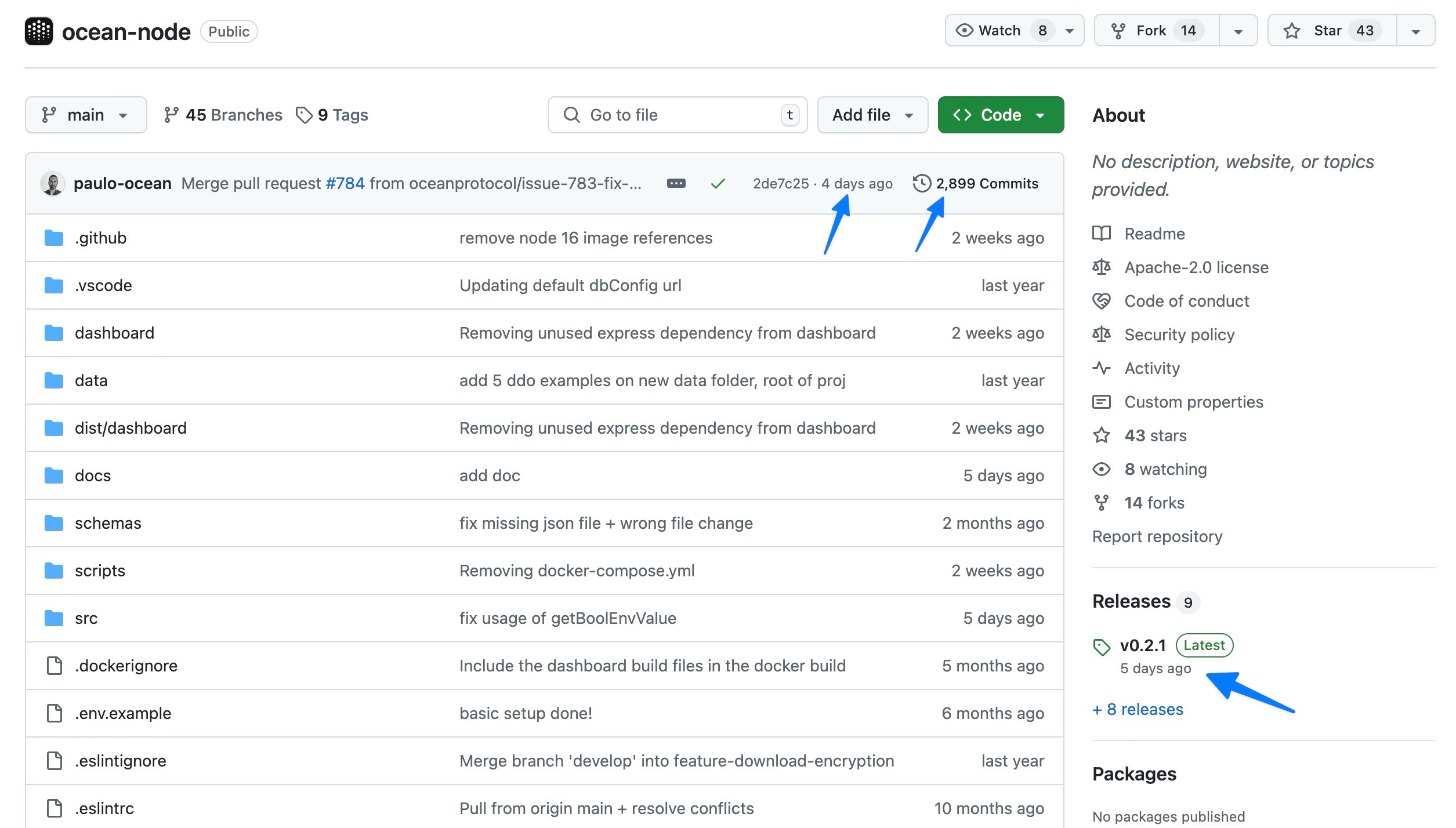
Development activity can generally be followed on GitHub, where teams publish their source code and document their technical progress. An active project shows regular updates, frequent contributions and an engaged developer community.
Assessing the best AI cryptocurrencies against these criteria gives a clearer view of their transformative potential and their capacity to fit into varied economic ecosystems.
finally regulated
Investing carries risks, including the risk of capital loss. Crypto-assets are highly volatile: you may lose all or part of your investment. Past performance is not a reliable indicator of future performance. Finary is authorised as a Crypto-Asset Service Provider (CASP) by the AMF under the MiCA regime.
Comparing the main AI cryptocurrency projects
Past performance and future outlook
The AI cryptocurrency market has grown significantly since ChatGPT broke through. Projects that combine blockchain and AI effectively attract particular attention from investors and developers.
For example, Render Network has seen its adoption rise on the back of growing demand for AI computing power.
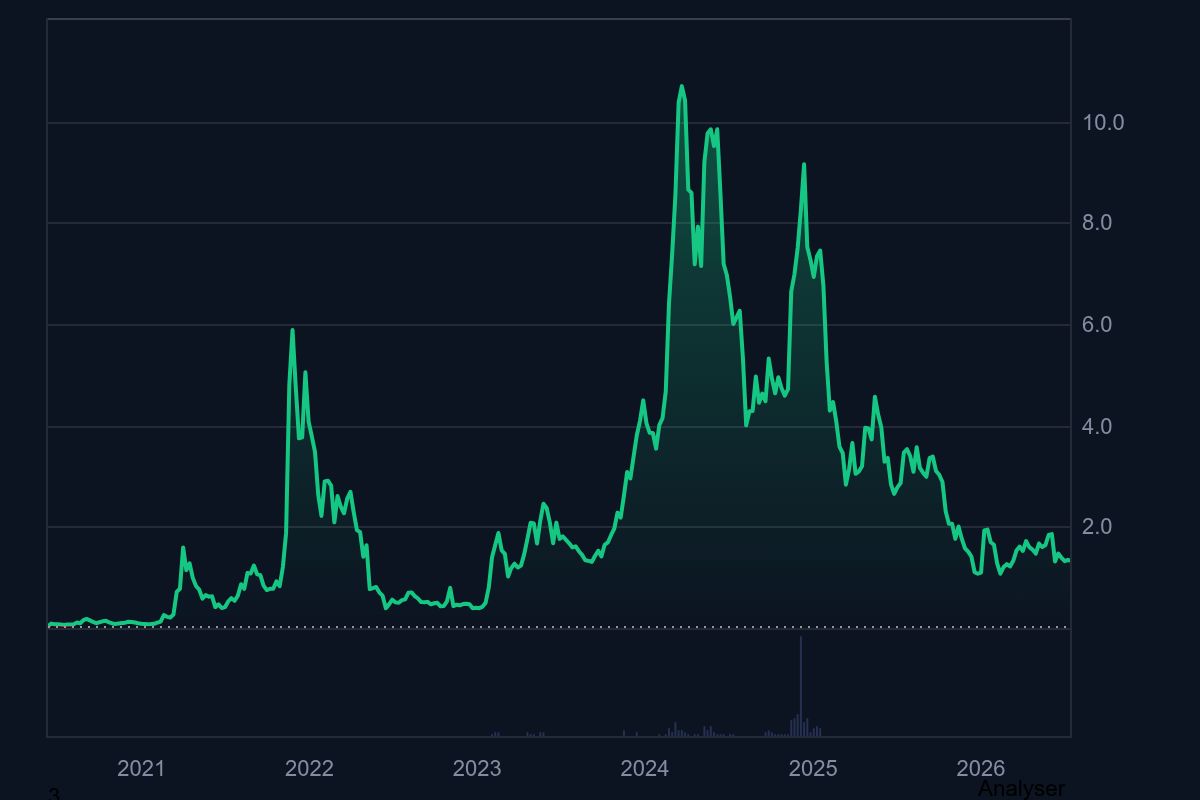
Adoption across platforms can be measured with concrete metrics:
- Number of active developers
- Transaction volume
- Volume of data processed
Strengths and weaknesses of each project
Here is a comparison of the main AI crypto projects:
| Project | Strengths | Weaknesses |
|---|---|---|
| Fetch.ai | Sophisticated autonomous agents, solid partnerships | Technically complex for new users |
| SingularityNET | Mature AI marketplace, experienced team | AGIX token delisted from the major exchanges since 2024, very thin liquidity since the merger into the ASI Alliance |
| Ocean Protocol | Innovative data protection, concrete use cases | Adoption still limited by sector; left the ASI Alliance in October 2025 to fund its roadmap alone |
| Render Network | Established GPU infrastructure, active community | Exposure to swings in the GPU market |
The strengths of each project often reflect its specialisation:
- Fetch.ai excels at intelligent automation.
- Ocean Protocol stands out in secure data monetisation.
That diversity lets investors build a balanced portfolio in line with their convictions.
Technical challenges are a major point of attention. Scalability, security and interoperability remain crucial issues for every project. SingularityNET, for example, is working actively on those aspects through its multi-chain migration initiative.
The best AI cryptocurrencies stand out for their ability to combine advanced technology, real-world usefulness and a solid economic model. That is what lets them meet market needs effectively and attract significant adoption.
How to invest in AI cryptocurrencies?
Investing in AI cryptocurrencies means diversifying between established and newer projects, using DCA to smooth volatility, and understanding the tax framework that applies in France.
Recommended investment strategies
Diversification remains the fundamental principle when investing in cryptocurrencies and AI tokens in particular. A balanced strategy means spreading investments between established projects such as Fetch.ai and newer initiatives such as Bittensor. That approach captures both the stability of mature projects and the growth potential of newcomers.
Using DCA is particularly relevant in this volatile sector. The method consists of investing small amounts regularly rather than making one large investment at once. For example, invest a fixed sum each month in 2-3 carefully selected AI crypto projects.
New investors should start by understanding the fundamentals of each project. Read the whitepapers, follow developments on GitHub and take part in the Discord or Telegram communities. Those sources give valuable insight into the technical health and adoption of a project.
Want to sharpen your crypto investment strategy? Discover the best exchange platforms for buying and trading your cryptocurrencies safely.
Regulation and legal considerations
The regulatory framework for AI cryptocurrencies is moving fast. In France, the AMF (Autorité des Marchés Financiers) oversees crypto-asset activities. Investors must declare their capital gains when converting into euros and pay the flat tax (PFU) of 31.4% (12.8% income tax and 18.6% social contributions), in force since 1 January 2026.
Regulatory compliance is becoming a major issue for AI crypto projects. Platforms that handle personal data must comply with the GDPR in Europe.
The outlook for AI cryptocurrencies
Emerging trends
Bringing LLMs into blockchain protocols opens up fascinating possibilities. Projects such as SingularityNET are exploring decentralised language models. Those models can produce smarter smart contracts and more natural user interfaces. This convergence between conversational AI and blockchain could transform how people interact with decentralised applications.
Opening up AI model training is emerging as a major trend. Bittensor and Ocean Protocol are building infrastructure that lets small organisations take part in the collaborative training of AI models. This decentralised approach could reduce dependence on the large technology players.
Intelligent automation of DeFi processes is another promising field. Fetch.ai is developing autonomous agents able to optimise trading strategies and crypto portfolio management. Those innovations could make decentralised finance more accessible and more efficient.
Long-term impact on the digital economy
The decentralisation of AI is deeply transforming several economic sectors. In healthcare, Ocean Protocol already enables medical data to be shared securely for research while preserving patient confidentiality. This approach could speed up the development of new treatments while giving patients control over their data.
Decentralised computing infrastructure, such as Render Network, opens up access to the resources AI needs. This redistribution of computing power could help new innovative players emerge in fields such as digital creation or scientific research.
The token economy is redefining how we value and exchange digital resources. AI crypto projects create new economic models in which contributing to model training, supplying data or providing computing power is rewarded directly. This tokenisation of AI resources could produce a fairer, more participatory economy.
Decentralised governance of AI systems is becoming crucial as their societal impact grows. DAOs (Decentralised Autonomous Organisations) specialising in AI, such as SingularityNET's, let communities take part in decisions about how these technologies are developed and used.
The best AI cryptocurrencies are not simply riding the artificial intelligence wave. They are actively building the infrastructure that will open up access to these technologies. From Fetch.ai to SingularityNET, by way of Ocean Protocol and Render Network, these projects offer concrete solutions for decentralising AI. At the same time, they create new investment opportunities for those who want to take part in this major technological shift.
finally simple

Investing carries risks, including the risk of capital loss. Crypto-assets are highly volatile: you may lose all or part of your investment. Past performance is not a reliable indicator of future performance. Finary is authorised as a Crypto-Asset Service Provider (CASP) by the AMF under the MiCA regime.
Frequently asked questions
What is an AI cryptocurrency?
An AI cryptocurrency is a token that funds or rewards blockchain infrastructure dedicated to artificial intelligence: model training, algorithm marketplaces, data sharing or decentralised computing power. The token pays for network services and grants a say in governance.
Why are Fetch.ai, SingularityNET and Ocean Protocol so often mentioned together?
These three projects merged their tokens in 2024 into the Artificial Superintelligence Alliance, pooling their autonomous-agent, AI marketplace and decentralised data technologies. Ocean Protocol has since left the alliance, in October 2025, to become independent again.
Is investing in AI cryptocurrencies risky?
Yes. AI cryptocurrencies remain volatile and, for most projects, thinly traded, as the case of SingularityNET (AGIX) shows after its delisting from the main exchanges in 2024. Investing carries a risk of partial or total capital loss and calls for prudent diversification.
How are capital gains on AI cryptocurrencies taxed in France?
Capital gains realised by a private individual when converting cryptocurrencies into euros are subject to the flat tax (PFU) of 31.4%, made up of 12.8% income tax and 18.6% social contributions, in force since 1 January 2026 (impots.gouv.fr).
Is DCA suited to AI cryptocurrencies?
Yes. Investing a fixed sum regularly rather than all at once smooths the sharp volatility typical of AI cryptocurrencies, a young sector where valuations can swing considerably from one month to the next with the technology news flow.
Sources
impots.gouv.fr, taxation of capital gains on disposals of digital assets
AMF, white lists of crypto-asset service providers
The Block, Ocean Protocol withdraws from the Artificial Superintelligence Alliance (09/10/2025)
Fetch.ai, details of the FET, AGIX and OCEAN token merger
CoinMarketCap, price and liquidity of the AGIX token (SingularityNET)
CoinMarketCap, price and liquidity of the OCEAN token (Ocean Protocol)
CoinMarketCap, price and market capitalisation of the RENDER token
Render Foundation, migration of the RNDR token to RENDER on Solana
CoinMarketCap, price and rank of the TAO token (Bittensor)
CoinGecko, price and rank of the GRT token (The Graph)
CoinGecko, no active market for the CTXC token (Cortex)
Regulatory disclaimers: Marketing communication. Investing carries a risk of partial or total capital loss. Past performance is not a reliable indicator of future performance. This article is provided for information and educational purposes only; it does not constitute personalised investment advice, a buy or sell recommendation, or tax advice. Crypto-assets are highly volatile and carry a risk of total capital loss. They are covered by no capital guarantee, and by no deposit guarantee or investor compensation scheme. Before investing, read the Key Information Document (KID) and, where relevant, consult an authorised adviser. Finary SAS, an investment firm authorised by the ACPR (no. 19283), member of AMAFI. Insurance broker registered with ORIAS (no. 21001279), member of the CNCGP (association approved by the AMF). Crypto-Asset Service Provider (CASP) authorised by the AMF under the MiCA regime, references no. A2026-026 and no. N2026-008.