Should You Hold Crypto in Your Portfolio?

Updated on 27 July 2026
One in ten French people already own crypto. Does that mean it belongs in your portfolio?
There is no universal yes or no. Crypto is worth a serious look, but it is not essential to any portfolio, and how much room it deserves depends on your time horizon, your risk tolerance and your goals.
Here is how to decide, and if the answer is yes, what allocation makes sense.

- Crypto is not essential to any portfolio: it comes after a solid foundation (an emergency fund, real estate, stocks).
- The decision rests on three factors: your investment horizon (aim for 5 to 10 years), your risk tolerance and your goals.
- If you do invest, keep the allocation modest: 1 to 5% for a cautious profile, 5 to 10% for a more dynamic one, and anything above 10% is not advisable.
- Bitcoin and Ethereum, which account for most of the market, are enough for most investors.
- Crypto assets are highly volatile and carry a risk of total capital loss.
What is crypto, exactly?
When people talk about crypto, they usually think first of Bitcoin, the first cryptocurrency ever issued. Born after the subprime crisis, its ambition was to be a decentralised currency, independent of central banks.
Like all cryptocurrencies, Bitcoin runs on a blockchain: a decentralised, tamper-proof ledger that records every transaction, with no central controlling authority.
Its defining feature, which earns it the nickname digital gold, is its scarcity: 21 million units will ever be issued, not one more. The principle of halving regularly slows down the creation of new bitcoins.
As an investment, crypto has two defining traits: it is a diversification tool, since it is only loosely correlated with other asset classes, and a high-potential but high-risk asset. Its volatility, often singled out, tends to ease as the market matures and becomes more regulated.
at your own pace

Investing carries risks, including the risk of capital loss. Crypto-assets are highly volatile: you may lose all or part of your investment. Past performance is not a reliable indicator of future performance. Finary is authorised by the AMF as a crypto-asset service provider (PSCA) under the MiCA regime.
Should you hold crypto?
Not necessarily. Crypto is worth a serious look, but it is not a mandatory piece of any portfolio. In a wealth pyramid, it sits at the third level, after a solid foundation: an emergency fund, then real estate and stocks or ETFs.
If you are just starting to invest, it is therefore better not to begin with crypto. The numbers confirm this: according to an ADAN and KPMG study, around one in ten French people hold crypto, mostly men under 35, and it usually accounts for less than 10% of their wealth.
Three questions are enough to know whether crypto belongs in your portfolio:
- What is your time horizon? Crypto is a long-term play: aim for 5 to 10 years, and avoid it for short-term needs.
- What is your risk tolerance? The AMF ranks investments on a risk scale from 1 to 7; crypto sits at the very top.
- What is your goal? Protecting capital close to retirement and chasing dynamic returns do not lead to the same decision.
The answer is the combination of these three factors.
What allocation should you aim for?
If you decide to invest, the rule is to keep your exposure modest. The right percentage depends on your conviction, how much diversification you are after, and the size of your portfolio: the larger it is, the more moderate the crypto allocation should stay.
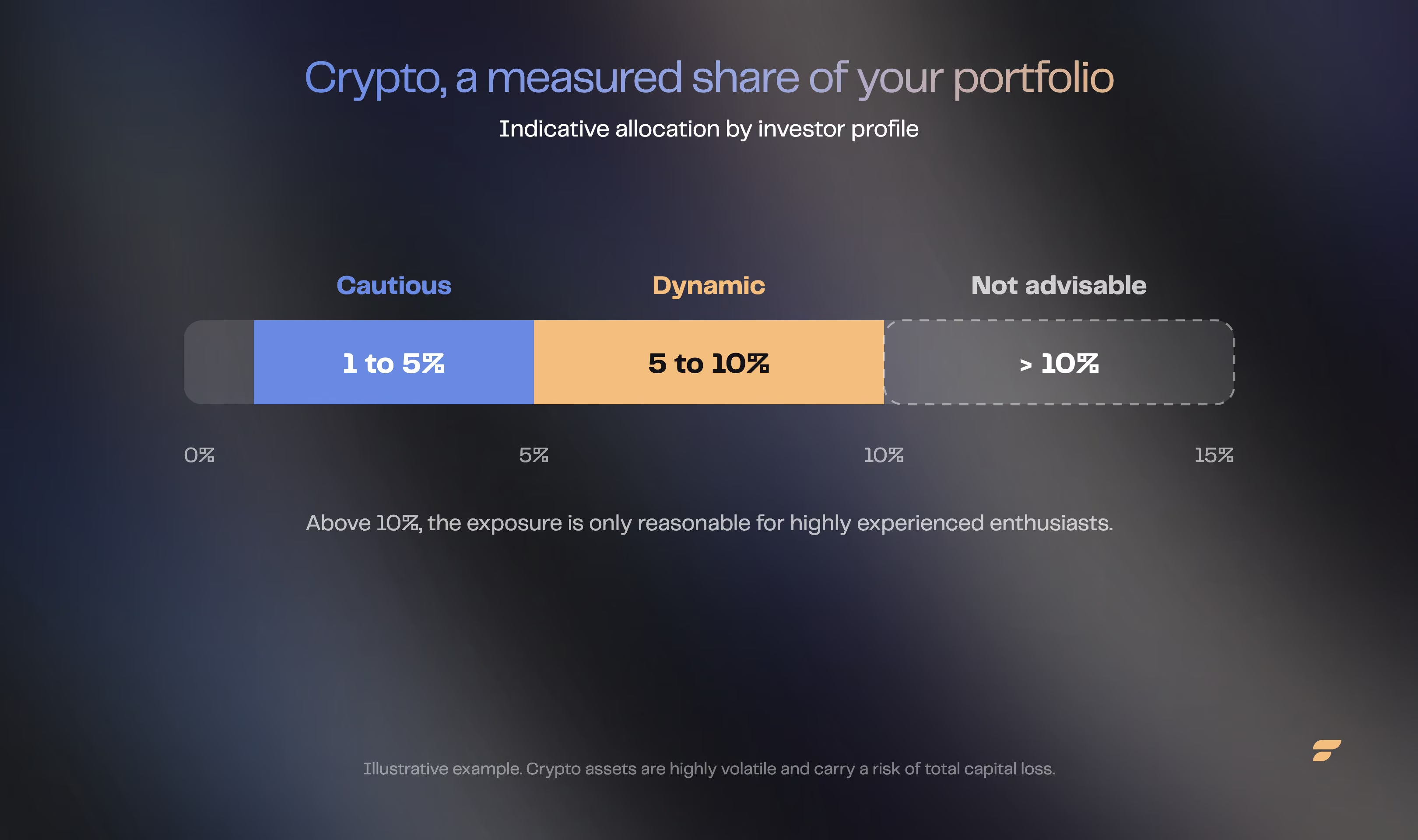
In practice, with 5% in crypto, even if that market halved, your portfolio would only drop by 2.5%, which would not put you in difficulty. A range of 1 to 5% lets you gain exposure without taking on too much risk, while 5 to 10% targets a more dynamic return while avoiding overexposure.
Above 10%, the exposure becomes hard to justify for a long-term investor, except for enthusiasts who know the ecosystem very well, and only on condition of not putting themselves at risk.
How to invest in crypto?
Start by choosing solid assets. Thousands of cryptos exist, but most are not serious. For most investors, Bitcoin and Ethereum are enough: they are the least volatile and account for most of the market's capitalisation.
Should you go through a Bitcoin ETF? These products have been approved in the United States, but they strip away the asset's own characteristics: with an ETF, you do not hold your crypto and you pay annual management fees. Holding your crypto directly, on a platform registered with the AMF if you are in France, avoids those fees.
Next comes how you invest. Two approaches exist: buying it all at once, or Dollar Cost Averaging (DCA), which means investing a fixed amount at regular intervals.
DCA is generally the better choice for three reasons: it smooths out the impact of volatility, it reduces the mental load of timing the market, and it can be automated.
5 tips to limit the risks
To invest in crypto without getting burned, five principles come up again and again.
- Invest in what you understand. The better you understand how an asset works, the less likely you are to fall into the traps.
- Beware of trends. Chasing the latest trending crypto exposes you to pump and dump schemes, where some players artificially inflate a price before selling. Stick to your strategy.
- Do not spread yourself thin. Exposure to Bitcoin and Ethereum is enough for most investors; no need to pile up tokens.
- Think long term. Crypto is notoriously volatile, and its value can swing sharply over short periods.
- Secure your holdings. For large amounts, a physical wallet (hardware wallet, such as a Ledger, becomes essential.
finally regulated
Investing carries risks, including the risk of capital loss. Crypto-assets are highly volatile: you may lose all or part of your investment. Past performance is not a reliable indicator of future performance. Finary is authorised by the AMF as a crypto-asset service provider (PSCA) under the MiCA regime.
Frequently asked questions
Should you hold crypto in your portfolio?
It is not essential for anyone. Crypto can earn a place once a solid foundation is in place (an emergency fund, real estate, stocks), and provided you accept a high level of risk. The decision depends on your time horizon, your risk tolerance and your goals.
What share of crypto should be in a portfolio?
A modest allocation: 1 to 5% for a cautious profile, 5 to 10% for a dynamic one. Above 10%, the exposure is only reasonable for highly experienced enthusiasts. With 5%, a market crash of 50% would only cost you 2.5% of your portfolio.
Bitcoin or Ethereum: where should you start?
For most investors, Bitcoin and Ethereum are enough. They are the least volatile cryptocurrencies and they concentrate most of the market's capitalisation. No need to spread across dozens of more obscure and riskier tokens.
Should you buy a Bitcoin ETF or hold your own crypto?
Holding your crypto directly, on a platform registered with the AMF, avoids an ETF's annual management fees and keeps the asset's own characteristics. An ETF can make access easier, but then you do not actually hold your cryptocurrencies.
How can you reduce risk in crypto?
Invest only in what you understand, stick to established assets like Bitcoin and Ethereum, invest gradually (DCA), think long term, and secure your holdings with a physical wallet for large amounts. And never invest more than you can afford to lose.
Sources
Étude ADAN & KPMG - crypto et Web3 en France et en Europe
AMF - comprendre l’échelle de risque d’un placement
Regulatory disclaimers: Marketing communication. Investing carries a risk of partial or total capital loss. Past performance is not a reliable indicator of future performance. This article is provided for information and educational purposes only; it does not constitute personalised investment advice, a buy or sell recommendation, or tax advice. Crypto-assets are highly volatile and carry a risk of total capital loss. They benefit from no capital guarantee and from no deposit guarantee or investor compensation scheme. Before investing, read the Key Information Document (KID) and, where relevant, consult an authorised adviser. Finary SAS, an Investment Firm authorised by the ACPR under no. 19283, member of AMAFI. Insurance broker registered with ORIAS under no. 21001279, member of the CNCGP (association approved by the AMF). Crypto-Asset Service Provider (PSCA) authorised by the AMF under the MiCA regime, references no. A2026-026 and no. N2026-008.