The Best Crypto RWA Projects to Watch in 2026

Updated on 13 July 2026
Crypto RWAs (Real World Assets) are tokens that represent exposure to a traditional asset such as gold, real estate or Treasury bills. In 2026, the eight most closely watched projects in the sector are PAX Gold, Propy, Ondo Finance, Chromia, OriginTrail, Pendle Finance, Realio Network and TokenFi.

- The tokenised Crypto RWA market is worth roughly $26 billion to $34 billion; the trillion-dollar projections are estimates for 2030.
- Since 1 July 2026, the transitional regime attached to the earlier French registration for digital-asset service providers has ended: only platforms authorised as Crypto-Asset Service Providers (CASP, “PSCA” in French) under MiCA may serve French residents.
- PAX Gold is now supervised by the OCC (the US federal banking regulator), following the conversion of Paxos Trust in December 2025.
- French taxation applies a flat tax (PFU) of 31.4% (12.8% income tax, 18.6% social contributions) on capital gains on disposal.
What is a Crypto RWA (Real World Asset)?
A Crypto RWA is a blockchain token that represents economic exposure to a traditional asset: gold, real estate, bonds or receivables, without conferring direct legal ownership of it.
Definition of RWAs
RWAs represent the tokenisation of traditional physical or financial assets on the blockchain. This includes assets such as real estate, commodities, bonds and art. These assets are now accessible in the form of digital tokens.
This approach differs from conventional cryptocurrencies in its ability to anchor tangible value in the digital world.
Key features of Crypto RWAs
Fractional ownership
Tokenisation (fractional ownership) makes it possible to split a high-value asset into smaller units. An investor can hold a fraction of a legal structure (LLC, SPV, fund) that itself owns a building, a work of art or a basket of Treasury bills. This sharply lowers the minimum ticket compared with buying directly.
Improved liquidity
Tokenising a traditionally illiquid asset (real estate, art) opens the way to an on-chain secondary market, theoretically active 24/7. In practice, real liquidity depends on the token's trading volume: some RWA projects show a deep order book, others stay confidential and hard to sell quickly.
Greater accessibility and inclusion
Crypto RWAs lower the barriers to entry: a smaller minimum ticket, a purchase in a few clicks via a wallet, no notary and no traditional broker. Access still depends on the eligibility rules specific to each token (mandatory KYC, restrictions by country of residence, qualified investor status for some products).
Transparency and security via the blockchain
The blockchain makes transactions publicly auditable and hard to alter after the fact. This on-chain transparency makes flows easier to trace and reserves easier to monitor through oracles. It does not remove the risks tied to the smart contract or to the solvency of the centralised issuer that maintains the link between the token and its underlying.
Portfolio diversification
Adding Crypto RWAs to a portfolio brings exposure to traditional underlyings (gold, real estate, bonds) while staying inside the blockchain ecosystem. The risk profile remains that of a crypto-asset and should not be confused with holding the underlying directly.
Lower costs and greater efficiency
Tokenisation automates part of the process (record keeping, payments, distribution of interest or rent) via smart contract, which cuts some administrative costs. Intermediaries do not disappear: a centralised issuer (Paxos, Ondo, Realio) remains responsible for the link between the token and its underlying. Buying and selling, by contrast, execute in minutes instead of several weeks for an equivalent asset in the traditional channel.
Comparison with traditional investments
Compared with traditional investments, Crypto RWAs stand out for their on-chain accessibility, their granularity (buying a fraction) and automated 24/7 execution via smart contract. They do not, however, offer the same legal guarantees as a bank savings account, a securities account or a life insurance policy: no deposit guarantee, no equivalent AMF/ACPR protection.
What are the best RWA tokenisation projects in 2026?
The eight most closely watched RWA tokenisation projects in 2026 are PAX Gold, Propy, Ondo Finance, Chromia, OriginTrail, Pendle Finance, Realio Network and TokenFi.
| Project | Token | Underlying | Issuer | Main regulatory framework |
|---|---|---|---|---|
| PAX Gold | PAXG | Physical gold (London) | Paxos Trust (US) | OCC (US federal banking regulator) |
| Propy | PRO | US real-estate closing infrastructure | Propy Inc. (US) | Licensed title agency (Propy Title), utility token |
| Ondo Finance | USDY | US Treasury bills | Ondo USDY LLC | EEA: qualified investors only |
| Ondo Finance | OUSG | US Treasury bills | Ondo I LP | Accredited / qualified institutional |
| Chromia | CHR | RWA infrastructure | Chromia Foundation | Decentralised protocol |
| OriginTrail | TRAC | Supply chain data | Trace Labs | Decentralised protocol |
| Pendle Finance | PENDLE | Yield tokenisation | DeFi protocol | Decentralised protocol |
| Realio Network | RIO | Tokenised private real estate | Realio | SEC Reg D / Reg S |
| TokenFi | TOKEN | No-code tokenisation platform | TokenFi (Floki ecosystem) | Decentralised protocol |
with confidence
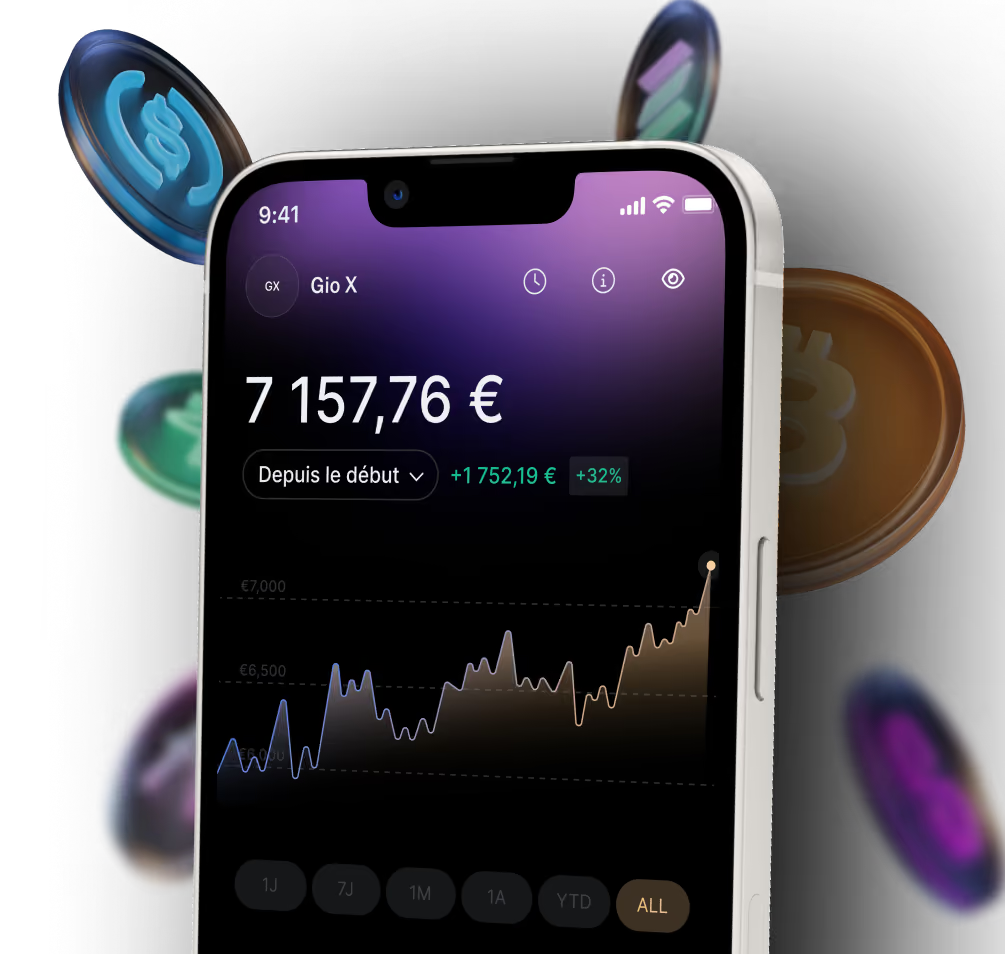
Investing carries risks, including the risk of capital loss. Crypto-assets are highly volatile assets: you may lose all or part of your investment. Past performance is not a reliable indicator of future performance. Finary is authorised by the AMF as a Crypto-Asset Service Provider (CASP) under the MiCA regime.
PAX Gold

PAX Gold (PAXG) is a gold-backed token issued by Paxos Trust Company. Each PAXG represents one troy ounce of physical gold stored in London vaults and certified by the LBMA. This tokenisation gives exposure to the gold price on the blockchain, without having to manage physical storage of the metal.
Holding PAXG gives exposure to the gold price without managing physical storage of the metal. On-chain access avoids the logistical constraints (vault, transport, insurance), and one PAXG can be split down to the 18th decimal to fine-tune a position.
For investors looking for further alternatives, gold ETFs are also a useful option to diversify a portfolio and gain exposure to the gold market without physically owning the precious metal.
Propy
Propy (PRO) is a blockchain platform for real-estate closing and title, which relies on its own licensed title agency (Propy Title) for the regulated part of the transaction. The PRO token is the technical building block: initiating transactions, managing escrow via smart contract and verifying property titles on-chain.
In 2025, for example, Propy opened a $100 million credit line to buy traditional title and escrow companies in the United States, as part of an AI-assisted real-estate closing strategy. Unlike a fractional-ownership token such as RealT, PRO remains a utility token and not a security representing a share of a building.
Ondo Finance
Ondo Finance (ONDO) tokenises traditional financial instruments, mainly US Treasury bills. Its products aim to bring the yield of US sovereign debt onto the blockchain and to widen the liquidity available 24/7 to eligible investors.
Ondo Finance issues two products backed by US Treasury assets. USDY is a yield token backed by a portfolio of short-term Treasury bills, open to qualified investors in the European Economic Area. OUSG is a token reserved for accredited investors or qualified institutions. Neither is open to the French retail public, as stated in the Ondo documentation. Together, the two products account for around $2.7 billion in assets in mid-2026 (OUSG around $625 million, USDY around $2.1 billion).
Chromia
Chromia (CHR) is a blockchain designed for high-performance RWA applications. It combines blockchain technology with relational database technology.
It supports a range of decentralised applications in sectors such as DeFi, GameFi and real-world asset tokenisation. Its modular architecture brings greater flexibility to data management for RWA projects, making processes more efficient and better suited to the specific needs of each sector.
OriginTrail

OriginTrail (TRAC) is a decentralised network for managing supply chain data, using its Decentralized Knowledge Graph (DKG).
It focuses on tracking and verifying the provenance of real-world assets such as goods and commodities. This system strengthens transparency and trust in supply chain operations. It ensures that product information is immutable and verifiable.
Pendle Finance

Pendle Finance (PENDLE) is a DeFi protocol that splits a yield-bearing asset into two distinct tokens: a Principal Token (PT) that tracks the capital, and a Yield Token (YT) that tracks future interest.
Users can then trade either one on secondary markets and structure their exposure depending on whether they expect the yield to rise or fall. Pendle is a decentralised protocol, with no central intermediary and therefore no recourse if a smart contract fails.
Realio Network
Realio runs on its own L1 blockchain (built with the Cosmos SDK and EVM-compatible), while the RIO token is distributed across several networks (Ethereum, Algorand, Stellar, BNB Chain). Its products primarily target accredited or qualified investors depending on the jurisdiction.
The platform enables trading and management of tokenised real-estate assets. The RIO token is distributed across several networks, including Stellar, to improve its liquidity, but the tokenisation infrastructure itself runs on Realio's proprietary L1 blockchain. This architecture makes tokenised real-estate investment opportunities easier to access.
TokenFi

TokenFi (TOKEN) is a no-code platform that simplifies the creation and tokenisation of RWAs. It offers tools such as ERC20/BEP20 token generators and a generative AI for NFTs.
This no-code approach sharply lowers the technical barrier to creating a token, which may appeal to a project owner or an SME wanting to experiment with tokenisation. It obviously does not remove the legal and tax work needed to back a token with a real asset.
Main applications of RWAs in DeFi
Lending and borrowing
Crypto RWAs can be used as collateral to borrow on DeFi platforms. An investor who pledges real-estate tokens as security can obtain a stablecoin loan without giving up exposure to the underlying.
As with any collateralised DeFi loan, if the value of the collateral falls below a threshold set by the protocol, the position can be liquidated automatically and all or part of the collateral seized. Understand this mechanism before making any deposit.
Index funds and investment baskets
Several DeFi protocols offer baskets of RWA tokens, making it possible to buy exposure to several underlyings (gold, Treasuries, real estate) in a single transaction.
These DeFi baskets are not ETFs in the regulatory sense. An ETF is a regulated fund (UCITS in Europe, '40 Act in the United States) with a depositary, an independent valuation agent and reporting obligations. A DeFi basket is a smart contract that rebalances tokens automatically, with no equivalent in terms of investor protection.
Income generation
Some RWA tokens distribute a periodic stablecoin flow. Some real-estate tokens pass on a share of net rent to holders; tokens backed by Treasury bills (USDY) pass on the interest.
Other tokens, such as those representing tokenised equities, may carry a right to dividend distributions under the conditions set by the issuer.
These flows are not guaranteed: they depend on the underlying (occupancy of the property, performance of Treasuries, the issuer's distribution policy) and can be interrupted or reduced.
Challenges and risks of RWA tokenisation
Regulatory issues
Since 30 December 2024, the European MiCA regulation has governed the issuance of and services on crypto-assets in the European Union. In France, the transitional regime attached to the earlier French registration for digital-asset service providers, which let incumbent providers keep operating without CASP authorisation, ended on 1 July 2026 (AMF press release).
The practical consequence: to offer a Crypto RWA to a French resident, a platform must now hold MiCA CASP authorisation (in France or via an EU passport). Purely decentralised protocols (Pendle, Chromia and others) fall outside MiCA but, in exchange, carry no investor protection.
Internationally, jurisdictions diverge: Reg D / Reg S in the United States (SEC), VARA in Dubai, MAS in Singapore. This fragmentation explains why the same RWA token can be marketable in one country and banned in another.
Security risks
Investing in a Crypto RWA exposes you to several categories of risk that must be understood before committing capital:
- Total capital loss: a smart contract bug, a protocol hack or a prolonged depeg can drive a token's value to zero.
- Issuer risk: the value of a backed token (PAXG, USDY and others) depends on the solvency of the centralised issuer. In the event of bankruptcy, holders are not covered by the FGDR or by insurers' guarantee schemes.
- Depeg risk: a token's price can drift lastingly from that of the underlying (illiquidity, loss of confidence, failed arbitrage).
- Regulatory risk: a platform without MiCA CASP authorisation may be forced to stop serving France from 1 July 2026, which can block withdrawals.
- Personal operational risk: losing your private keys means losing the tokens for good, with no recourse.
Before subscribing, read the smart contract audit, check the reserve attestations when the issuer publishes them, and never commit more than you are prepared to lose.
Liquidity issues
The liquidity of an RWA token depends on the volume of buyers and sellers continuously present on the secondary market. Some tokens show a deep order book (PAXG, ONDO), others can be hard to sell quickly without accepting a discount.
Before buying a Crypto RWA, look at three indicators:
- Average daily volume on the exchanges where it is listed.
- The bid-ask spread: a wide spread signals weak liquidity.
- The existence of a redemption mechanism run by the issuer itself (Paxos for PAXG, for example), which acts as a safety net if the secondary market runs short of buyers.
Fees to anticipate as an investor
For the investor, several layers of fees add to the purchase price of a Crypto RWA:
- Gas fees on the blockchain used (Ethereum, Polygon, Solana and others), which vary with network congestion.
- Platform fees on purchase (spot commission, withdrawal fees to a personal wallet).
- Bid-ask spread on secondary markets, sometimes high for illiquid tokens.
- Management or performance fees on some structured products (Pendle, DeFi baskets, tokenised funds).
Together, these fees can significantly erode the effective return: check them project by project before allocating capital.
What is the taxation of Crypto RWAs in France?
Crypto RWAs are legally classified as digital assets within the meaning of article L. 54-10-1 of the French Monetary and Financial Code. Three main cases:
- Occasional capital gain on disposal (article 150 VH bis of the CGI, the French General Tax Code): taxed under the flat tax (PFU) at 31.4% in 2026 (18.6% social contributions + 12.8% income tax, excluding the additional contribution), with an annual allowance of €305 on total disposals.
- Periodic distributions (tokenised property rent, USDY interest): the tax treatment depends on the exact nature of the flow and on the issuer. To be handled case by case with a tax adviser; the French tax authorities have not yet publicly ruled on flows from foreign real-estate tokens.
- Regular activity: if the tax authorities judge the buying and selling to be habitual, the gains fall under the BIC or BNC regime depending on the case.
Official reference: Digital assets on impots.gouv.fr. The rates shown apply to 2026 income and must be reconfirmed each year.
Opportunities and investment strategies in RWAs
How to buy RWAs
Buying Crypto RWAs involves several steps. The first is choosing a platform suited to your profile: Finary Crypto, authorised by the AMF as a Crypto-Asset Service Provider (CASP) under the MiCA regime, allows spot investment in the main listed RWA tokens (PAXG, ONDO, PENDLE, CHR, TRAC). For products issued directly by their protocols (RealTokens, USDY, OUSG), you have to go through the original platforms (Ondo) and check the eligibility conditions for your country of residence first.
Want to go further on crypto exchanges? Read our detailed guide to the best investment platforms to refine your investment strategy.
Next, you have to open an account, usually completing a KYC (Know Your Customer) check. Once the account is active, investors can buy RWA tokens using cryptocurrencies or stablecoins.
Each platform has its own conditions (minimum amount, fees, lock-up period, resale terms). Reading the product's technical and legal documentation before clicking “buy” remains essential.
Strategies for investing in RWAs
Combining several Crypto RWAs gives diversified exposure to different underlyings: a gold token (PAXG) for the commodity dimension, a Treasuries token (USDY, for eligible investors) for the monetary dimension, a real-estate token (Realio) for the property dimension.
Before allocating capital, look at four points:
- the exact nature of the underlying and the quality of the reserve audits
- the legal status of the platform in relation to your country of residence
- the token's liquidity on exchanges
- the applicable taxation
Past performance of an RWA token is not a reliable indicator of its future performance.
Outlook for the sector
According to RWA.xyz, the value of on-chain tokenised assets currently stands at around $26 billion to $34 billion in mid-2026; the Crypto RWA market is growing fast. BlackRock (the BUIDL fund, around $2.5 billion to $2.9 billion in assets) and Franklin Templeton (the BENJI fund, around $700 million to $830 million in assets) launched their own tokenised products in 2024-2025. The most optimistic estimates from BCG and 21Shares point to several trillion dollars of tokenised assets by 2030, but these projections remain hypothetical against the current size of the market.
Crypto RWAs combine exposure to traditional underlyings with blockchain infrastructure. Several players are shaping this market today (PAX Gold, Propy, Ondo Finance, Chromia, OriginTrail, Pendle Finance, Realio Network, TokenFi), each with its own underlying and its own legal framework.
For an investor, this is a segment worth following, but one that demands a fine understanding of the underlying, the smart contract and the legal framework applicable to each token before any allocation.
at your own pace

Investing carries risks, including the risk of capital loss. Crypto-assets are highly volatile assets: you may lose all or part of your investment. Past performance is not a reliable indicator of future performance. Finary is authorised by the AMF as a Crypto-Asset Service Provider (CASP) under the MiCA regime.
Frequently asked questions
What is a Crypto RWA?
A Crypto RWA (Real World Asset) is a blockchain token representing economic exposure to a traditional asset: gold, real estate, Treasury bills, receivables. The token is not the physical asset but a representation conditional on the issuer's solvency.
Are Crypto RWAs regulated in France?
Since 30 December 2024, MiCA has governed crypto-asset services in the EU. The transitional regime attached to the earlier French registration for digital-asset service providers ended on 1 July 2026. Since that date, only platforms authorised as CASPs may serve French residents. Most of the RWA projects mentioned in this article are not authorised to date.
What taxation applies to Crypto RWAs?
Capital gains on disposal are taxed under the flat tax (PFU) at 31.4% in 2026 (article 150 VH bis of the CGI), with an allowance of €305 on total annual disposals. Periodic flows (rent, interest) are classified case by case.
Can you invest in Propy from France?
Propy is not authorised by the AMF or as a MiCA CASP in its own right. The PRO token is a utility asset listed on exchanges (Coinbase, Gate, MEXC) and is bought like any other cryptocurrency, provided the platform used is itself authorised for French residents.
Which Crypto RWAs are available through Finary?
Finary Crypto, authorised by the AMF as a Crypto-Asset Service Provider (CASP) under the MiCA regime, allows spot investment in several RWA tokens listed on the main exchanges (PAXG, ONDO, PENDLE, CHR, TRAC). Products issued outside the secondary market (USDY, OUSG, RealTokens) are not available through Finary.
Sources
impots.gouv.fr, taxation of capital gains on disposals of digital assets
AMF, end of the transitional period for digital-asset service providers on 1 July 2026
Paxos, conversion under OCC supervision (December 2025)
Outlier Media, investigation into the RealT dispute in Detroit
RWA.xyz, market data on tokenised real-world assets
Ondo Finance, USDY eligibility documentation
Realio Network, technical documentation (Cosmos SDK)
DLA Piper, CSG increase on 1 January 2026 (LFSS 2026)
Regulatory disclaimers: Marketing communication. Investing carries a risk of partial or total capital loss. Past performance is not a reliable indicator of future performance. This article is provided for information and educational purposes only; it does not constitute personalised investment advice, a buy or sell recommendation, or tax advice. Crypto-assets are highly volatile and carry a risk of total capital loss. They benefit from no capital guarantee and from no deposit-guarantee or investor-compensation scheme. Before investing, read the Key Information Document (KID) and, where relevant, consult an authorised adviser. Finary SAS, an investment firm authorised by the ACPR under no. 19283, member of AMAFI. Insurance broker registered with ORIAS under no. 21001279, member of the CNCGP (association approved by the AMF). Crypto-Asset Service Provider (CASP) authorised by the AMF under the MiCA regime, references no. A2026-026 and no. N2026-008.