Bitcoin vs Ethereum: which cryptocurrency should you choose?

Updated on 9 July 2026
Bitcoin is a scarce digital store of value; Ethereum is a platform for decentralised applications. The two are complementary and both carry a significant risk of capital loss. This article compares their technology, performance and real-world use cases to help you choose.

- Bitcoin (capped at 21 million units) is a scarce digital store of value; its price follows halving cycles every 4 years.
- Ethereum powers more than 80% of decentralised applications (DeFi, NFTs, DAOs) through smart contracts and Proof of Stake.
- Bitcoin consumes around 150 TWh a year (Proof of Work); Ethereum uses 99.95% less energy since The Merge in 2022.
- The spot Bitcoin ETFs approved in the United States in January 2024 mark a turning point in institutional adoption.
- Neither offers a capital guarantee or a return: invest only what you are prepared to lose.
Bitcoin or Ethereum: what are the fundamental differences?
Bitcoin is a decentralised digital currency with a capped supply (21 million units); Ethereum is a programmable platform for decentralised applications.
What is Bitcoin and why is it seen as digital gold?
Bitcoin, the first cryptocurrency, was created in 2009 by Satoshi Nakamoto to build a decentralised electronic payment system. Today, Bitcoin is seen as a digital store of value, an alternative to traditional gold.
The analogy with gold rests on several similarities. Bitcoin is scarce, capped at 21 million units. Creating it, a process called mining, demands substantial resources, much like extracting gold.
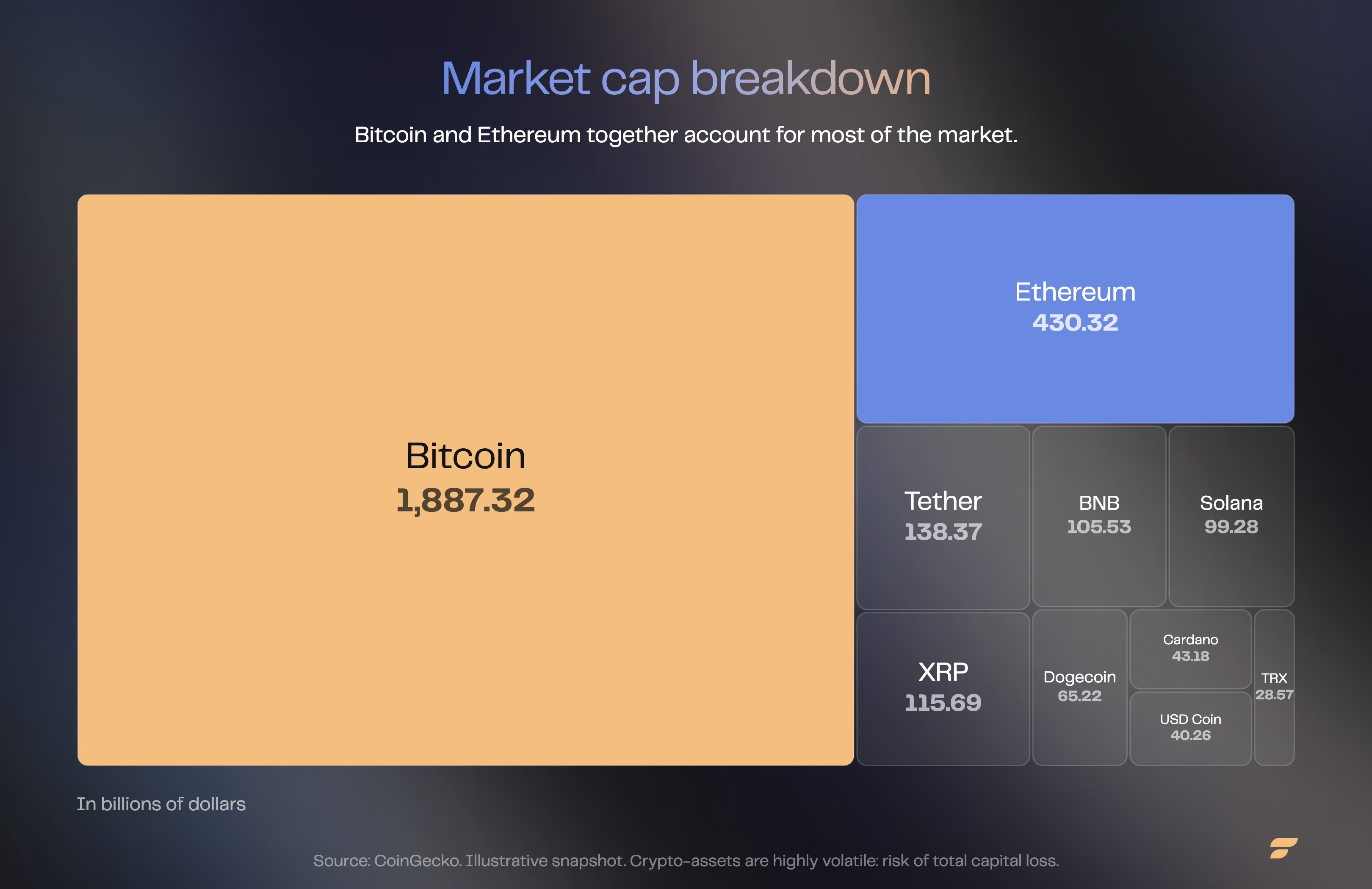
Institutional investors such as BlackRock and Fidelity now see Bitcoin as a hedge against inflation. In July 2026, its market capitalisation stands at around $1.2 trillion (source: CoinGecko), a sign of its growing importance.
What is Ethereum and how is it transforming decentralised applications?
Ethereum is a decentralised network that works like a global computer. Launched in 2015 by Vitalik Buterin, it makes it possible to build and run applications with no central server, thanks to smart contracts, autonomous programs that execute agreements automatically.
Ether (ETH), Ethereum’s native cryptocurrency, powers that ecosystem. It pays transaction fees and rewards the validators who secure the network. In 2025, more than 3,000 decentralised applications were hosted on Ethereum.
Ethereum has transformed sectors such as:
- The decentralised finance (DeFi) sector, which lets people borrow and lend without a bank intermediary.
- The rise of NFTs, which transformed the digital art market.
- DAOs, which offer new forms of governance for organisations.
Key differences in concept and purpose
Understand the fundamental differences between Bitcoin and Ethereum, their distinct goals and their diverging approaches.
Bitcoin focuses on a single function: being a decentralised digital currency. Its relative simplicity strengthens its security and its stability. Bitcoin’s code evolves slowly, favouring reliability over fast innovation.
Ethereum, by contrast, is a general-purpose platform that allows complex applications to be built through its programming language. That flexibility brings greater technical complexity and higher security risks.
Here is a summary of their fundamental differences:
| Aspect | Bitcoin | Ethereum |
|---|---|---|
| Primary purpose | Digital currency | Application platform |
| Use cases | Payments, store of value | DeFi, NFTs, Smart Contracts |
| Philosophy | Stability and security | Innovation and flexibility |
| Evolution | Conservative | Fast and adaptive |
Why do Bitcoin and Ethereum dominate the cryptocurrency market?
Bitcoin’s dominance comes from its pioneer status and its reputation for security. As the first cryptocurrency, it enjoys global recognition and growing institutional adoption. The approval of spot Bitcoin ETFs in January 2024 strengthened that position.
Ethereum dominates thanks to its application ecosystem. More than 80% of decentralised applications run on its blockchain. Its successful transition to Proof of Stake in 2022 proved it could evolve while remaining stable.
These two cryptocurrencies complement each other more than they compete. Bitcoin excels as a store of value, while Ethereum is establishing itself as the infrastructure of Web3. Together they account for more than 60% of total cryptocurrency market capitalisation in 2026.
with confidence
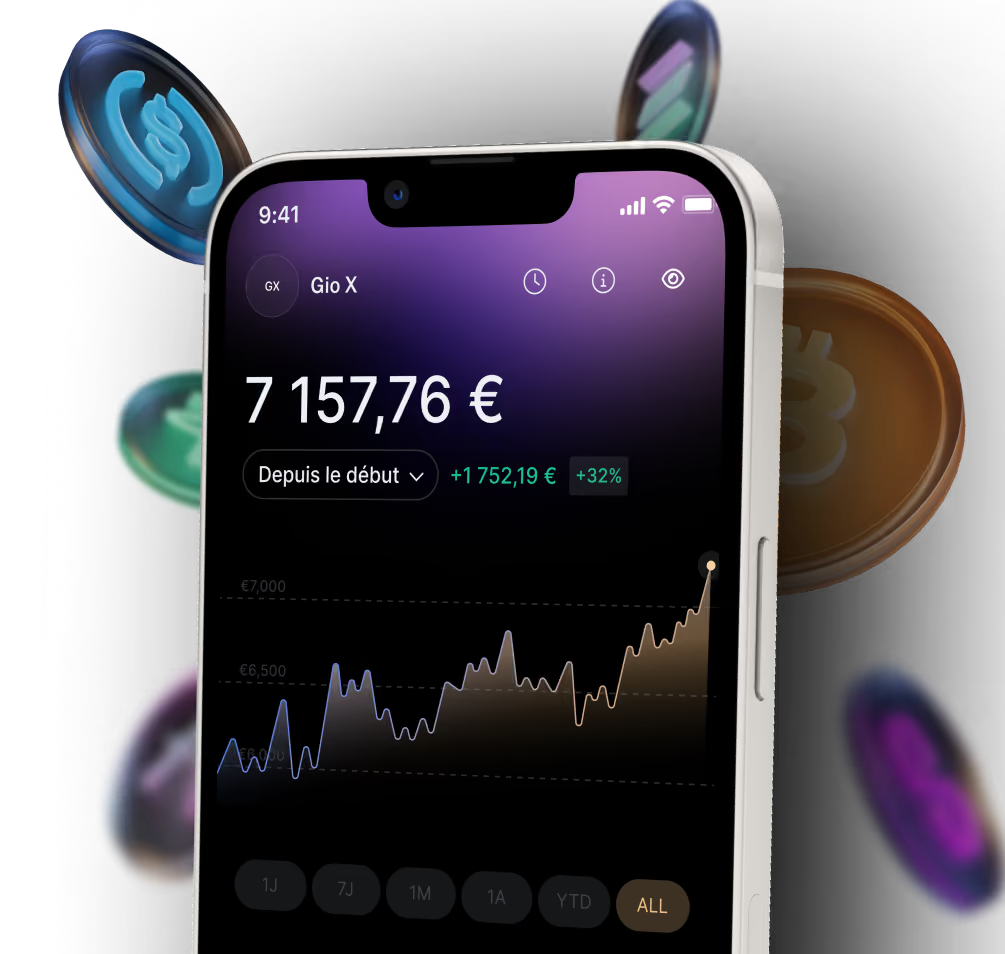
Investing carries risks, including the risk of capital loss. Crypto-assets are highly volatile: you may lose all or part of your investment. Past performance is not a reliable indicator of future performance. Finary is authorised as a crypto-asset service provider (CASP, "PSCA" in French) under the MiCA regime by the AMF.
What technologies set Bitcoin and Ethereum apart?
Bitcoin runs on Proof of Work, an energy-intensive mechanism consuming around 150 TWh a year; Ethereum moved to Proof of Stake in 2022, cutting its consumption by 99.95%.
How Bitcoin’s Proof of Work works
The Proof of Work (PoW) used by Bitcoin relies on a complex mining process. Miners compete to solve mathematical equations using their computing power. The first to find a valid solution can add a new block to the blockchain.
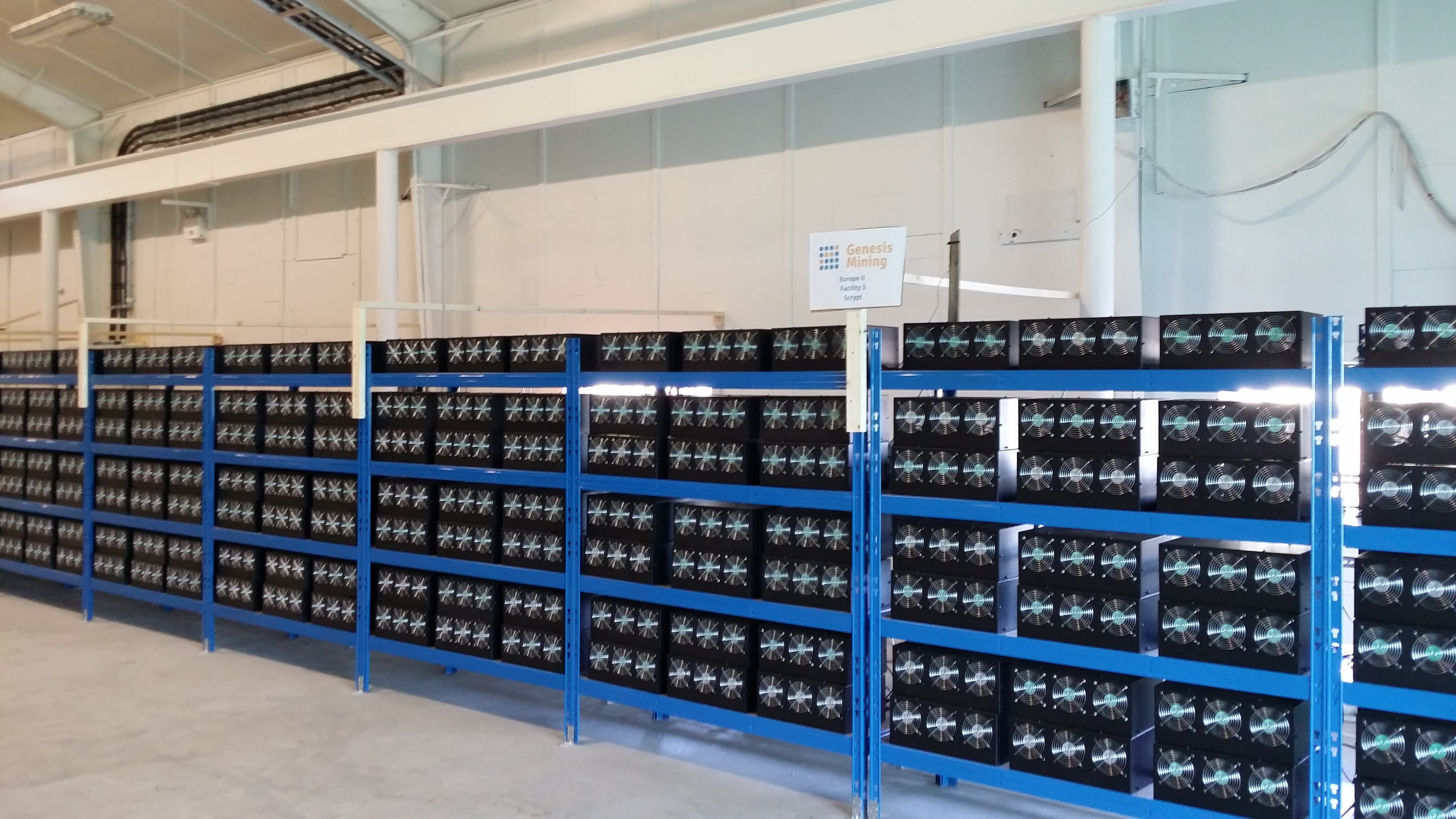
This mechanism demands substantial hardware. Miners have to invest in ASICs, specialised machines built solely to mine Bitcoin. A single modern ASIC can cost more than $10,000.
Mining difficulty adjusts automatically every 2,016 blocks. That adjustment keeps the average time between blocks at 10 minutes, whatever the network’s total computing power.
Ethereum’s transition to Proof of Stake
Ethereum’s transition to Proof of Stake (PoS), known as The Merge, completed in September 2022. Instead of solving complex calculations, validators stake 32 ETH to take part in block validation.
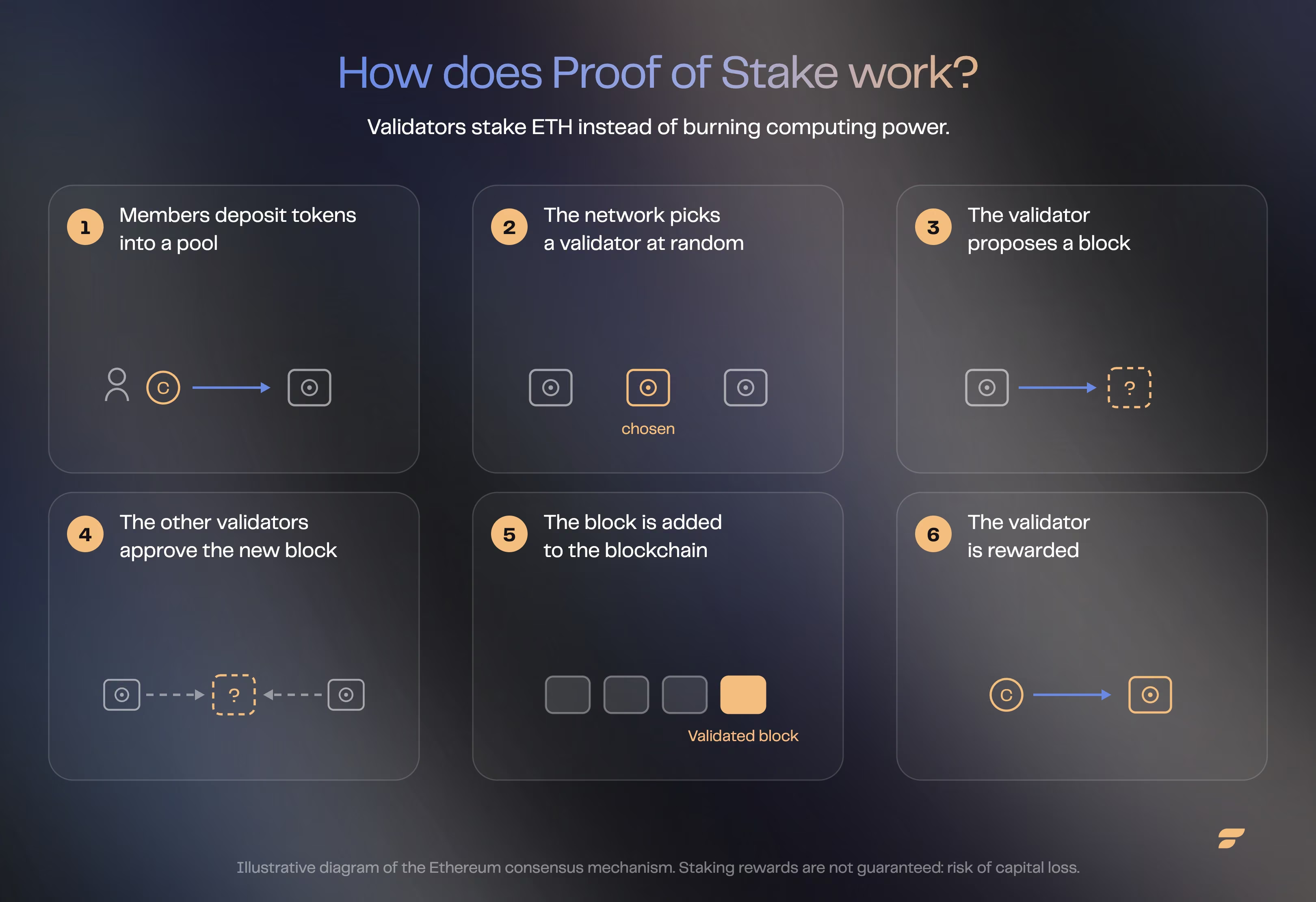
That change reshaped Ethereum’s economics. Validators earn a variable return, historically around 3% to 5% a year, with no guarantee. Past performance is not a reliable indicator of future performance. The network can also handle more transactions per second.
Security now rests on financial stakes rather than on computing power. A malicious validator risks losing the ETH it has staked if it tries to defraud the system.
Comparing the energy consumption of Bitcoin and Ethereum
Here is a comparison of the two networks’ energy footprint in 2025:
| Metric | Bitcoin | Ethereum |
|---|---|---|
| Annual consumption | 165 TWh | 0.006 TWh |
| Country equivalent | The Netherlands | A small town |
| Energy per transaction | ~1,000 kWh | 0.01 kWh |
| Renewable sources | ~50% | ~95% |
The difference in consumption comes from their distinct consensus mechanisms. Bitcoin’s PoW requires massive computing power, while Ethereum’s PoS consumes 99.95% less energy.
Transaction speed and scalability
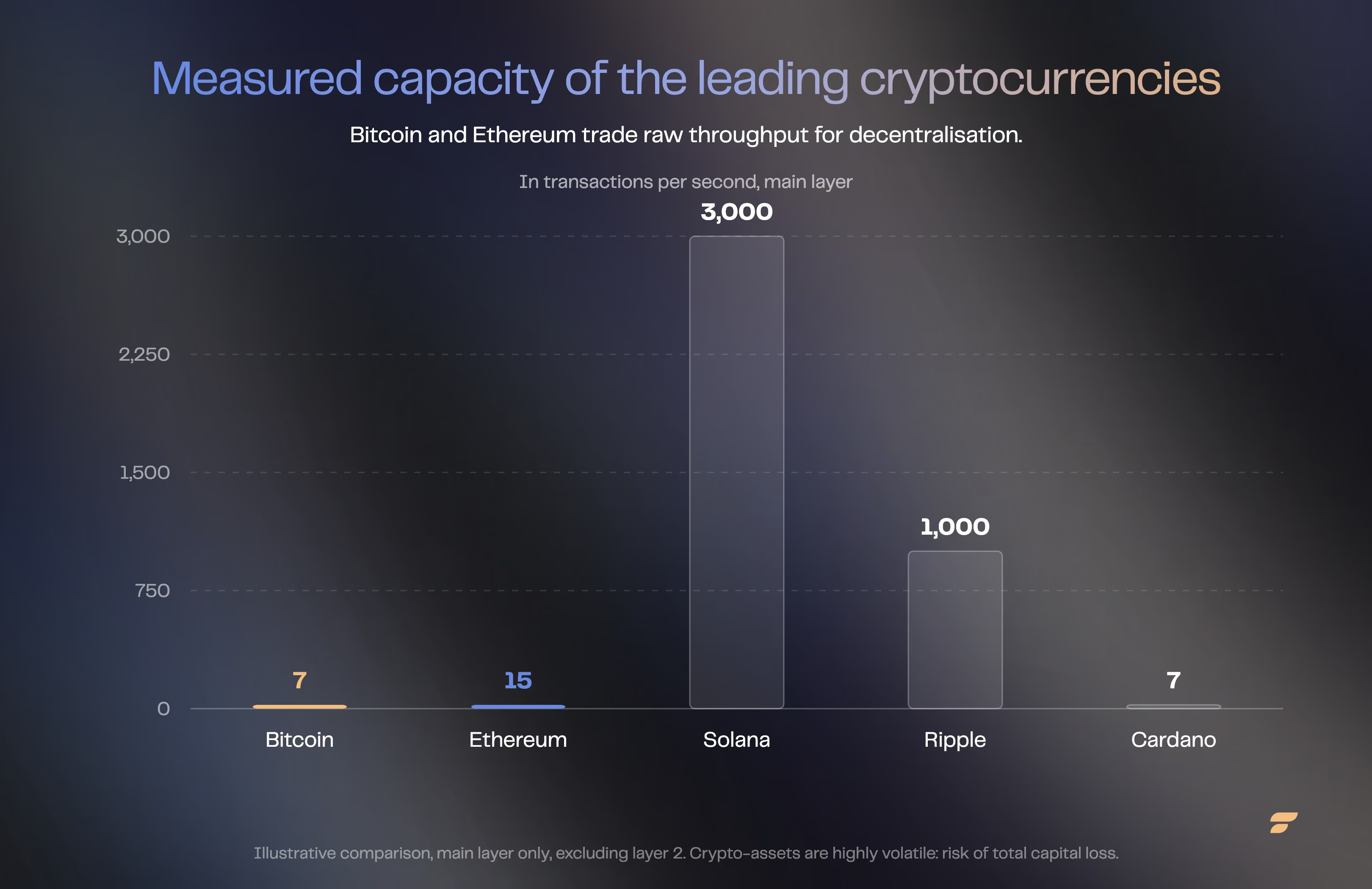
Bitcoin handles around 7 transactions per second on its main layer. Blocks are created every 10 minutes, with an average confirmation time of 30 minutes for optimal security.
Ethereum reaches 15 transactions per second on its main layer. Blocks are produced every 12 seconds, giving faster confirmations. Layer 2 solutions such as Optimism and Arbitrum enable thousands of transactions per second.
Bitcoin’s Lightning Network and Ethereum’s rollups are their main scaling solutions. These layer 2 technologies enable faster and cheaper transactions.
What are the current technological limits of Bitcoin and Ethereum?
Bitcoin faces significant scaling challenges. The limited block size (1 MB) creates congestion during periods of heavy activity. Transaction fees can then climb above $100.
Ethereum runs into liquidity fragmentation across its various layer 2 solutions. Users often have to pay high fees to move their assets between those networks.
How do the performance and investment potential of Bitcoin and Ethereum compare?
Bitcoin has a far larger market capitalisation than Ethereum, with historically lower volatility over the long run.
Market capitalisation and current price: Bitcoin vs Ethereum
Bitcoin leads the market with a capitalisation of around $1.2 trillion and a price of around $63,000 in July 2026. Ethereum ranks second, with a capitalisation of around $215 billion and a price of around $1,800 in July 2026. According to CoinDesk, Bitcoin briefly passed $64,000 in early July 2026 before settling back around $63,000, as inflation fears eased.
That gap reflects their distinct roles. Bitcoin benefits from its status as the first cryptocurrency and its reputation as digital gold. Ethereum draws its value from its usefulness as a technology platform and from the activity of its ecosystem.
Volatility and risk profile: which is the better choice for investors
The risk profile of these two cryptocurrencies is very different:
- Bitcoin: Moderate volatility, similar to that of digital gold.
- Ethereum: Higher volatility, with greater upside potential but also greater risk.
Bitcoin’s larger capitalisation can come with relatively lower volatility. Ethereum has historically shown higher volatility for higher growth potential.
Diversification: why investing in both can be a winning strategy
A mixed allocation captures the strengths of both cryptocurrencies. Bitcoin offers protection against inflation and relative stability. Ethereum gives the investor exposure to the growth of decentralised finance.
Purely for illustration and not as a recommendation, here are examples of theoretical allocations:
| Profile | Bitcoin | Ethereum | Rationale |
|---|---|---|---|
| Conservative | 70-80% | 20-30% | Prioritises stability |
| Moderate | 50-60% | 40-50% | Balances risk and return |
| Aggressive | 30-40% | 60-70% | Aims to maximise growth potential |
Correlation between Bitcoin and Ethereum: a changing relationship
Bitcoin and Ethereum long showed a strong price correlation. ETH often outperformed BTC during bull markets. But that relationship is changing.
Recent data shows a significant weakening of that correlation, especially since Ethereum’s Shanghai hard fork in 2023. The growing divergence reflects Ethereum’s own evolution: the growth of dApps and NFTs, and the move to proof of stake.
Data from February 2025 even points to minimal correlation, with a coefficient of just -0.04. Bitcoin’s 2024-2025 rally barely benefited ETH.
For investors, this gradual decorrelation opens new diversification opportunities. It also calls for a more nuanced approach to investment strategy.
What factors drive the price of Bitcoin and Ethereum?
Bitcoin is mainly driven by:
- Central bank monetary policy.
- Institutional adoption.
- General sentiment in risk asset markets.
- The halving cycles (every four years).
Ethereum is sensitive to:
- The growth of DeFi.
- Technical upgrades to the network.
- Adoption of decentralised applications.
- Activity around NFTs and other blockchain innovations.
Both cryptocurrencies are also influenced by regulation. The recent approval of spot Bitcoin ETFs shows the positive impact of a favourable regulatory environment on prices.
finally simple

Investing carries risks, including the risk of capital loss. Crypto-assets are highly volatile: you may lose all or part of your investment. Past performance is not a reliable indicator of future performance. Finary is authorised as a crypto-asset service provider (CASP, "PSCA" in French) under the MiCA regime by the AMF.
In which sectors are Bitcoin and Ethereum being adopted?
Bitcoin is gaining ground in cross-border payments and as an institutional store of value; Ethereum dominates DeFi, NFTs and blockchain gaming.
Bitcoin: a store of value and a means of payment
Bitcoin has established itself as a digital store of value, above all in countries facing high inflation. In Argentina, for instance, inflation had passed 211% in 2023, which lifted Bitcoin transaction volumes by 45% on the previous year. Argentine inflation has since fallen back to 31.5% in 2025, its lowest level in eight years, thanks to the economic reforms launched in late 2023.
Cross-border payments are another important use case. Migrant workers increasingly use Bitcoin to send money to their families.
In 2024, the average cost of an international transfer via Bitcoin was 1.2% of the amount, against 6.3% for traditional services such as Western Union. Bitcoin therefore offers a cheaper alternative for international money transfers.
Large retailers are also starting to accept Bitcoin as a means of payment. Microsoft, AT&T and Whole Foods are among the 700,000 merchants that now accept Bitcoin payments through processors such as BitPay. Merchant adoption of Bitcoin is growing.
Ethereum: a platform for dApps, DeFi and NFTs
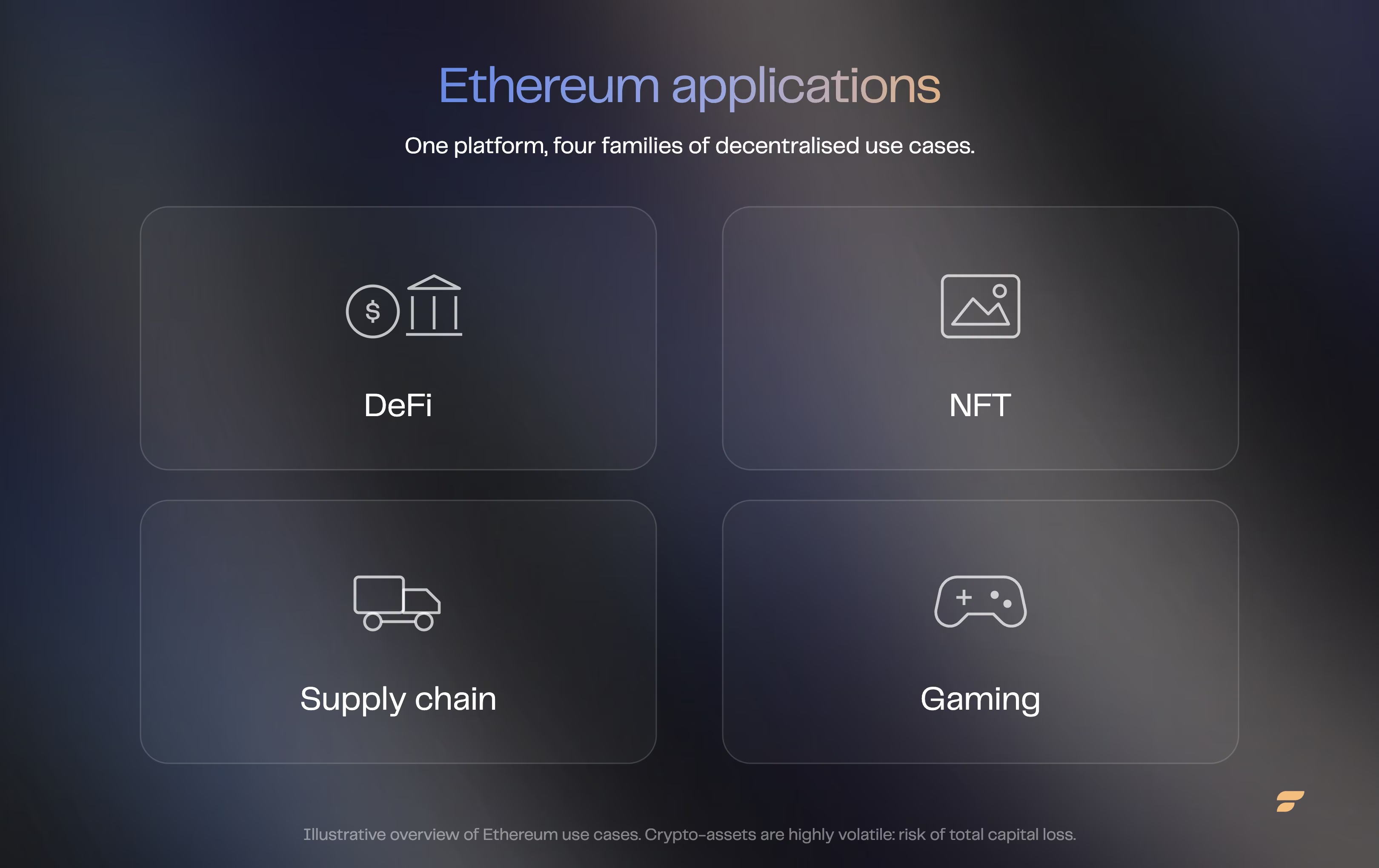
Decentralised finance (DeFi) on Ethereum has transformed traditional financial services. In early 2025, more than $48 billion was locked in Ethereum’s DeFi protocols.
Aave, the largest decentralised lending platform, had more than 3 million active users.
The NFT market on Ethereum remains volatile. OpenSea, the largest NFT marketplace, recorded more than $6 billion in trading volume (NFTs and tokens combined) in 2025 (source: Phemex).
Blockchain gaming on Ethereum has fallen sharply from its 2022 peak. Axie Infinity averaged 359,254 monthly active players in early 2026, against a peak of 2.8 million monthly players in January 2022 (source: Priori Data).
Real examples of applications built on Bitcoin and Ethereum
The Bitcoin Lightning Network enables instant, low-cost micropayments. El Salvador uses that network for its national payment system, handling more than 4 million transactions a month with average fees of $0.01.
On Ethereum, Uniswap enables decentralised cryptocurrency trading. The platform handles more than $3 billion in trading volume every day, outstripping many traditional centralised exchanges.
MakerDAO, a lending protocol on Ethereum, has issued more than $7 billion in DAI, its decentralised stablecoin. This alternative to centralised stablecoins shows that autonomous financial systems are viable.
Institutional adoption: Bitcoin leads, Ethereum gains ground
Institutional investors favour Bitcoin as their entry point into cryptocurrency. The spot ETFs launched in January 2024 attracted more than $50 billion of institutional money in two months.
Ethereum is gaining ground with technology companies. Microsoft uses the Ethereum network for its decentralised identity management platform, while JP Morgan is building settlement solutions on Ethereum.
Sectors that benefit most from using Ethereum
The video game industry is adopting Ethereum NFTs on a large scale. The global blockchain gaming market was valued at $10.2 billion in 2024, with Ethereum remaining one of the sector’s dominant blockchains at a 34.4% market share in 2023 (source: Custom Market Insights).
Supply chains benefit from Ethereum’s traceability. Walmart uses Ethereum to track its food products, cutting losses from recalls.
Real estate is tokenising assets on Ethereum. A growing number of property assets are tokenised there, potentially opening this traditionally illiquid market to small investors, although exact volumes remain hard to verify independently.
What challenges do Bitcoin and Ethereum face?
Environmental impact: can Bitcoin become more sustainable?
Bitcoin faces environmental challenges (Proof of Work, around 150 TWh a year) and scaling challenges; Ethereum has to solve liquidity fragmentation across its layer 2 solutions.
Bitcoin’s energy consumption is a major concern. Its Proof of Work mechanism requires around 150 TWh a year, the equivalent of Poland’s annual consumption.
Initiatives are emerging to make Bitcoin greener, however. Today, more than 50% of the energy used by Bitcoin comes from renewable sources. Some miners set up near hydroelectric plants or use surplus natural gas from oil wells.
More efficient mining technology could cut the carbon footprint considerably. Companies such as Blockstream and Square are working on large-scale solar mining.
Regulatory challenges for Bitcoin and Ethereum
Cryptocurrency regulation is moving fast. Regulators are focusing on several key points:
- The classification of crypto-assets (security vs commodity).
- Retail investor protection.
- Anti-money laundering.
- The environmental impact of cryptocurrencies.
The recent approval of spot Bitcoin ETFs in the United States marks a major turning point. Europe is finalising its MiCA regulation, which will set a clear framework for crypto-assets. These regulatory steps could encourage institutional adoption.
Future innovations
Ethereum’s Pectra upgrade, launched in May 2025, improved network performance. The improvements include:
- Faster transaction processing.
- Lower gas fees.
- Better energy efficiency.
- Stronger network security.
Bitcoin is evolving too, with innovations such as the Lightning Network and Taproot. These improvements aim to solve scaling problems while preserving the network’s decentralisation.
Can Bitcoin and Ethereum coexist, or are they in direct competition?
Bitcoin and Ethereum occupy distinct niches in the blockchain ecosystem. Bitcoin is a digital store of value, while Ethereum dominates the market for decentralised applications.
The data shows a positive correlation between their prices, which suggests investors treat them as complementary. Total crypto market capitalisation is rising steadily, which benefits both assets.
Recent technical developments reinforce that complementarity. Cross-chain bridges make it possible to use Bitcoin on the Ethereum network, creating new synergies.
What opportunities are there for investors in a constantly changing market?
The cryptocurrency market offers a range of investment opportunities for different risk profiles. Here are some promising trends:
- Growing adoption of crypto ETFs by institutional investors.
- The growth of the DeFi market on Ethereum, with new financial products.
- The emergence of staking solutions to generate passive income.
- The gradual integration of cryptocurrencies into traditional portfolios.
at your own pace

Investing carries risks, including the risk of capital loss. Crypto-assets are highly volatile: you may lose all or part of your investment. Past performance is not a reliable indicator of future performance. Finary is authorised as a crypto-asset service provider (CASP, "PSCA" in French) under the MiCA regime by the AMF.
How do you actually invest in Bitcoin or Ethereum?
Buying Bitcoin or Ethereum goes through exchange platforms (Finary, Binance, Coinbase); secure storage means a hardware wallet such as Ledger or Trezor.
How to buy and store Bitcoin and Ethereum safely
Buying cryptocurrency means following a few essential steps to secure your investments. Centralised exchange platforms such as Finary, Binance or Coinbase are the simplest way to acquire Bitcoin and Ethereum.
These platforms allow euro deposits by bank transfer or card, which makes cryptocurrency easy to access.
Securing your cryptocurrency starts with choosing the right wallet. Hardware wallets such as Ledger or Trezor offer the highest level of security.
These physical devices store your private keys offline, protecting your assets from hackers. It is the most recommended method for securing large amounts.
For small amounts, a software wallet such as MetaMask (for Ethereum) or Blue Wallet (for Bitcoin) may be enough. These free options strike a reasonable balance between security and ease of use. It is crucial, however, to understand the risks attached to these wallets before using them.
The golden rule is to never share your recovery phrases or private keys. That information gives full access to your funds, and keeping it safe is absolutely critical. Treat it like your bank password: never disclose it.
Common mistakes to avoid when investing in cryptocurrency
New investors often make mistakes that can prove costly. Emotional investing is one of the most common traps.
Buying out of fear of missing out (FOMO) or selling in panic usually leads to losses. It is essential to keep a cool head and make decisions based on rational analysis.
A lack of diversification creates needless risk. Even within cryptocurrency, spreading across several assets can help moderate a portfolio’s volatility. Do not put all your eggs in one basket.
The absence of a clear strategy is another major mistake. Setting precise investment goals and a time horizon will help you stay the course through volatile periods. Ask yourself why you are investing and how long you are prepared to wait before seeing results.
Resources for following crypto market news and trends
Reliable sources of information play a crucial role in decision-making. To stay informed, here are a few essential resources:
- Specialist sites: CoinDesk, Cointelegraph and The Block provide in-depth coverage of the sector. These sites are excellent for following the latest market news and analysis.
- Analysis tools: Glassnode and CryptoQuant offer detailed on-chain data. These tools analyse data straight from the blockchain, giving a unique perspective on network activity.
- Social media: Finary’s YouTube channels, or Hasheur. Be careful, though, and do your own research before making decisions based on these sources.
The quality of your sources directly affects the quality of your investment decisions. It is worth cross-checking several sources for a balanced view of the market. Do not rely on a single source of information, and always stay critical of what you read.
How do you judge the right time to invest in Bitcoin or Ethereum?
Analysing market cycles can help you spot investment opportunities. Bitcoin, for instance, runs in 4-year cycles set by its halvings. These events, which halve the reward paid to miners, have historically influenced prices.
The DCA (Dollar Cost Averaging) method is an effective way to reduce the impact of volatility. The approach means investing small amounts regularly, whatever the market price. It smooths the purchase price and reduces the risk tied to volatility.
Finary (a CASP authorised by the AMF under MiCA, no. A2026-026/N2026-008) offers DCA templates for information purposes. These ready-made models let you follow proven approaches designed by professionals, without building your strategy from scratch.
Comparing investment strategies:
- DCA:
- Advantages: reduces emotional impact, simplicity.
- Drawbacks: can miss the best entry points.
- Active trading:
- Advantages: higher potential gains.
- Drawbacks: time-consuming, risky for beginners.
- Buy & Hold:
- Advantages: simple, effective over the long run.
- Drawbacks: requires strong conviction and patience.
Investing in cryptocurrency demands a methodical, disciplined approach. Combining a clear strategy, the right security tools and regular monitoring significantly improves your chances of success. Remember that investing in cryptocurrency carries risks, and that you should never invest more than you can afford to lose.
Our verdict: Bitcoin and Ethereum, a choice that depends on your strategy
Bitcoin and Ethereum are complementary: Bitcoin as a digital store of value, Ethereum as the infrastructure for decentralised applications. The choice depends on your profile, your horizon and your tolerance for the risk of capital loss.
Every investment decision depends on personal circumstances. This article does not constitute personalised advice. Each investor can choose between Bitcoin’s stability and Ethereum’s innovation potential, according to their profile and their goals.
Another option is a diversification strategy, which draws on the distinct strengths of these two technologies.
Frequently asked questions
Can you invest in both Bitcoin and Ethereum?
Yes. Bitcoin and Ethereum occupy complementary niches: Bitcoin as a store of value, Ethereum as the infrastructure for decentralised applications. A mixed allocation (for example 60% BTC / 40% ETH) is often considered as a way to diversify within cryptocurrency, with no guarantee of performance.
What is the difference between Bitcoin’s Proof of Work and Ethereum’s Proof of Stake?
Proof of Work (Bitcoin) requires massive computing power to validate transactions, consuming around 150 TWh a year. Proof of Stake (Ethereum, since 2022) selects validators according to their ETH deposits, cutting energy consumption by 99.95%.
Are Bitcoin and Ethereum available to retail investors in France?
Yes. Finary (a CASP authorised by the AMF under MiCA, no. A2026-026/N2026-008) lets you buy and sell more than 25 cryptocurrencies, including Bitcoin and Ethereum. Investing carries a risk of total capital loss; crypto-assets are not covered by any capital guarantee or deposit protection scheme.
What risks are specific to Bitcoin and Ethereum?
Both show high volatility and a risk of total capital loss. Bitcoin is sensitive to halving cycles and regulatory decisions. Ethereum is exposed to technical risks (flaws in smart contracts) and to competition from other programmable blockchains.
Sources
Bitcoin (BTC): price and market cap, CoinGecko
Ethereum (ETH): price and market cap, CoinGecko
Bitcoin retakes $63,000, CoinDesk, July 2026
Walmart: Ethereum case study, LF Decentralized Trust
Argentina's inflation in 2025 fell to 31.5%, Buenos Aires Herald
OpenSea Hits $6 Billion in 2025 Trading Volume, Phemex
Axie Infinity Player Statistics, Priori Data
Blockchain Gaming Market Report, Custom Market Insights
Bitcoin halving: Finary definition
Proof of Stake: Finary definition
Decentralised finance (DeFi): Finary definition
Regulatory disclaimers: Marketing communication. Investing carries a risk of partial or total capital loss. Past performance is not a reliable indicator of future performance. This article is provided for information and educational purposes only; it does not constitute personalised investment advice, a buy or sell recommendation, or tax advice. Crypto-assets are highly volatile and carry a risk of total capital loss. They are not covered by any capital guarantee, deposit guarantee scheme or investor compensation scheme. Before investing, read the Key Information Document (KID) and, where relevant, consult an authorised adviser. Finary SAS, an investment firm authorised by the ACPR (no. 19283), member of AMAFI. Insurance broker registered with ORIAS (no. 21001279), member of the CNCGP (association approved by the AMF). Crypto-Asset Service Provider (CASP) authorised by the AMF under the MiCA regime, references no. A2026-026 and no. N2026-008.