


Closing a life insurance policy in France: complete guide

Updated on 5 August 2026
Closing a life insurance policy in France, or making a full withdrawal, ends the policy and pays the whole of the savings to the policyholder, but forfeits the tax seniority and cancels the beneficiary clause. This article sets out the procedure, the taxation that applies and the alternatives to a full closure.

- A full withdrawal can be requested at any time, but the insurer has a legal maximum of two months to pay out the funds.
- After 8 years, gains benefit from an annual tax allowance of €4,600 for a single person and €9,200 for a couple, on income tax only.
- A partial withdrawal, or keeping a minimum balance in the policy, preserves the tax seniority instead of closing the policy outright.
- During the first 30 days after taking out the policy, the right of cancellation allows the money paid in to be recovered with no fees and no reason given.
- Moving the money to a PER (France's retirement savings plan) is still possible after a closure, but without the doubled tax allowance, withdrawn in January 2023.
Before considering closure, it is worth weighing the benefits of life insurance to judge whether this really is the option best suited to your situation.
What is the closure of a life insurance policy?
Closing a life insurance policy means requesting a full withdrawal in order to recover all of the savings built up, capital and interest included, which ends the policy for good.
What a full withdrawal is
Closing a life insurance policy, also called a full withdrawal, is an operation that ends your policy. You recover all of your savings, including the interest accumulated.
Closure versus cancellation
Closure and cancellation are two distinct operations:
- Cancellation takes place within 30 days of signing the policy. You recover your initial payment with no fees and no penalties.
- Closure can happen at any time. You recover your initial payment and the gains accumulated, but fees and taxation may apply.
Consequences of closing a policy
Closing a life insurance policy has several implications:
- Loss of the policy's tax seniority.
- Tax on the gains at the time of withdrawal, more favourable after 8 years thanks to the annual tax allowance (€4,600 for a single person) and the reduced rate of 7.5%.
- Any exit penalties provided for in the policy.
Before you decide, read your policy terms carefully, in particular those covering life insurance fees.
Impact on the named beneficiaries
Closure cancels the beneficiary clause of your policy. The people named to receive the capital on death will be entitled to nothing. That is a crucial point if you were using your life insurance as a wealth transfer tool.
If transferring wealth remains your objective, consider other options such as a new life insurance policy or other estate planning tools. A new policy can be taken out online with Finary, for example.

More capital invested

Non-contractual document for promotional purposes. Investment in unit-linked funds carries a risk of capital loss, since their value is subject to fluctuation, both upwards and downwards, depending in particular on developments in the financial markets. The insurer guarantees the number of unit-linked funds held, not their value, which it does not guarantee. The e-vie life insurance policy is an individual life insurance policy, denominated in euros and/or unit-linked funds, underwritten by Generali Vie, a company governed by the French Insurance Code. Finary SAS - 58 rue de Monceau 75380 Paris 8 - ORIAS no. 21001279
How do you close a life insurance policy?
To close a life insurance policy, send the insurer a full withdrawal request by registered letter, together with the supporting documents; the insurer then has a legal deadline of two months to pay out the funds.
Sending a registered full withdrawal request
To close your life insurance policy, send your insurer a registered letter with acknowledgement of receipt. That official route guarantees your request is received and traceable.
In your letter, state clearly that you wish to close the policy and request the full withdrawal of the funds. Be precise and unambiguous.
The insurer has a legal deadline of two months at most to process your request and pay out the funds. Beyond that deadline, late payment interest applies.
Documents to supply
Enclose the following documents with your letter:
- The original or a copy of your life insurance policy
- A copy of both sides of your valid identity document
- A RIB (French bank account details slip) for the payment of the capital
Make sure you supply all of these documents to avoid any delay in processing your request.
Sample letter
Here is a template letter to adapt to your own situation:
[Your name and address]
[Name and address of the insurer]
[Place], [Date]
Subject: request for the full withdrawal of life insurance policy no. [Your policy number]
Dear Sir or Madam,
I, the undersigned [Your name], holder of life insurance policy no. [Your policy number] taken out with your company on [Subscription date], hereby request the full withdrawal of that policy.
Please transfer the corresponding amount to my bank account, whose details are enclosed.
Also enclosed are the documents required for this operation:
- The original of my life insurance policy
- A copy of both sides of my identity document
- A RIB (French bank account details slip)
I would remind you that, under article L. 132-21 of the French Insurance Code, you have a maximum of two months from receipt of all the documents required to process my request.
Yours faithfully.
[Your signature]
Following these steps carefully makes closing your life insurance policy easier. Bear in mind that processing can take up to two months. A well-worded request and a complete set of documents will speed the process up.
What taxation applies when a life insurance policy is closed?
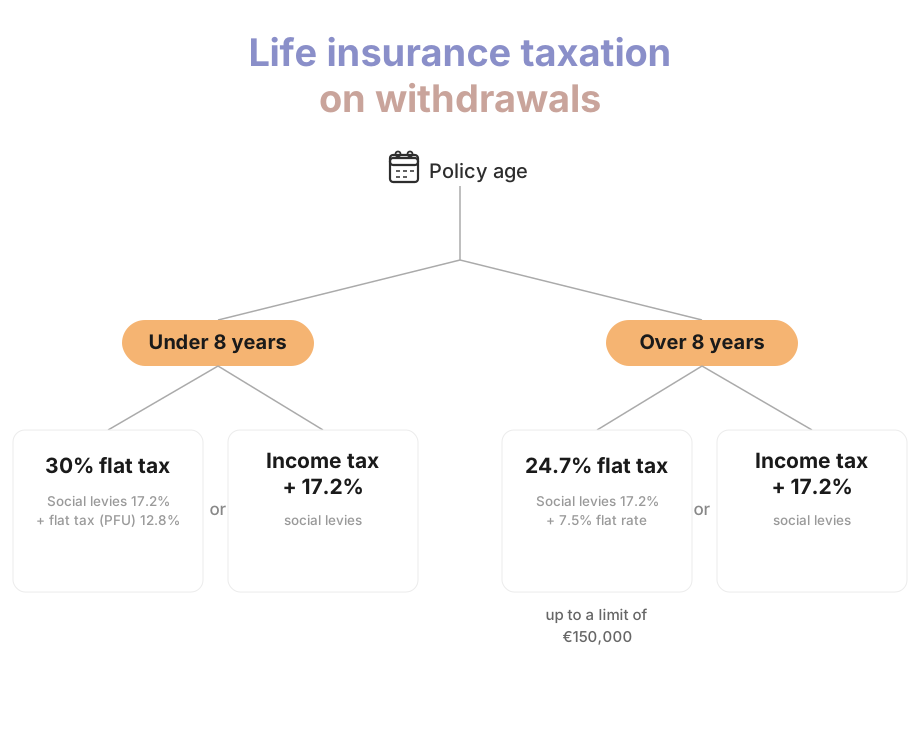
The taxation of a withdrawal depends on how long the policy has run and on when the contributions were made: the older the policy, the lower the tax on the gains, thanks to an annual tax allowance that applies after 8 years.
Taxation by how long the policy has been held
Life insurance taxation varies with the age of the policy. Here are the main rules:
The special case of policies older than 8 years
Policies older than 8 years enjoy tax advantages:
- An annual tax allowance of €4,600 for a single person (€9,200 for a couple) on the gains
- The allowance only exempts the income tax component, the flat tax (PFU) at 7.5%: social levies of 17.2% remain due on the whole of the gains, including the part covered by the allowance.
Example: on a 10-year-old policy with €20,000 of gains, a single person would pay €1,155 of income tax instead of €1,500 without the allowance.
Social levies
Social levies come to 17.2% and apply to all gains:
- For euro funds: collected annually
- For unit-linked funds: due at the time of the withdrawal or the closure
Working out the taxable gain
The formula is: Gain = withdrawal amount - (contributions paid in x withdrawal amount / total policy value)
Example: for a policy worth €100,000 with €80,000 of contributions, the gain would be €20,000.
The taxation of life insurance is complex, but understanding these mechanisms will help you anticipate the tax impact of your decision to close. Do not forget to factor in the life insurance tax allowance, which can cut your tax bill considerably, especially on older policies.
When should you close your life insurance policy?
The right moment to close depends above all on the age of the policy and on the goal pursued: during the 30-day cancellation period, to switch to a better policy, or when cash is urgently needed.

During the cancellation period (30 days)
The cancellation period gives you 30 days after signing the policy to cancel with no fees and no reason given. To exercise that right:
- Send your insurer a registered letter with acknowledgement of receipt.
- The insurer must refund you in full within 30 days.
This option is open if you want to undo the subscription, or if you find a better policy within that window.
To take up a better policy
Closing in order to move to another policy is worth considering when the new one offers:
- Lower management fees
- A wider choice of investment options
The pros and cons have to be weighed against your own situation. Losing the tax seniority of an old policy can be significant.
If you are considering this option, look at the possibility of a life insurance transfer rather than a closure, which could let you keep some of the advantages.
within your reach
Non-contractual document for promotional purposes. Investment in unit-linked funds carries a risk of capital loss, since their value is subject to fluctuation, both upwards and downwards, depending in particular on developments in the financial markets. The insurer guarantees the number of unit-linked funds held, not their value, which it does not guarantee. The e-vie life insurance policy is an individual life insurance policy, denominated in euros and/or unit-linked funds, underwritten by Generali Vie, a company governed by the French Insurance Code. Finary SAS - 58 rue de Monceau 75380 Paris 8 - Investment Firm authorised by the ACPR under no. 19283, ORIAS no. 21001279, member of AMAFI
When cash is urgently needed
Faced with a large unexpected expense, closure can give quick access to the funds. Before closing, however:
- Work out exactly how much you need
- Consider a partial withdrawal, to keep part of the savings and the policy's seniority
Pros and cons of closing at different times
For contributions made after 27/09/2017 (most current policies):
- Less than 8 years:
- Advantage: quick access to the funds
- Drawback: standard taxation, 30% (flat tax 12.8% + social levies 17.2%)
- More than 8 years:
- Advantage: reduced taxation, 24.7% (flat tax 7.5% + social levies 17.2%) up to €150,000 of net contributions (12.8% above that), with a tax allowance of €4,600 (single person) / €9,200 (couple)
- Drawback: permanent loss of the tax seniority
For contributions made before 27/09/2017 (older policies):
- Before 4 years: 35% PFL (the flat-rate withholding levy) + social levies 17.2%
- Between 4 and 8 years: 15% PFL + social levies 17.2%
- After 8 years: 7.5% + social levies 17.2%, with the allowance
You will find every detail on the official French tax authority page on life insurance taxation.
Example: on a policy worth €50,000 with €10,000 of gains, income tax would come to €1,280 before 8 years, against €405 or less after 8 years.
The ideal moment to close depends on your personal circumstances, your cash needs and your long-term goals. Take the time to think, and speak to an authorised financial adviser before any decision.
Alternatives to a full closure
Partial withdrawals
Partial withdrawals let you take out part of your savings without closing the policy. Advantages:
- Access to cash while keeping the policy
- Flexibility: one-off or scheduled withdrawals
- The policy's tax seniority is preserved
Taxation: identical to a full closure, but applied in proportion to the amount withdrawn.
Moving the money to a PER, France's retirement savings plan
There is no direct transfer between a life insurance policy and a PER. Moving savings from one wrapper to the other takes two steps:
- Make a withdrawal, full or partial, from the life insurance policy.
- Pay the money recovered into the PER.
Until 31 December 2022, the French loi PACTE had put in place a tax incentive to encourage such moves: provided the policy was more than 8 years old and the saver was more than 5 years from the statutory retirement age, the tax allowance on the gains withdrawn was doubled (€9,200 for a single person, €18,400 for a couple). That scheme ended on 1 January 2023 and was not renewed.
Today the operation is still possible, but with no specific tax bonus.
It can still make sense in wealth terms: sums paid into a PER are deductible from your taxable income, up to the retirement savings ceiling.
For a taxpayer in the 30% marginal bracket, a €10,000 contribution translates into a €3,000 tax saving in the year it is paid; in exchange, the sums paid in will be taxed on the way out of the PER.

Whether such a move is worthwhile therefore depends heavily on your current tax position and your retirement horizon. PER taxation differs from life insurance taxation: contributions deducted on the way in are taxed on the way out.
Keeping a token amount in the policy to hold on to the tax seniority
Another option is to leave a residual amount in the policy so as to keep its tax seniority.
Advantages:
- The tax seniority is preserved
- The option to reinvest later while still benefiting from the policy's age
This option mainly concerns policies older than 8 years.
Before choosing an alternative, assess your current and future financial needs carefully. Each option has its advantages and its drawbacks. A partial withdrawal offers flexibility, moving the money to a PER can bring immediate tax advantages, while keeping a token amount in the policy leaves your options open for the future.
Comparing the options on flexibility and taxation
Each alternative to a full closure has its own advantages and drawbacks:
- Full closure
- Flexibility: access to the funds within a maximum of 2 months
- Taxation: tax on all the gains, loss of the tax seniority
- Partial withdrawals
- Flexibility: withdrawals on demand, policy kept
- Taxation: tax in proportion to the withdrawals, seniority preserved
- Moving the money to a PER
- Flexibility: limited, funds locked until retirement (bar exceptions)
- Taxation: immediate tax advantage, but tax on the way out
- Keeping a token amount in the policy
- Flexibility: most of the funds recovered, policy still active
- Taxation: preserves the tax seniority for future contributions
Worked example: a policy worth €100,000 (10 years old, €20,000 of gains)
- Full closure: tax on €20,000
- Partial withdrawals: €20,000 a year over 5 years, with the life insurance tax allowance (€4,600, or €9,200 for a couple) each year
- Move to a PER: immediate tax advantage, funds locked
- Keeping €1,000 in the policy: allows a later reinvestment with 10 years of seniority
The most suitable choice depends on your cash needs, your tax position and your long-term goals.
Points to consider before closing a life insurance policy
Possible exit fees
Some policies, above all the older ones, may carry exit fees:
- They vary from policy to policy (tapering, or flat)
- Example: 3% for the first 5 years, 1% until the 10th year, 0% after that
Impact on your overall wealth strategy
Closing a life insurance policy can affect your whole financial and wealth strategy. Consider:
- The balance of your investment portfolio
- Your short, medium and long-term financial goals
- The tax implications across your whole wealth
Before deciding, assess carefully how the closure fits into your overall wealth strategy.
Use our life insurance simulator to model the impact of a withdrawal on your savings and compare the scenarios before you decide.
Consequences for your estate
Closing a life insurance policy can significantly affect your estate planning:
- Loss of a favoured wealth transfer tool:
- Life insurance allows capital to pass outside the estate, within certain legal limits.
- Closure forfeits that significant tax advantage.
- Impact on inheritance taxation:
- Example: for a couple with two children as beneficiaries, up to €152,500 per beneficiary can pass free of inheritance tax on premiums paid in before the age of 70, so €305,000 in total for the two children.
- On closure, those funds rejoin the general estate and fall under the standard inheritance rules, which are potentially less favourable.
- Loss of flexibility in naming beneficiaries:
- Life insurance allows beneficiaries to be named freely, including outside the legal heirs.
- Closure removes that flexibility in passing on wealth.
Closing a life insurance policy is therefore never a trivial act: it commits the taxation, the wealth transfer and the future flexibility of the savings all at once.
On an older policy that already enjoys tax advantages, a partial withdrawal or keeping a minimum balance often remains more advantageous than a full closure.

Frequently asked questions
How long does it take to close a life insurance policy?
The insurer has a legal maximum of two months from receipt of the complete file (registered letter, identity document, bank details) to pay out the funds, under article L. 132-21 of the French Insurance Code. Beyond that deadline, late payment interest applies automatically.
Can a full withdrawal request be cancelled once it has been sent?
Once the insurer has processed a full withdrawal request, it is in principle irrevocable, since the policy is closed and the funds paid out. Before the withdrawal is actually carried out, you can contact the insurer to try to cancel the request, with no guarantee it will be accepted.
Does closing a life insurance policy have to be declared to the tax authorities?
Yes: the gains from a full withdrawal are subject to the flat tax (PFU) of 12.8% (or 7.5% after 8 years, with the allowance) and to social levies of 17.2%, deducted directly by the insurer before the funds are paid to the policyholder.
Can a life insurance policy be reopened after it has been closed?
No: a policy closed by a full withdrawal disappears for good and cannot be reactivated. To keep saving through this wrapper, you have to take out a new policy, which starts again with zero tax seniority.
Is a partial withdrawal a better option than a full closure?
A partial withdrawal takes out part of the savings while keeping the policy active and keeping its tax seniority, unlike a full closure, which ends both for good. It is generally preferable once the policy is more than 8 years old.
What happens to the beneficiary clause on closure?
Closing the policy automatically cancels the beneficiary clause: the people named receive nothing on death, since the policy no longer exists. To keep that inheritance advantage, a partial withdrawal is preferable to a full closure.
Sources
Impots.gouv.fr, life insurance and the PEA: flat tax rate, tax allowances and social levies
Légifrance, article L132-21 of the French Insurance Code: deadline for paying the surrender value
Légifrance, article L132-5-1 of the French Insurance Code: the 30-day cancellation period
Regulatory disclaimers: Marketing communication. Investing carries a risk of partial or total capital loss. Past performance is not a reliable indicator of future performance. This article is provided for information and educational purposes only; it does not constitute personalised investment advice, a buy or sell recommendation, or tax advice. The capital guarantee on euro funds is provided by the insurer and depends on its financial strength. In a severe systemic crisis, the French "Sapin 2" law allows withdrawals to be temporarily restricted (liquidity), without affecting the guaranteed capital. Unit-linked funds are not guaranteed and carry a risk of capital loss. Before investing, read the Key Information Document (KID) and, where relevant, consult an authorised adviser. Finary SAS, an investment firm authorised by the ACPR under no. 19283, member of AMAFI. Insurance broker registered with ORIAS under no. 21001279, member of the CNCGP (association approved by the AMF). Crypto-Asset Service Provider (CASP) authorised by the AMF under the MiCA regime, references no. A2026-026 and no. N2026-008.


