Life Insurance in France: 5 Mistakes to Avoid

Updated on 28 July 2026
Life insurance is French savers' favourite investment wrapper. Yet many people do not know what their policy actually holds, or what returns to expect from it.
The result: mistakes that cost dearly over the long run. Here are the 5 most common mistakes in life insurance, and how to avoid them.
One clarification upfront: life insurance is not the perfect wrapper for everyone. The goal here is not to convince you to open one, but to help you understand both its advantages and its limits, so you avoid mistakes that cost thousands of euros.

- Putting everything into euro funds turns life insurance into a second Livret A: 2.10% per year on average over the last 13 years.
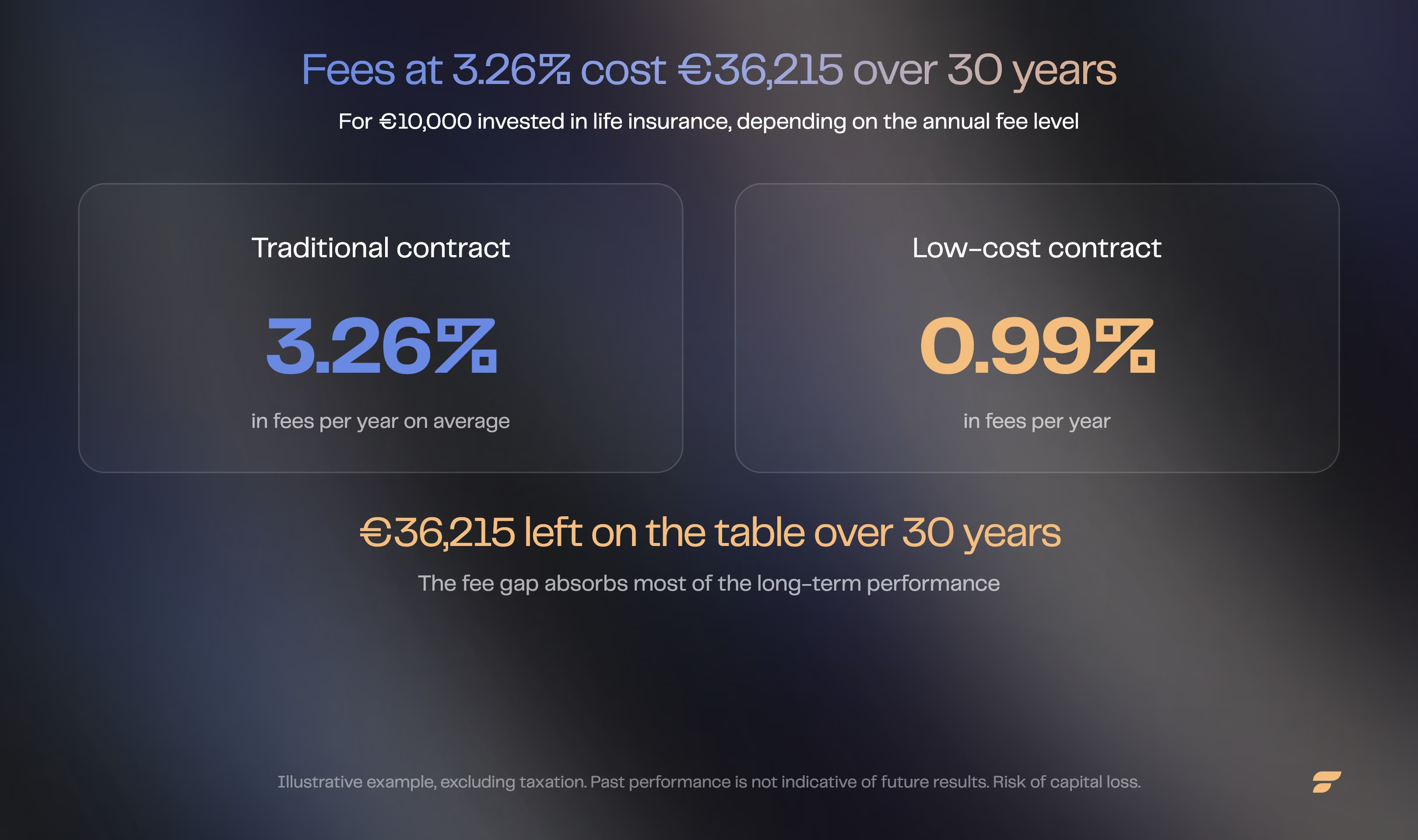
- The average fees on traditional policies (3.26% per year) cost €36,215 on €10,000 invested over 30 years, compared with a policy charging 0.99%.
- Opening a policy early, even with a small amount, starts the tax clock: the €4,600 or €9,200 allowances kick in from the 8th year.
- Money held in a life insurance policy stays available at any time; a withdrawal before 8 years simply forfeits the tax benefit.
- Contributions made before age 70 are passed on with a €152,500 allowance per beneficiary, taxed at 20% beyond that.
Why is life insurance so often misused?
Because most of that savings sits dormant in the most cautious option available: according to France Assureurs, 72% of life insurance assets are held in euro funds.
A life insurance policy nonetheless offers two types of investment options. The euro fund, a "secured" option with capital guarantee, with a ratchet effect: gains earned each year are permanently locked in.
And unit-linked funds: equities, ETFs, bonds, real estate. To revisit the basics of the wrapper, our guide how life insurance works covers each one in detail.
More capital invested
Non-contractual document for promotional purposes. Investment in unit-linked vehicles carries a risk of capital loss, since their value is subject to fluctuation, both upwards and downwards, depending in particular on developments in the financial markets. The insurer guarantees the number of unit-linked units, not their value, which it does not guarantee. The e-vie life insurance policy is an individual life insurance policy, denominated in euros and/or unit-linked vehicles, underwritten by Generali Vie, a company governed by the French Insurance Code. Finary SAS - 58 rue de Monceau 75380 Paris 8 - Investment Firm authorised by the ACPR under no. 19283, ORIAS no. 21001279, member of AMAFI
Mistake #1: should you put everything into euro funds?
No, not unless you are happy with a savings-account return. Over the last 13 years, euro funds returned 2.10% per year on average. That performance does not yet account for social security contributions or income tax. Past performance is not a reliable indicator of future performance.
By comparison, the Livret A returned 1.20% net per year over the same period. Using life insurance only for euro funds therefore turns this powerful wrapper into a second Livret A.
In the wealth reviews Finary carries out, this mistake comes up constantly: being too cautious out of a lack of knowledge. Life insurance is not meant to replace your Livret A or your LDDS (the French sustainable development savings account).
It is meant to give you access to the financial markets with a tax boost. That is the role of unit-linked funds: historically, they can target 5% to 10% per year over the long term, provided you accept volatility and a risk of capital loss. Here too, past performance is not a reliable indicator of future performance.
The trend is starting to shift. The share of unit-linked funds in new contributions has more than doubled in ten years:
| New contributions | 2013 | 2023 |
|---|---|---|
| Unit-linked funds | 16.8% | 41% |
| Euro funds | 83.2% | 59% |
Source: France Assureurs.
That is good news, but there is still a way to go. In short: stop using life insurance as a glorified Livret A.
Mistake #2: how much do fees really cost you?
Most life insurance policies are riddled with fees.
Contribution fees reach 3% on average among traditional providers, and can legally run as high as 5%. In practical terms, you pay in €100 and up to €5 is deducted straight away.
On top of that come management fees: 0.75% per year on the euro fund, 0.9% on unit-linked funds. Paying fees would not be a problem if performance kept pace. Yet according to the SPIVA study, the international benchmark on active versus passive management, 90% of managers underperform the market.
In total, fees on traditional policies average 3.26% per year. That may not sound like much, but the cumulative effect is massive.
That is not all. Each unit-linked fund carries its own fees: between 1.5% and 3% per year depending on the option. Banks have every incentive to fill them with their own in-house funds, on which they collect commissions.
It is easy to miss: brochures only ever show performance net of fees. Add switching fees, and count another 0.2% to 0.5% on top.
Be wary of providers who only disclose part of their fees. Some advertise "0.8% in fees" while leaving out the fees on the underlying funds. Demand full transparency.
If you already hold policies with opaque providers, the Finary app's fee scanner draws on the first open-access database compiling life insurance fees. Enter your policy's details, and Finary automatically tells you if you are paying too much.

How to reduce the fees on your life insurance policy
By choosing a modern, transparent online policy, and self-directed or profiled management rather than costly active management. This one choice alone saves considerable sums over the long term.
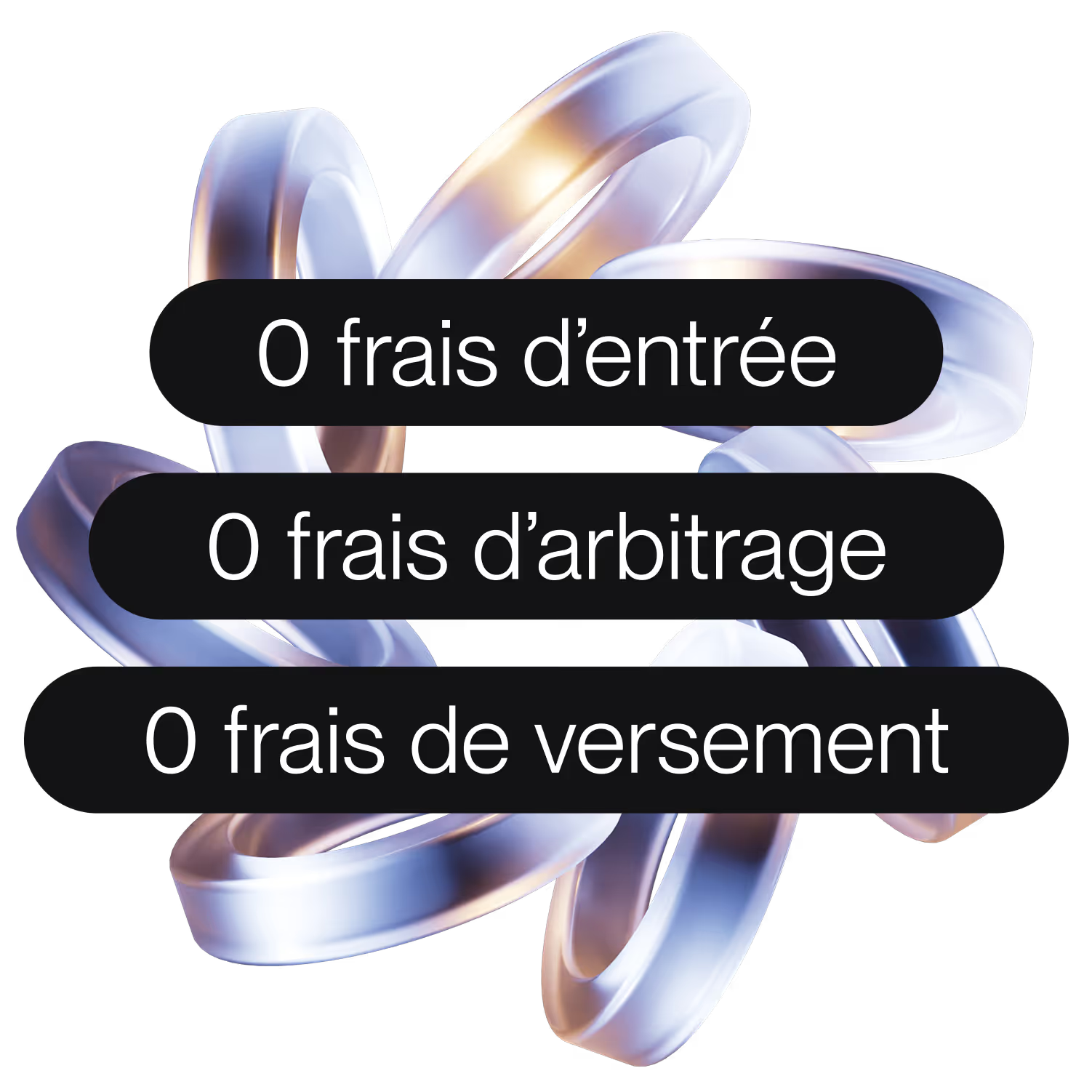
Finary Life, Finary's life insurance policy co-built with BlackRock and Generali, illustrates this new generation: 0% entry fees, switching fees and contribution fees, among the cheapest policies on the market for profiled management.
With profiled management, you choose your investor style (cautious, bold, adventurous) and receive an allocation recommendation that combines euro funds with BlackRock's iShares ETF Portfolio, giving exposure to more than 8,000 stocks and bonds worldwide. Self-directed management is also available for those who prefer to pick their own options.
Mistake #3: waiting to open your policy
If you tell yourself "I will open a life insurance policy once I have more money to invest," that is a mistake. The tax clock starts running the moment you open it.
From the 8th year onward, you benefit from considerable tax advantages: an annual allowance of €4,600 on withdrawn gains for a single person, €9,200 for a couple.
Opening a policy purely to start this tax countdown is known in France as "prendre date" ("securing your date"). You can always fund the policy later: the 8 years count from the moment you open it.
And you can do it today with the minimum amount accepted. On Finary Life, for example, the policy opens with as little as €300, or €150 with scheduled contributions.
Scheduled contributions are nothing more than DCA (dollar cost averaging): investing a fixed amount at regular intervals, whatever the market weather.
Mistake #4: believing the money is locked up or risky
Two common myths circulate about life insurance. The first: savings held in it are supposedly locked up. That is false.
Your funds are available at any time, through a partial or full withdrawal. The only difference: if you withdraw before 8 years, you miss out on the tax boost and your gains go through the PFU (prélèvement forfaitaire unique, the flat tax), at 30%. It works exactly like the PEA (a French tax-advantaged equity savings account), where the benefit is lost if you exit before 5 years.
The second myth: life insurance is supposedly risky by definition, since it depends on an insurer. In reality, all French life insurance policies are guaranteed up to €70,000 per insurer.
If an insurer's insolvency worries you, you can open several policies, each guaranteed up to €70,000 per insurer. With €500,000, it is therefore better to spread it out.
At this level of wealth, there is another option: the Luxembourg policy. Its famous security triangle guarantees the entirety of the funds and gives access to a wider range of options, such as private equity. These policies are generally only accessible from €250,000 invested: our guide to Luxembourg life insurance covers how they work. Beyond €1,000,000 in investable assets, the Finary One team has made this its specialty.
Mistake #5: why you should not neglect estate planning
Because it is one of the biggest advantages of the wrapper, and a poorly worded clause cancels it out entirely. When you open a policy, you name one or more beneficiaries, who will receive the capital when you die.
For contributions made before age 70, each beneficiary is entitled to a €152,500 allowance. In practical terms, if you leave €200,000 to your child through life insurance, they will only pay duties on €47,500. The applicable rate is just 20%, compared with standard inheritance duties, which can climb as high as 45%.
Careful: for contributions made after age 70, the allowance drops to €30,500, shared between all beneficiaries. But the wrapper stays useful past that age: all the capital gains are then exempt from estate transfer duties.
For example, you contribute €100,000 at age 71. Ten years later, the policy is worth €200,000: the €100,000 in gains are passed on entirely tax-free. Our article on life insurance after age 70 covers this regime in detail.
A reminder before any decision: no investment should ever be motivated by tax reasons alone. Tax advantages are a bonus, but performance remains the priority.
Finally, take care over your beneficiary clause. You do not need to name your spouse or PACS partner: since 2007, the surviving spouse has already been exempt from inheritance duties. Use life insurance instead to optimise what you pass on to your children or other beneficiaries.
You can change your beneficiary at any time. Also consider naming several successive beneficiaries: if your sole beneficiary dies before you, the policy falls back into the standard inheritance process and all the tax advantages are lost.
Frequently asked questions
What return should you expect from a euro fund?
Euro funds returned 2.10% per year on average over the last 13 years, before social security contributions and income tax. The Livret A returned 1.20% net per year over the same period. Past performance is not a reliable indicator of future performance.
Can you withdraw money from a life insurance policy before 8 years?
Yes, the funds remain available at any time, through a partial or full withdrawal. Before 8 years, the gains are simply taxed at the 30% flat tax rate. After 8 years, an annual allowance of €4,600 (€9,200 for a couple) applies.
What happens if the insurer goes bankrupt?
French life insurance policies are guaranteed up to €70,000 per insurer. Beyond that, it is possible to spread your savings across several policies, or consider a Luxembourg policy: its security triangle covers the entirety of the funds.
What allowance applies when passing on a life insurance policy?
For contributions made before age 70, each beneficiary benefits from a €152,500 allowance, then a 20% tax rate. For contributions made after age 70, the allowance drops to €30,500 to be shared, but all the capital gains are exempt.
When should you open a life insurance policy?
As early as possible: the tax clock runs from the moment the policy is opened, which is what the French call "prendre date". A minimum contribution is enough, and the policy can be topped up later, once your savings capacity is in place.
Sources
France Assureurs - L'assurance vie : chiffres clés et fonctionnement
Service-Public - Comment sont imposés les revenus d'un contrat d'assurance-vie ?
impots.gouv.fr - Bénéficiaire d'une assurance-vie : comment sont imposées les primes ?
FGAP - Fonds de garantie des assurances de personnes : questions fréquentes
Regulatory disclaimers: Marketing communication. Investing carries a risk of partial or total capital loss. Past performance is not a reliable indicator of future performance. This article is provided for information and educational purposes only; it does not constitute personalised investment advice, a buy or sell recommendation, or tax advice. Before investing, read the Key Information Document (KID) and, where relevant, consult an authorised adviser. The capital guarantee on euro funds is provided by the insurer and depends on its financial strength. In a severe systemic crisis, the French "Sapin 2" law allows withdrawals to be temporarily restricted (liquidity), without affecting the guaranteed capital. Unit-linked funds are not guaranteed and carry a risk of capital loss. Finary SAS, an investment firm authorised by the ACPR (no. 19283), member of AMAFI. Insurance broker registered with ORIAS (no. 21001279), member of the CNCGP (association approved by the AMF). Crypto-Asset Service Provider (CASP) authorised by the AMF under the MiCA regime, references no. A2026-026 and no. N2026-008.