


How Much Does €300,000 Invested Earn per Month in France?

Updated on 29 July 2026
€300,000 invested in France earns between €650 and €2,250 per month depending on the vehicle: about 2.6% a year in a euro fund within life insurance, 4% to 6% in rental property, and 7% to 9% on average in stocks or ETFs, with a risk of capital loss. This guide breaks down returns by investment type.
When it comes to investing a substantial sum such as €300,000, understanding the range of investment options available and their potential returns is essential. Each type of investment, whether stocks, bonds, mutual funds or other investment vehicles, carries a distinct risk and return profile. The return on invested capital depends on market conditions, interest rates and the investment strategy chosen.
Beyond that, the tax implications are a significant factor to consider, since they can materially affect the net return on an investment. Taxation varies depending on the nature of the investment and the tax regime of the country concerned.

- In the stock market (stocks, ETFs), €300,000 can target an indicative historical gross return of 5% to 7% a year, with no guarantee.
- In rental property or SCPI (a French non-listed real-estate investment fund, comparable to a REIT), the net return before tax is often between 2% and 6%, subject to vacancy, non-payment and illiquidity risk.
- Regulated savings accounts (Livret A, LDDS) pay 1.50%, a rate raised to 1.70% from 1 August 2026, but they remain capped (€22,950 and €12,000): they can only absorb part of a €300,000 capital.
- Income from financial investments has been subject to the flat tax (PFU) of 31.4% since 2026 (12.8% income tax and 18.6% social contributions).
- After 8 years, life insurance grants an annual tax allowance of €4,600 (€9,200 for a couple) on gains.
- Any investment in stocks, ETFs, real estate or unit-linked funds carries a risk of capital loss.
Why is it so hard to know how much €300,000 invested earns per month?
Working out the monthly return on €300,000 invested is complex, since it is shaped by several factors: market volatility, the range of investment products available, changes in taxation, and the impact of inflation on the real value of returns.
The fluctuation of returns on investments with no capital guarantee
Returns depend heavily on market volatility, which makes past performance an unreliable guide to future returns. Every type of investment carries a risk level that shapes its expected return, and riskier assets can potentially offer higher returns, with no guarantee.
The risks tied to different types of investment
Effective diversification is essential to managing a portfolio, since it spreads out risk. That said, every investment category, whether stocks, funds, bonds or others, has its own volatility and expected return, which makes it hard to estimate gains precisely.
The effect of taxation across different investment and account types
Both income tax on investment income and social contributions can significantly reduce net returns. The tax framework varies by product (life insurance, PEA (a French tax-advantaged equity savings account), and so on), which complicates the calculation of returns after tax.
Accounting for the effect of inflation in financial analysis
Rising inflation reduces the real value of returns. To understand its real impact on purchasing power, the real return must be calculated after accounting for changes in consumer prices, which adds another layer of complexity to financial analysis.
Goals
How much does €300,000 invested earn per month, by investment type?
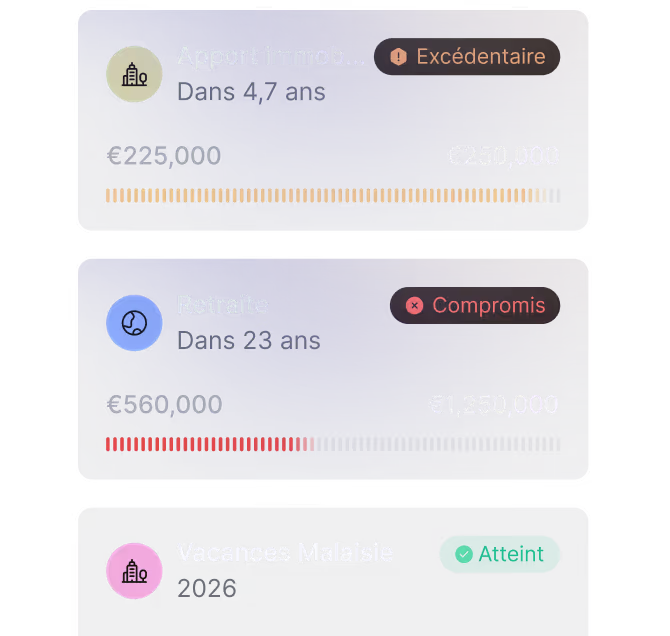
Investing a capital of €300,000 can potentially generate significant income, whether through the stock market, real estate or savings products. Profitability varies depending on the type of investment, asset valuation, taxation and the investor's risk profile. Apps such as Finary make it possible to track the evolution of one's net worth over time and visualise how a capital sum could grow under different return scenarios.
How much can €300,000 invested earn per month in the stock market?
Investing €300,000 in the stock market offers the option of investing in stocks, ETFs (Exchange-Traded Funds) or bonds. With ETF investments, for example, an investor might expect an indicative average historical gross return of 5% to 7% a year, with no guarantee (based on historical stock-market data), subject to market fluctuations. It is essential to note, however, that the valuation of stocks and other listed products can vary, which affects the final return.
€300,000 in Listed Stocks (7% return assumption, not guaranteed)
| Duration (years) | Monthly Gains (€) | Annual Gains (€) | Total Gains (€) |
|---|---|---|---|
| 5 | 2,012.76 | 24,153.10 | 120,765.52 |
| 10 | 2,417.88 | 29,014.54 | 290,145.41 |
| 15 | 2,931.72 | 35,180.63 | 527,709.46 |
| 20 | 3,587.11 | 43,045.27 | 860,905.34 |
| 25 | 4,427.43 | 53,129.19 | 1,328,229.79 |
| 30 | 5,510.21 | 66,122.55 | 1,983,676.51 |
€300,000 in S&P 500 ETFs (10% return assumption, not guaranteed)
| Duration (years) | Monthly Gains (€) | Annual Gains (€) | Total Gains (€) |
|---|---|---|---|
| 5 | 3,052.55 | 36,630.60 | 183,153.00 |
| 10 | 3,984.36 | 47,812.27 | 478,122.74 |
| 15 | 5,295.41 | 63,544.96 | 953,174.45 |
| 20 | 7,159.37 | 85,912.50 | 1,718,249.98 |
| 25 | 9,834.71 | 118,016.47 | 2,950,411.78 |
| 30 | 13,707.84 | 164,494.02 | 4,934,820.68 |
€300,000 in World ETFs (8% return assumption, not guaranteed)
| Duration (years) | Monthly Gains (€) | Annual Gains (€) | Total Gains (€) |
|---|---|---|---|
| 5 | 2,346.64 | 28,159.68 | 140,798.42 |
| 10 | 2,897.31 | 34,767.75 | 347,677.50 |
| 15 | 3,620.28 | 43,443.38 | 651,650.73 |
| 20 | 4,576.20 | 54,914.36 | 1,098,287.14 |
| 25 | 5,848.48 | 70,181.70 | 1,754,542.56 |
| 30 | 7,552.21 | 90,626.57 | 2,718,797.07 |
The rates shown in these tables (7%, 8%, 10%) are simulation assumptions based on average historical stock-market returns (MSCI World, +8.1%/year over 1990-2025); they do not constitute a guarantee of future performance.
How much can €300,000 invested earn per month in real estate?
As an asset class, real estate investment, particularly through rental property or pierre-papier via SCPI (Sociétés Civiles de Placement Immobilier), is a profitable option. With a €300,000 investment, the rental yield can range between 2% and 6% net of tax, subject to the risks of vacancy, non-payment and depreciation of the property. The rents collected generate an income stream, and the return can be enhanced over the long term through compound interest.
€300,000 in Rental Property (4% return assumption, not guaranteed)
| Duration (years) | Monthly Gains (€) | Annual Gains (€) | Total Gains (€) |
|---|---|---|---|
| 5 | 1,083.26 | 12,999.17 | 64,995.87 |
| 10 | 1,200.61 | 14,407.33 | 144,073.29 |
| 15 | 1,334.91 | 16,018.87 | 240,283.05 |
| 20 | 1,488.90 | 17,866.85 | 357,336.94 |
| 25 | 1,665.84 | 19,990.04 | 499,750.90 |
| 30 | 1,869.50 | 22,433.97 | 673,019.25 |
€300,000 in SCPI (5% return assumption, not guaranteed, fees and illiquidity)
| Duration (years) | Monthly Gains (€) | Annual Gains (€) | Total Gains (€) |
|---|---|---|---|
| 5 | 1,381.41 | 16,576.89 | 82,884.47 |
| 10 | 1,572.24 | 18,866.84 | 188,668.39 |
| 15 | 1,798.21 | 21,578.56 | 323,678.45 |
| 20 | 2,066.62 | 24,799.47 | 495,989.31 |
| 25 | 2,386.35 | 28,636.26 | 715,906.48 |
| 30 | 2,768.29 | 33,219.42 | 996,582.71 |
How much can €300,000 earn in regulated savings accounts?
These regulated savings accounts (Livret A, LDDS) are risk-free investments, guaranteed by the French state and available at any time, but their return is low and, above all, capped. They can therefore only absorb part of a €300,000 capital: the remaining balance must be directed to other vehicles (life insurance, the stock market, real estate).
- Livret A: a regulated rate, currently 1.50%, raised to 1.70% from 1 August 2026, capped at €22,950 in contributions.
- LDDS (Livret de Développement Durable et Solidaire): same rate as the Livret A, capped at €12,000.
For a single saver, the combined Livret A and LDDS therefore represent a maximum of €34,950. The table below shows what these accounts would earn once filled to the cap, at the 1.70% rate applicable from 1 August 2026.
Livret A + LDDS at the Cap (€34,950 at 1.70% from 1 August 2026)
| Duration (years) | Monthly Gains (€) | Annual Gains (€) | Total Gains (€) |
|---|---|---|---|
| 5 | 51.22 | 614.70 | 3,073.49 |
| 10 | 53.48 | 641.73 | 6,417.26 |
| 15 | 55.86 | 670.34 | 10,055.07 |
| 20 | 58.39 | 700.64 | 14,012.80 |
| 25 | 61.06 | 732.74 | 18,318.57 |
| 30 | 63.90 | 766.77 | 23,002.98 |
Tax considerations and their impact on returns
When it comes to investing €300,000, it is essential to factor in the tax impact that shapes the net return. Both financial products and tax wrappers can vary considerably in how they are taxed.
First, tax on interest income can take the form of the flat tax, also known as the PFU (Prélèvement Forfaitaire Unique), at 31.4%, which includes 18.6% in social contributions and 12.8% in income tax (see Service-public.gouv.fr). According to Service-public.gouv.fr, the social-contributions rate on investment income rose to 18.6% from 1 January 2026. This option simplifies taxation and can be advantageous if savings generate significant income.
Certain savings options, such as life insurance, offer preferential tax treatment after eight years, with an annual allowance of €4,600 for a single person or €9,200 for a couple. This mechanism can increase the net return.
In addition, investing in certain financial products can qualify for tax benefits. For example, when the investment is made through mutual funds or SICAVs, they must report certain information to the tax authorities, which can affect the taxation applied under Article 41 Y of Annex III to the French General Tax Code (CGI).
It is also worth noting that different rates can apply depending on the size of the company invested in. Reduced rates may apply to companies of certain sizes in 2020 and 2021.

Frequently asked questions
When considering investments for a capital of €300,000, investors naturally have a range of relevant questions about the most profitable options, optimisation strategies, and the associated risks.
What types of investment should be considered for €300,000?
For a €300,000 investment, financial products such as term deposits, equity funds or life insurance offer a potentially higher return, paired with greater risk. Rental property or SCPI can also be profitable, depending on the market and location.
How can the management of €300,000 be optimised to aim for a monthly income?
To aim for extra monthly income with €300,000, building a diversified portfolio is recommended. Fixed-income investments can be combined with more dynamic ones to balance security and growth potential.
What are the risks associated with different types of investment for €300,000?
Each investment carries its own risks: fixed-rate vehicles are affected by inflation, stocks by market volatility, and real estate by value fluctuations and vacancy. Any investment in stocks, ETFs or unit-linked funds carries a risk of capital loss.
What taxation applies to income from €300,000 invested?
Income from financial investments (interest, dividends, capital gains) has been subject to the flat tax of 31.4% since 2026, comprising 12.8% income tax and 18.6% social contributions. Life insurance policies over eight years old benefit from an annual tax allowance on gains.
How much does €300,000 invested earn per month in life insurance?
In life insurance, the return depends on the options chosen: the euro fund aims for security with a modest return, while unit-linked funds offer higher potential, with no capital guarantee. After eight years, the tax treatment of gains becomes more favourable.
Sources
Service-public.gouv.fr: taxation of savings and investment income, flat tax (PFU) 2026
BOFiP: income from movable capital (BOI-RPPM-RCM-40-30)
Regulatory disclaimers: Marketing communication. Investing carries a risk of partial or total capital loss. Past performance is not a reliable indicator of future performance. This article is provided for information and educational purposes only; it does not constitute personalised investment advice, a buy or sell recommendation, or tax advice. Before investing, read the Key Information Document (KID) and, where relevant, consult an authorised adviser. Finary SAS, an investment firm authorised by the ACPR (no. 19283), member of AMAFI. Insurance broker registered with ORIAS (no. 21001279), member of the CNCGP (association approved by the AMF). Crypto-Asset Service Provider (CASP) authorised by the AMF under the MiCA regime, references no. A2026-026 and no. N2026-008.