Should You Buy or Rent Your Home in France?

Updated on 27 July 2026
“Renting is throwing your money out the window.” The saying comes up at every family dinner. It deserves better than a cliché.
The answer mostly depends on two things: how long you plan to stay, and which city in France you are in. Depending on the case, buying or renting wins out, numbers in hand.
Here is how to decide, beyond the clichés.

- Buying costs far more than the sticker price: down payment, loan interest, notary fees, borrower's insurance, property tax and upkeep all add up.
- Renting is not “throwing your money out the window” if you invest, every month, the difference between the rent and a mortgage payment.
- Below roughly 15 years in the same home, renting is often the winner; beyond that, buying regains the edge.
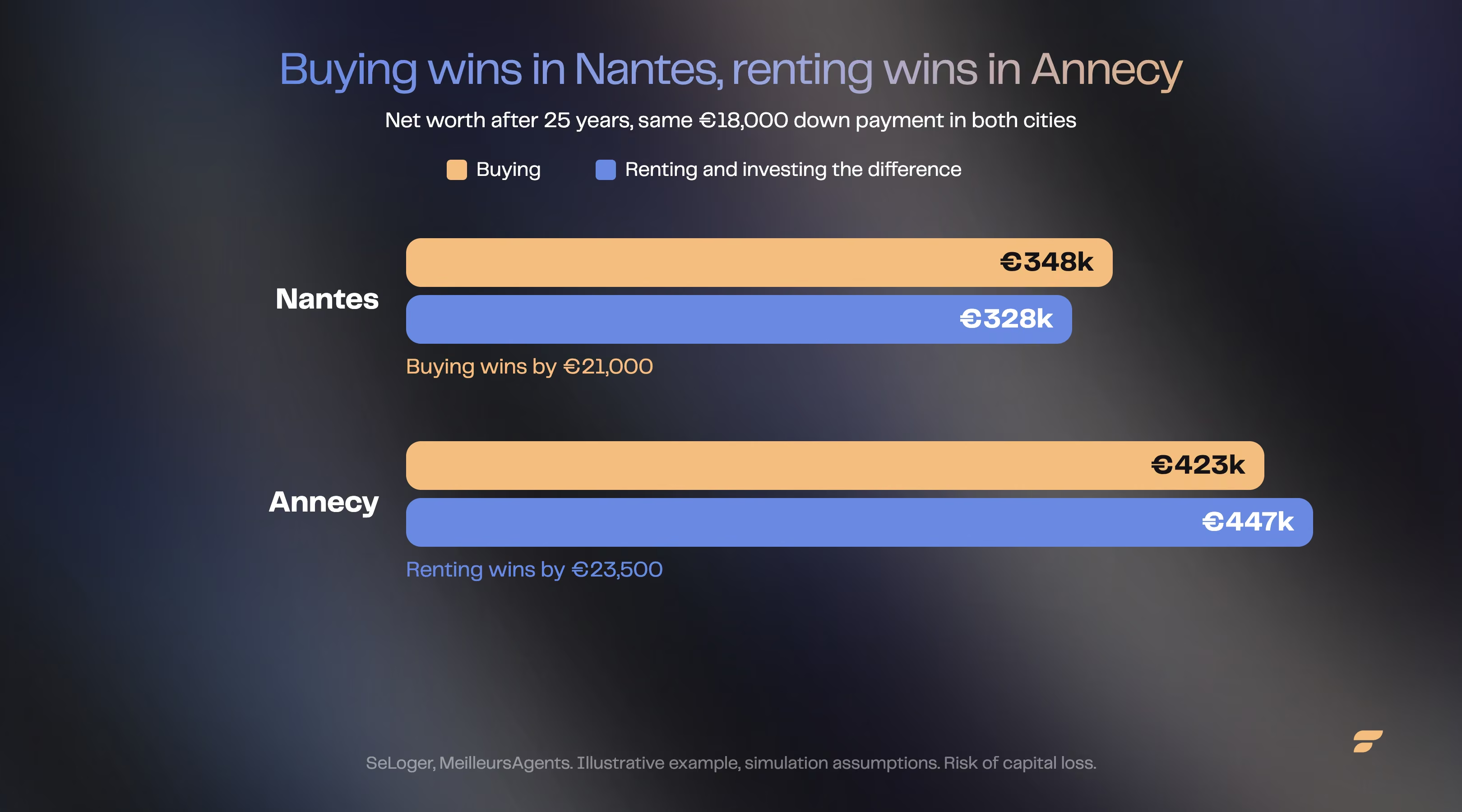
- The result depends heavily on the city: in one example buying wins in Nantes, while renting wins in Annecy.
- The real question is not financial but personal: stability, time horizon, and your need for flexibility and security.
How Much Does Buying a Home Really Cost?
Far more than the sticker price. When you buy, you first pay a down payment, loan interest, notary fees and borrower's insurance.
Once you own the property, the costs keep coming: property tax and upkeep, not counting surprises like a boiler giving out.
Add it all up, and a home listed at €200,000 today will end up costing you between €344,000 and €453,000 over 25 years, depending on the interest rate and local taxes. And that calculation does not even include inflation.
Buying is expensive, then. The real question is: does renting cost more, or less, than buying?
Goals
Buying or Renting: What Do the Numbers Say?
It depends on the city. The best way to see this is to compare two real-world cases with the same down payment (€18,000), over 25 years, investing each month the difference between the rent and the mortgage payment.
Nantes. A 45 m² flat in the city centre is worth about €179,000 (€3,975/m²). With notary fees at 8%, the project comes to €193,320, meaning €175,320 to borrow over 25 years at 3.5%, insurance included. Including property tax and upkeep, the property ends up costing €359,574 after 25 years, for an all-in monthly payment of €1,198.
By comparison, the same flat rents for about €711 a month. Investing the difference at a net 5% a year, the tenant builds up net worth of €327,723 after 25 years, versus €348,429 for the buyer. Buying wins by €21,000.
Annecy. The price per m² is higher there (€5,400). With a lower rent (€547 a month) but the same mortgage payment, there is more money left to invest each month on the renting side.
The result flips: after 25 years, renting leads to €446,584 in net worth, versus €423,021 for buying. Renting wins by €23,500. Past performance is not a reliable indicator of future performance.
| Net worth after 25 years | Buy | Rent and invest the difference | Winner |
|---|---|---|---|
| Nantes (property +2.7%/yr) | €348,429 | €327,723 | Buying (+€21,000) |
| Annecy (property +3.5%/yr) | €423,021 | €446,584 | Renting (+€23,500) |
Illustrative example, assumptions: rent +2%/yr, difference invested at a net 5%/yr, over 25 years.
One rule emerges: below roughly 15 years in the same home, renting is generally the winner, because notary fees and upkeep costs have not yet been paid off. Beyond that, buying regains the edge.
The Factors That Matter Beyond the Numbers
Investing in real estate is not just a matter of maths. Five non-financial factors often weigh as much as the calculation.
Security versus freedom. Property is reassuring: even if its value fell, a home keeps its use, that of housing you. Renting, on the other hand, keeps your wealth liquid and available for other projects or the unexpected.
Predictability versus flexibility. Fixed monthly payments make it easier to plan your life. But a job relocation, a new project or a growing family are far easier to handle when renting, with no property to sell.
Customisation. As an owner, you can knock down a wall or redo the kitchen, and every euro you invest adds value to your property. As a tenant, you do not decide anything, but you do not pay for major work either.
Mental load. A broken boiler, a leak, a roof that needs redoing: that is the owner's problem, not the tenant's.
Risks. Buying also means illiquidity (a divorce or an urgent sale can strike at the worst moment) and a geographic lottery: over ten years, Saint-Étienne lost about 25% while Bordeaux gained 70%.
So, Should You Buy or Rent?
There is no single answer: it all depends on your situation. The right question is not “should I buy or rent?” but “what fits my life, my priorities, my moment?”
Buying makes sense if your professional and family life is stable, if you can see yourself staying 7 to 10 years in the same place, if you need that security, and if you enjoy fitting out your home.
Renting makes sense if your career could take you elsewhere, if your situation is changing, if you are after flexibility, or if you would rather keep your cash for other investments, such as rental property investing.
Ultimately, the best housing choice is not the one that earns the most, but the one that lets you sleep soundly. Housing should serve your life, not the other way round.

Frequently Asked Questions
Is Renting Really Throwing Your Money Out the Window?
No, as long as you invest the difference. Rent is often lower than an all-in mortgage payment: by investing the gap every month, the tenant builds up net worth. In the Annecy example, this strategy even beats buying over 25 years.
After How Many Years Does Buying Become Worthwhile?
As a rule of thumb, around 15 years in the same home. Below that, notary fees (often 8%) and upkeep costs have not yet been paid off, which favours renting. Beyond that, buying generally regains the edge.
What Costs Do People Forget When Buying?
Beyond the down payment and loan interest, you also need to count notary fees, borrower's insurance, property tax, routine upkeep and major surprises. These items explain why a €200,000 property can end up costing between €344,000 and €453,000 over 25 years.
Is It Better to Buy or Rent If You Might Move?
If you are not sure you will stay several years in the same place, renting is generally preferable. It avoids paying acquisition costs that never get paid off and having to sell in a hurry, when the property market could be unfavourable at the worst possible time.
Sources
SeLoger - prix de l'immobilier à Nantes et Annecy
MeilleursAgents - évolution des prix immobiliers
Regulatory disclaimers: Marketing communication. Investing carries a risk of partial or total capital loss. Past performance is not a reliable indicator of future performance. This article is for informational and educational purposes only; it does not constitute personalised investment advice, a buy or sell recommendation, or tax advice. Before investing, read the Key Information Document (KID) and, where relevant, consult an authorised adviser. Finary SAS, an investment firm authorised by the ACPR (no. 19283), member of AMAFI. Insurance broker registered with ORIAS (no. 21001279), member of the CNCGP (association approved by the AMF). Crypto-Asset Service Provider (CASP) authorised by the AMF under the MiCA regime, references no. A2026-026 and no. N2026-008.