



Rental Property Investment in France: The Complete 2026 Guide

Updated on 22 July 2026
Successfully investing in rental property in France means choosing a well-located property, calculating its net yield, financing it on the best terms, and picking the right tax regime: unfurnished letting, LMNP (the French tax status for furnished-rental landlords), or an SCI (a French property-holding company). This guide walks through every step, illustrated by my own investment in Chambéry, to help you carry out your project with full confidence.

- Rental demand is expected to rise sharply by 2050, with 4 million additional households in France, according to Insee.
- Net yield is calculated by deducting running costs, property tax and letting-agency fees from the annual rent received, excluding any resale gain.
- The LMNP status under the actual-expenses regime lets you depreciate the property and wipe out rental income tax for several years, unlike the micro-BIC regime.
- The Pinel and Censi-Bouvard tax schemes closed to new subscriptions in 2024 and 2022; Denormandie, Malraux and Monuments Historiques remain open in 2026.
- A down payment of roughly 10% of the price, covering incidental costs, makes it easier to get a loan but is not mandatory with a strong application.
Why invest in rental property?
The advantages of rental property:
- Context: rental demand keeps rising for demographic as well as societal reasons. By 2050, there will be 4 million more households according to INSEE.
- Appreciation: according to Insee, French households' real-estate wealth rose 233% between 1998 and 2021, driven by rising prices (Insee, twenty years of household wealth trends).
- A tangible asset: "The years go by, but bricks and mortar remain." A tangible asset whose return depends on market conditions.
- Inflation hedge: an investment indexed to inflation (IRL: the French rent reference index).
- Extra income: rent provides a source of regular income.
- Planning for retirement: a long-term investment. Either for the income, or to have a roof over your head. Real estate is often cited by the French as a long-term investment for retirement.
- Leverage: rental property may look less attractive on yield alone, but leverage changes the picture!
To illustrate this leverage effect: investing €20,000 in stocks at a hypothetical return of 8% a year would earn around €1,600 that year. For the same down payment, that same €20,000 combined with a €180,000 mortgage on a property yielding 6% a year generates a much higher annual gain, because that return applies to the full financed value of the property, not just the down payment. These rates are illustrative assumptions only, not guaranteed and not representative of future performance: rental investment remains subject to the usual risks (vacancies, rate changes, property valuation, capital loss).
To make your investment a success, several points need attention.
How to choose the right property and location
Choosing a property comes down above all to location, the quality of the home, and its price relative to the local market.
The 3 golden rules: location, location, location
If you buy a "dump" in Paris, you will still find a tenant. Investing near where you live is often easier to manage, and picking a dynamic town with a strong economy and tourist appeal is crucial. Check the level of demand by looking at how long listings stay up, or by using the tensiomètre locatif tool.


Property price
You can renegotiate your loan later, but not the price! Check the property's price per square metre against its local area. Use sites such as the government's DVF (Demandes de Valeurs Foncières) database to check recorded property values, and Castorus to track price trends.
Property quality
Bringing in a third party for a second opinion is always useful. Staying objective and not buying on a whim (save that for your primary residence) matters. Yield is an essential criterion to weigh.

Co-ownership
Check the proportion of owner-occupiers in the building, the monthly service charges, and the co-ownership accounts. Review the property manager's report on recent and upcoming works, as well as the amount of property tax and any residence tax.
Finding the property
There's no secret: you need to scan listings and use your network. If you're looking for a first investment with a lower entry ticket, investing in a parking space is worth considering.
How to calculate the yield and return of a rental investment
Gross yield is calculated by dividing the annual rent by the purchase price plus notary fees; net yield further deducts the actual running costs.
Yield
Gross → To calculate gross yield, simply divide the annual rent by your purchase price plus notary fees.
GROSS yield = Annual rent / (price + notary fees)Net → To calculate net yield, you can run the same calculation as for gross yield, deducting running costs from the annual rent received.
Example of running costs: maintenance (set aside 0.5% of the property's value per year), property tax, letting-agency management fees (6% of the rent), and non-occupant landlord insurance (PNO).
NET yield = (Annual rent - running costs) / (price + notary fees)
IRR (Internal Rate of Return)
Used to calculate the total return on the investment, factoring in every cash flow including the capital gain. Use Excel or Finary's tools to get an analysis of your rental investment. Also see 6 tips to optimise the return on your rental investment.
Self-financing
Self-financing is a key goal for every property investor. It means the income generated by renting out the property covers all the associated costs, including loan instalments, taxes, insurance and any management fees.
To reach self-financing, it's crucial to carefully assess incoming and outgoing cash flows. For example, if your property generates €600 in monthly rent but your monthly costs come to €700, your cash flow will be negative by €100 each month. That means you'll have to cover the difference out of your own pocket, which isn't ideal.
How to finance your rental investment
Financing a rental investment involves a down payment (generally around 10%), a loan term of 15 to 25 years, and a rate that depends on market conditions at the time of purchase.
You've found a property in the right area, the right street, the right building, with a good yield. Now it's time to move on to financing your investment:
The down payment
A down payment strengthens your application. Lenders generally ask for around 10%, enough to cover incidental costs. It's possible to borrow without one if your application is very strong.
You can check our simulations of the salary needed to borrow based on the amount borrowed.
Term
Between 15 and 20 years. Borrowing over 25 years for a rental property is possible. The longer the term, the easier it is to reach self-financing.
Unpaid Rent Guarantee (GLI, garantie loyers impayés)
Guarantees rent payments if your tenant becomes unable to pay. GLI comes at a cost but offers protection against non-payment; whether it's worth it depends on each investor's profile.
Rates:
As I write this article, interest rates are markedly higher than in previous years. If you're planning to borrow now, I recommend reading this article to understand loan refinancing, an option that could be very useful to you if rates were to fall.
Choosing your notary:
Before buying, choose carefully the notary who will handle your purchase. Ask for a recommendation, and some investors prefer recently established notaries for their availability. Why? Because they're motivated, hands-on (a clerk won't be the one handling your file), tech-savvy (email and notaries don't always mix…), and responsive!
A bad notary can seriously slow down your project. A good notary will warn you about missing documents, explain the sales process, and make it easier to communicate with other parties. In short, they're someone you can rely on.
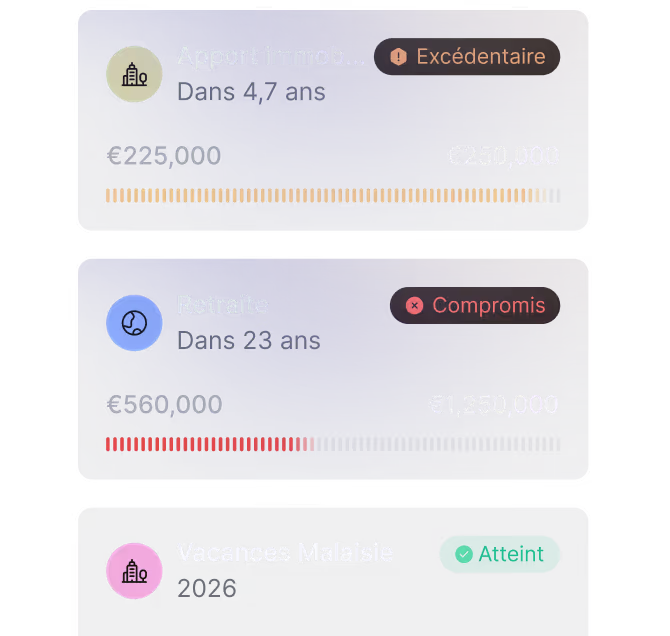
Goals
4. Property management
Outsource or manage it yourself?
For a first property, some investors choose to self-manage. It lets you learn the ropes and see first-hand the issues tenants raise. Outsourcing eats into your yield, with a management fee of 6-12% (excl. tax) of rent collected on furnished lettings. So you can manage it yourself, but only if you have the time, the flexibility, and either the skills or the right people around you.
Choosing your tenant
Favour the DossierFacile site, the official public service for building a tenant file, and check the authenticity of a tax notice on the French tax authority's website.

Which tax regime should you choose for a rental investment?
The choice mainly comes down to unfurnished letting (simple taxation, larger market) and furnished letting under LMNP status (more favourable taxation under the actual-expenses regime, thanks to depreciation).
When investing in rental property, it's crucial to choose the right tax regime to optimise your income and minimise your tax. Here's a detailed comparison of the main options:
Unfurnished or furnished letting
The choice between unfurnished and furnished letting depends on several factors, including yield potential and tax benefits.
For furnished letting, we're assuming the LMNP status (Loueur Meublé Non Professionnel, France's non-professional furnished-landlord status).
| Criteria | Unfurnished | Furnished (LMNP) |
|---|---|---|
| Under LMNP: accounting depreciation on the actual-expenses regime | ❌ no accounting depreciation | ✅ (can depreciate the purchase price of the property) |
| Under micro-BIC: taxation (non-rated furnished let) | ❌ (30% allowance on rental income, €77,700 threshold) | ➖ (30% allowance since 2025, €15,000 threshold, versus 50% previously) |
| Addressable market | ✅ (larger) | ❌ |
| Can target high-yield activities | ❌ | ✅ (house-sharing, Airbnb, short-term letting) |
| Tax filings and bookkeeping | ✅ (simple) | ❌ (more complex) |
| Vacancy risk | ✅ | ❌ (higher risk) |
Under the micro-BIC regime, the furnished-letting advantage now only applies to a rated tourist furnished let (50% allowance, €77,700 threshold); a non-rated furnished let gets the same allowance as unfurnished letting (30%). It's mainly the actual-expenses regime, with its accounting depreciation, that remains advantageous: generally, for as long as the property is being depreciated under LMNP, you pay no tax on furnished-rental income.
Gross yield is generally better with furnished letting. With furnished letting, you can especially target high-yield rental types such as house-sharing and Airbnb; I actually tried short-term Airbnb-style letting on this property during a period of strong tourist demand.
And once you factor in the LMNP tax niche, net yield is even better. Furnished letting under LMNP can be more tax-efficient depending on the situation; professional advice is recommended.
Personal name vs. company (SCI, Société Civile Immobilière)
| Criteria | Personal name | Company (SCI) |
|---|---|---|
| Setting up the entity | ✅ (simple) | ❌ (more complex) |
| Protecting the property | ❌ | ✅ (creditors can only seize the SCI's shares) |
| Estate transfer | ❌ | ✅ (avoids co-ownership deadlock) |
| Investing with others | ❌ | ✅ (can bring in partners) |
| Management | ✅ (simple) | ❌ (demanding: specific lease requirements) |
| Taxation | ✅ (LMNP, capital gain calculated on the purchase value) | ❌ (capital gain calculated on the book value) |
A frequently considered option:
Starting under your own name and considering an SCI later is one approach among others. The right structure depends on your personal, wealth and tax situation; specialised advice is recommended.
My rental investment
Let's get practical: I'll walk you through my own rental investment, made in early 2021.
The purchase
A one-bedroom flat in Chambéry, a town where I used to live. The property is occupied and furnished.
- Purchase price: €126,000
- Agency fees: none, I dealt directly with a property dealer
- Notary fees: €10,600
- Total cost of the deal: €136,600
The financing
- Amount borrowed: €100k
- Down payment: €36k (loan obtained without a permanent employment contract)
- Rate: 1.1% (looks amazing today, but it was completely standard a few years ago)
- Monthly payment: €550
- Term: 15 years
Taxation
- Regime: LMNP under actual expenses
- Bookkeeping: €300/year
- Property tax: €550
Renting it out
- Rent: €760 (30% more than unfurnished letting)
- I initially rented it out for around €640, then adjusted the rent for inflation at each change of tenant (I avoid adjusting it while the same tenant stays).
- Service charges: €20 (no lift in the building, so low co-ownership charges)
Total: €780
This deal was certainly a good one, but on the other hand I ran into some very real problems, such as roof issues and risks of the building collapsing…
Tax-incentivised real estate
Investing in tax-incentivised real estate lets you benefit from tax reductions while contributing to development or renovation projects. It's not an option I chose myself, but here are a few key schemes:
Pinel law (closed scheme)
- Status: The Pinel/Pinel+ scheme ended on 31 December 2024 (2024 Finance Act). Investments made before that date continue to benefit from the tax reduction under the original terms.
- Conditions (for investments made before 31/12/2024): a home meeting energy standards, located in an eligible zone, with capped rents and tenant income limits.
Denormandie law
- Purpose: Renovating older homes in run-down town centres.
- Tax benefit: A tax reduction of 12%, 18% or 21% of the total investment (purchase price + renovation works), depending on the length of the letting commitment (6, 9 or 12 years).
- Conditions: A home located in one of the 222 municipalities of the Action Cœur de Ville programme (extended to municipalities under an ORT agreement and run-down housing areas), with renovation works accounting for at least 25% of the total cost, and letting for at least 6 years after renovation.
Malraux law
- Purpose: Restoring properties in protected heritage areas.
- Tax benefit: 22% of restoration costs (30% if the property is in a Site Patrimonial Remarquable with an approved conservation and enhancement plan), capped at €400,000 of works over 4 years.
- Conditions: A property in a protected heritage area, works supervised by an Architecte des Bâtiments de France (state heritage architect), and letting for at least 9 years after the works.
Monuments Historiques
- Purpose: Restoring buildings listed or registered as Monuments Historiques (protected historic monuments).
- Tax benefit: 100% deduction of renovation costs from rental income, with property-income deficits offsettable against total taxable income.
- Conditions: A listed or registered property, works approved by the relevant authorities, and a commitment to preserve the property for 15 years.
Rental property, a long-term wealth-building lever
Rental property can be a relevant wealth-building lever for generating extra income, provided you accept the risks involved (vacancies, non-payment, illiquidity, capital loss). France offers some favourable features, such as fixed-rate loans, but the property market runs in cycles. That said, be aware that the process is long and sometimes tedious. If you'd rather not get your hands dirty, you can delegate all or part of the project to a company specialised in turnkey rental investment, or turn to investing in SCPI (a French non-listed real-estate investment fund, comparable to a REIT), which pools rental management (worth evaluating based on the fees, terms and services offered).
My video on the topic
If you'd like to know more, I made a dedicated video on the topic:

Frequently asked questions
What are the key criteria for choosing a rental property?
Key criteria include location, the quality of the property, its price relative to the local area, and co-ownership factors such as monthly charges and upcoming works. The DPE (Diagnostic de Performance Énergétique, France's energy-performance rating) should also be checked before investing.
What is the DPE, and why does it matter for a rental investment?
The DPE (Diagnostic de Performance Énergétique) assesses a property's energy consumption. Poorly insulated homes are being progressively banned from the rental market in France, which makes this rating decisive before any purchase intended for letting.
How do you calculate the gross yield of a rental investment?
Gross yield is calculated by dividing the annual rent by the purchase price plus notary fees. Net yield, which is more precise, further deducts running costs (property tax, management, insurance) from the annual rent received.
What's the difference between unfurnished letting and furnished letting (LMNP)?
Furnished letting under LMNP status lets you depreciate the property under the actual-expenses regime, which sharply reduces the tax on rental income received. Unfurnished letting offers a larger market but more limited tax benefits.
Should you invest under your own name or set up an SCI for a rental investment?
Starting under your own name and considering an SCI (Société Civile Immobilière, a French property-holding company) later is a common approach. The SCI shields the property from personal creditors and makes estate transfer easier, but it's more complex to set up and manage than holding the property under your own name.
Which property tax-incentive schemes are still open to new investors in 2026?
The Pinel scheme has been closed to new subscriptions since 31 December 2024. Denormandie, Malraux and the Monuments Historiques regime remain open in 2026, subject to conditions on renovation works, location and letting duration.
Sources
Insee, household projections to 2050
Insee, twenty years of household wealth trends
Service-public.fr, the rent reference index (IRL)
Ministry for Ecological Transition, the energy performance rating (DPE)
Légifrance, order of 28 February 2020 setting regulated notary fees
Impots.gouv.fr, the new micro-BIC allowance for tourist furnished lettings
Service-public.fr, the closure of the Pinel scheme on 31 December 2024
Ministry for Ecological Transition, the Denormandie scheme
BOFiP, the Malraux tax reduction
Impots.gouv.fr, the Monuments Historiques regime
Regulatory disclaimers: Marketing communication. Investing carries a risk of partial or total capital loss. Past performance is not a reliable indicator of future performance. This article is provided for information and educational purposes only; it does not constitute personalised investment advice, a buy or sell recommendation, or tax advice. Before investing, read the Key Information Document (KID) and, where relevant, consult an authorised adviser. Finary SAS, an investment firm authorised by the ACPR (no. 19283), member of AMAFI. Insurance broker registered with ORIAS (no. 21001279), member of the CNCGP (association approved by the AMF). Crypto-Asset Service Provider (CASP) authorised by the AMF under the MiCA regime, references no. A2026-026 and no. N2026-008.