Best ESG ETFs in 2026: The Complete Comparison

Updated on 21 July 2026
The best ESG ETFs combine a strict SRI screen or an ESG Leaders/Selection methodology, fees below 0.30% and solid geographic diversification. This selection compares the main World, US, European and emerging-market ESG ETFs available in France, in a PEA (a French tax-advantaged equity savings account) or in a standard brokerage account.

- Three strategies coexist: exclusion, best-in-class/SRI and thematic, with very different levels of selectivity.
- A physically replicated ESG ETF (World, Europe) is rarely PEA-eligible; synthetic replication makes it possible to hold US or emerging-market exposure in one.
- Fees range from 0.18% to 0.35% depending on the region and the replication method, a gap that weighs heavily over 20 years.
- Two “green” ETFs can share up to 80% of their holdings, which limits the real diversification of a portfolio combining several ESG funds.
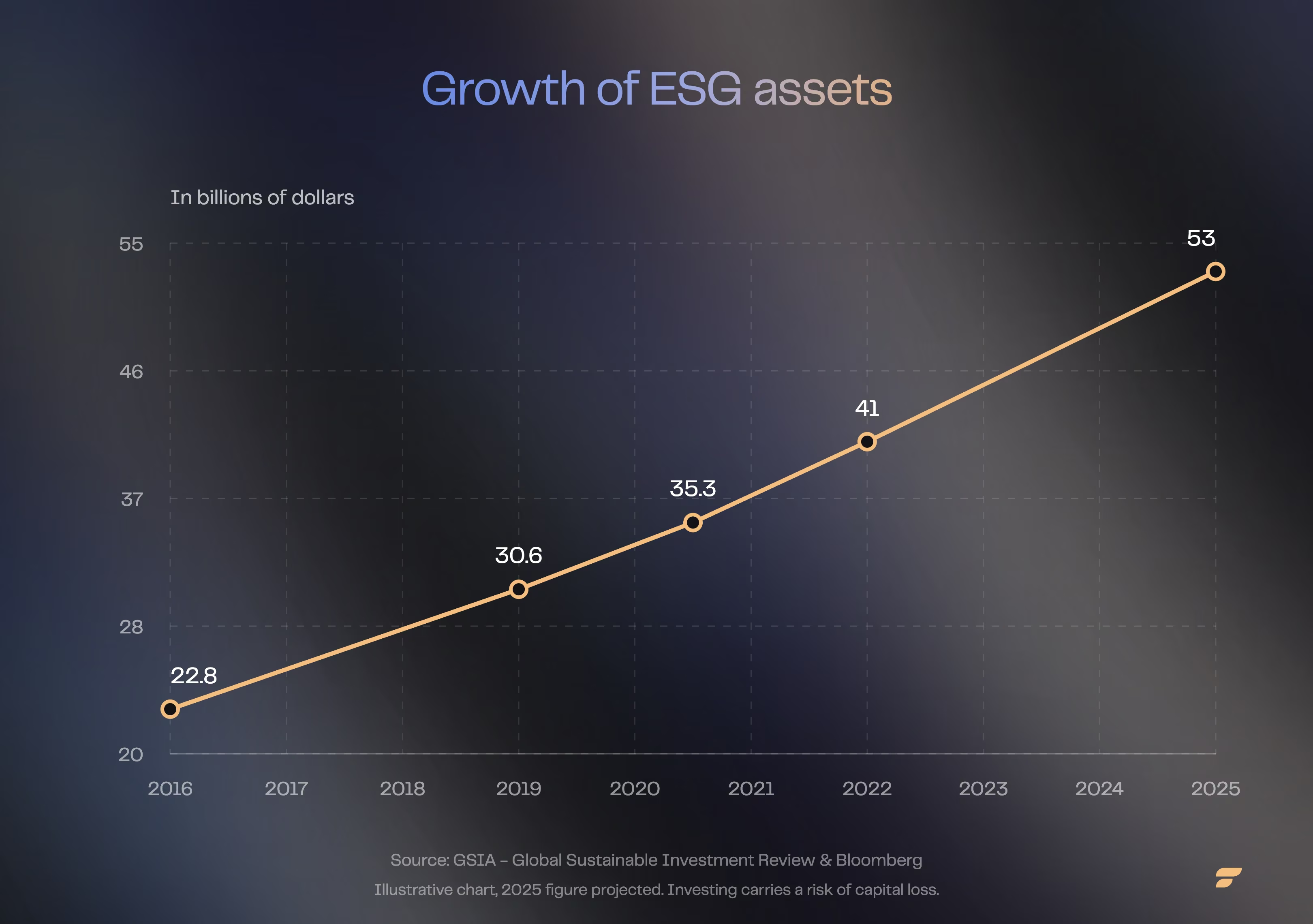
According to the Global Sustainable Investment Alliance, global assets invested against ESG criteria rose from $22.8 trillion to $35.3 trillion between 2016 and 2020, before falling back to $30.3 trillion in 2022 as a methodological tightening in the United States sought to curb greenwashing.
ESG ETFs are no longer aimed solely at idealistic investors. The segment has reached a maturity that now offers sophisticated investment solutions. These products make it possible to build non-financial criteria into an equity allocation.
What is an ESG ETF and how does it work?
An ESG ETF tracks an equity index while applying Environmental, Social and Governance screens: excluding controversial sectors, selecting the best ESG ratings in each sector, or targeting a specific theme.
What is ESG investing?
ESG investing is not limited to financial performance. It assesses companies against three major criteria: Environmental, Social and Governance. These criteria offer a broader perspective than revenue alone.
More and more investors now question the impact of their investments. They want to know the real cost to the planet, to employees and to society. ESG acts as a compass for measuring both risks and opportunities. It looks at the carbon footprint, board diversity, waste management and pay transparency.
ESG is not philanthropy. By directing investment flows towards the most virtuous companies, ESG ETFs encourage companies to improve their practices. Even a passive investor can therefore contribute to concrete change.
The different ESG strategies (exclusion, best-in-class, ISR, thematic)
ESG investing offers several approaches, each with its own characteristics:
- Exclusion: this method removes sectors deemed incompatible, such as tobacco, weapons or coal. It avoids controversial activities, but can leave out companies in the middle of a transition.
- Best-in-class: this strategy selects the companies with the best ESG ratings in each sector. An oil company, for example, can enter an ESG ETF if it outperforms its peers environmentally. That rewards continuous improvement.
- ISR (Investissement Socialement Responsable, the French socially responsible investment label): this approach combines strict exclusions with a selection of the best ESG performers.
- Thematic ESG ETFs: these funds target specific issues such as water, renewable energy or gender equality. They offer direct impact, but sometimes come with higher volatility and less diversification.
The key for an informed ESG investor lies in understanding the criteria behind each label. ESG is not a simple box to tick: it is a demanding analytical framework that keeps evolving.

Which are the best ESG ETFs to pick in 2026?
The choice depends on the region targeted, the level of ESG stringency sought and PEA eligibility: here are the main World, US, European, French and emerging-market ESG ETFs available to a French investor.
World ESG ETF examples: comparison and analysis
iShares MSCI World SRI UCITS ETF
The iShares MSCI World SRI applies a strict screen to keep only the most virtuous quarter of the world's large companies. The selection excludes entire sectors wholesale: tobacco, weapons, fossil fuels, GMOs, nuclear. The ETF also requires compliance with the UN Global Compact principles.
The process results in a concentrated portfolio, dominated by US technology (Microsoft, Nvidia, Tesla). Giants such as Exxon or Philip Morris stay out, whatever their market capitalisation.

This approach reduces sector diversification. Performance can therefore drift noticeably from the standard MSCI World index, especially when the excluded sectors rally. For investors seeking uncompromising ESG commitment, this ETF may be an option to study. Fees stay low (0.20%) and liquidity is high thanks to €6.87 billion in assets (justETF, 21/07/2026).
Amundi MSCI World SRI Climate Paris Aligned UCITS ETF (formerly Amundi World SRI PAB)

Amundi offers an often slightly cheaper alternative (0.18% ongoing charges). The philosophy is similar: strict SRI selection, broad exclusions and a focus on the ESG leaders in each sector. The differences lie mainly in the weightings and a smaller asset base, but the ethical bar is just as high.
Amundi stands apart for holding the French ISR label. One caveat: the fund's former Luxembourg share classes (LU1861134382 and its hedged version LU2249056297) were merged in 2024 into the Amundi MSCI World SRI Climate Paris Aligned UCITS ETF Acc, now domiciled in Ireland (IE000Y77LGG9), for the same 0.18% fee. Neither the iShares nor the Amundi World SRI is PEA-eligible, however, because they physically replicate a global index. Investors wanting to use their PEA will need to turn to synthetic replication.
US ESG ETF examples: comparison and analysis
Amundi PEA MSCI USA ESG Selection UCITS ETF
Investing in the US market through a PEA remains complex because of the rules. Amundi offers a solution with a synthetic ETF. It holds a basket of European equities and replicates the performance of a US ESG index via a swap. The structure makes it possible to use the PEA tax framework while gaining exposure to ESG-screened US equities.
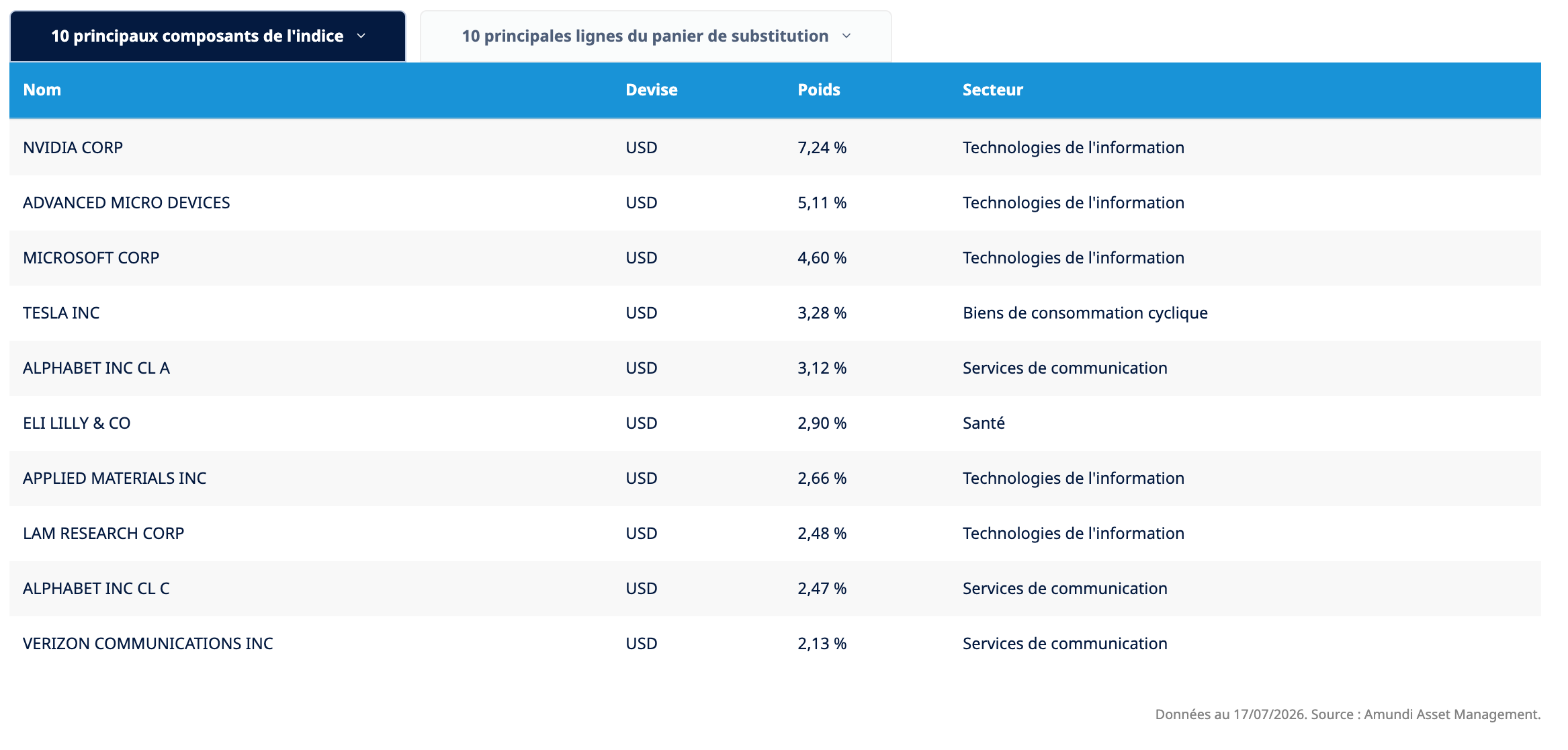
MSCI's “ESG Selection” methodology is less strict than SRI. It picks the best ESG-rated companies in each sector, without exclusions that are as broad. The approach delivers better diversification and performance often closer to the parent index. Fees are set at 0.35%, but access to US tech (Microsoft, Nvidia, Tesla, Visa) through a PEA appeals to many investors.
The counterparty risk attached to the swap has to be factored in. The most cautious investors should weigh it carefully.
European and French ESG ETF examples
Amundi MSCI EMU SRI Climate Paris Aligned UCITS ETF DR
Europe, a pioneer in sustainable finance, is prime ground for physically replicated ESG ETFs. The Amundi MSCI EMU SRI Climate Paris Aligned (formerly Amundi EMU SRI) stands out for:
- Very low fees (0.18%)
- Strict exclusions (fossil fuels, nuclear, tobacco)
- A selection of eurozone ESG champions (Nokia, ASML, Schneider Electric, AXA, Dassault Systèmes)
This ETF manages to combine ESG commitment with sector diversification. Industrials, financials and technology carry significant weight, without the overweight in US tech. For investors looking for both conviction and stability, this ETF offers a diversified profile.
BNP Paribas Easy Low Carbon 100 Europe PAB UCITS ETF

This ETF stands out for its firmly climate-driven approach: it holds 100 large European companies whose CO₂ footprint ranks among the lowest in their sector, while meeting the strict criteria of the Paris Aligned Benchmark (PAB).
It includes big names such as ASML, Novartis and AstraZeneca, with an emphasis on healthcare, financials and sustainable consumer goods.
This thematic tracker therefore lets you target lower carbon-intensity exposure, through companies selected under the Paris Aligned Benchmark. Note that it is not PEA-eligible (it holds UK and Swiss shares) and charges 0.30%.
Want to go further in sustainable investing? Read our selection of the best climate ETFs to make your portfolio greener still.
Amundi CAC 40 ESG UCITS ETF DR
The CAC 40 ESG reflects France's drive to build environmental and social criteria into its economy. The index selects 40 companies from among the 60 largest French market capitalisations. It excludes the most controversial sectors, such as weapons, coal and tobacco, then weights companies by their ESG scores.
Major groups such as LVMH, Schneider Electric, Sanofi and Airbus dominate the index. Industrials and luxury goods carry significant weight. Fees stay reasonable (0.25%) and the asset base is solid. For an investor who wants to favour responsible French companies without giving up performance, this ETF may be one of the options to consider.
Emerging-market ESG ETF examples: comparison and analysis
Amundi PEA Emergent (MSCI Emerging) ESG Transition UCITS ETF Acc
Emerging markets are often criticised over their ESG commitment, in particular for a lack of rigour or for greenwashing practices.
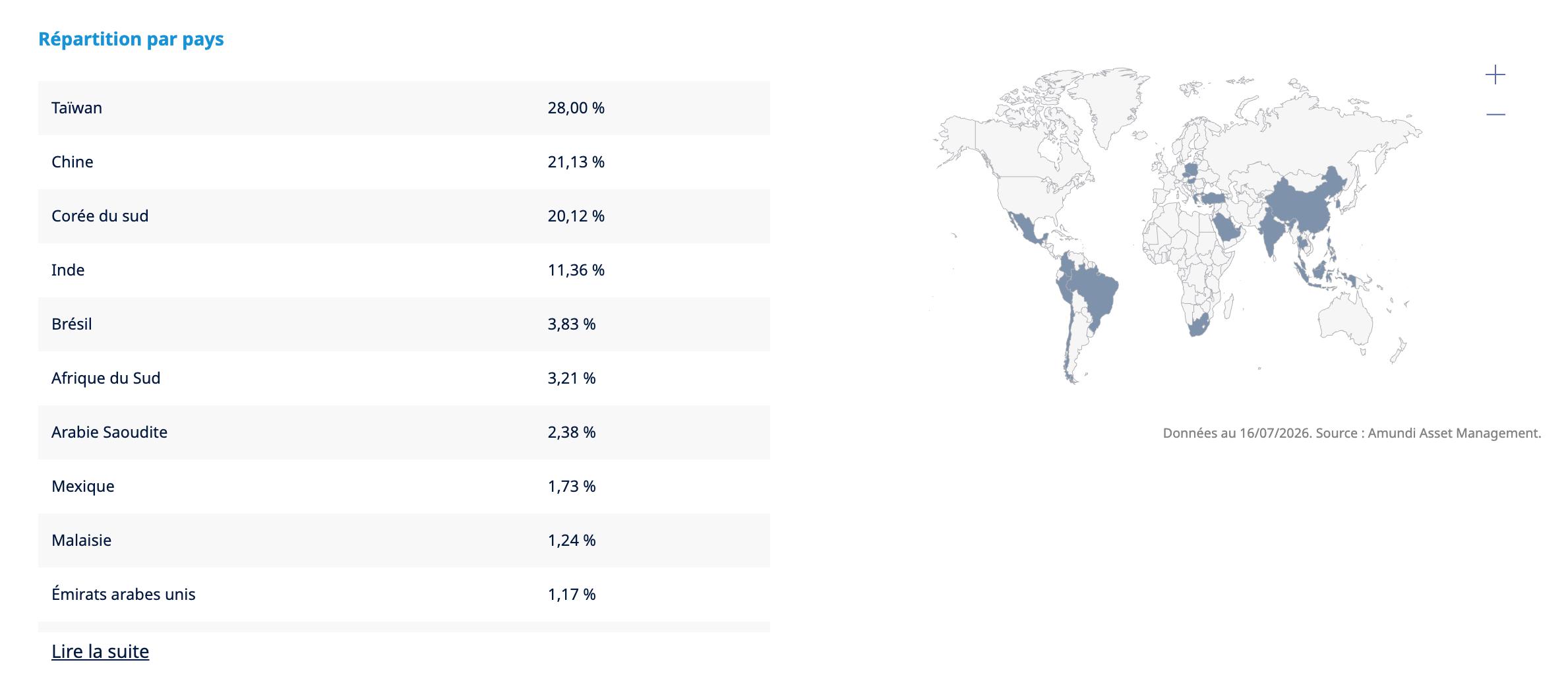
The Amundi PEA Emergent ESG Transition ETF selects the best ESG-rated companies in each country, while capping each issuer's weight at 5%. Synthetic replication makes the ETF PEA-eligible, but introduces counterparty risk.
The portfolio is led by China, Taiwan, India and Korea. Emerging tech and financial giants sit alongside industrial companies in transformation. Fees are reasonable, all the more so as ESG-screened access to emerging-market growth remains rare within the PEA universe.
The table below compares the main ESG ETFs by region, thematic screen and replication method:
| ETF | Universe | Fees (TER) | Replication | ESG: strategy | PEA | Assets (AUM) | 5-year perf. |
|---|---|---|---|---|---|---|---|
| iShares MSCI World SRI | World | 0.20% | Physical | Strict SRI | ❌ | €6.87 bn | +60.0% |
| Amundi MSCI World SRI Climate Paris Aligned | World | 0.18% | Physical | Strict SRI | ❌ | €3.56 bn | N/A |
| Amundi PEA MSCI USA ESG Selection | US | 0.35% | Synthetic | ESG Selection | ✅ | €150 m | +72.4% |
| Amundi MSCI EMU SRI Climate Paris Aligned | Europe | 0.18% | Physical | Strict SRI | ✅ | €119 m | +49.1% |
| Amundi CAC 40 ESG | France | 0.25% | Physical | ESG-weighted | ✅ | €767 m | +51.9% |
| Amundi PEA Emergent ESG Transition | Emerging markets | 0.30% | Synthetic | ESG Transition | ✅ | €849 m | +43.0% |

How do you choose the right ESG ETF?
The decisive criteria are fees (TER), the performance record, the replication method and the level of geographic and sector diversification actually achieved.
ESG ETF fees (TER)
Fees, or the TER (Total Expense Ratio), are a key factor for any long-term investor. Even a 0.20% TER can, over 20 years, noticeably reduce the final outcome because of the cumulative effect of compounding.
ESG ETFs, often seen as “premium” because of their ethical screen, sometimes charge slightly more than conventional ETFs. Competition is gradually pushing issuers to cut those fees, which benefits investors.
Some thematic or highly specialised ETFs, such as those focused on water or clean energy, carry TERs two to three times higher than broad ETFs. That premium is not always justified by better performance or deeper ESG analysis. It remains essential to compare fees carefully and not to be won over by marketing alone.
ESG ETF performance
Performance remains a central criterion, but it never follows a straight line. ESG ETFs suffer from the idea that they “sacrificed” returns for ethical criteria.
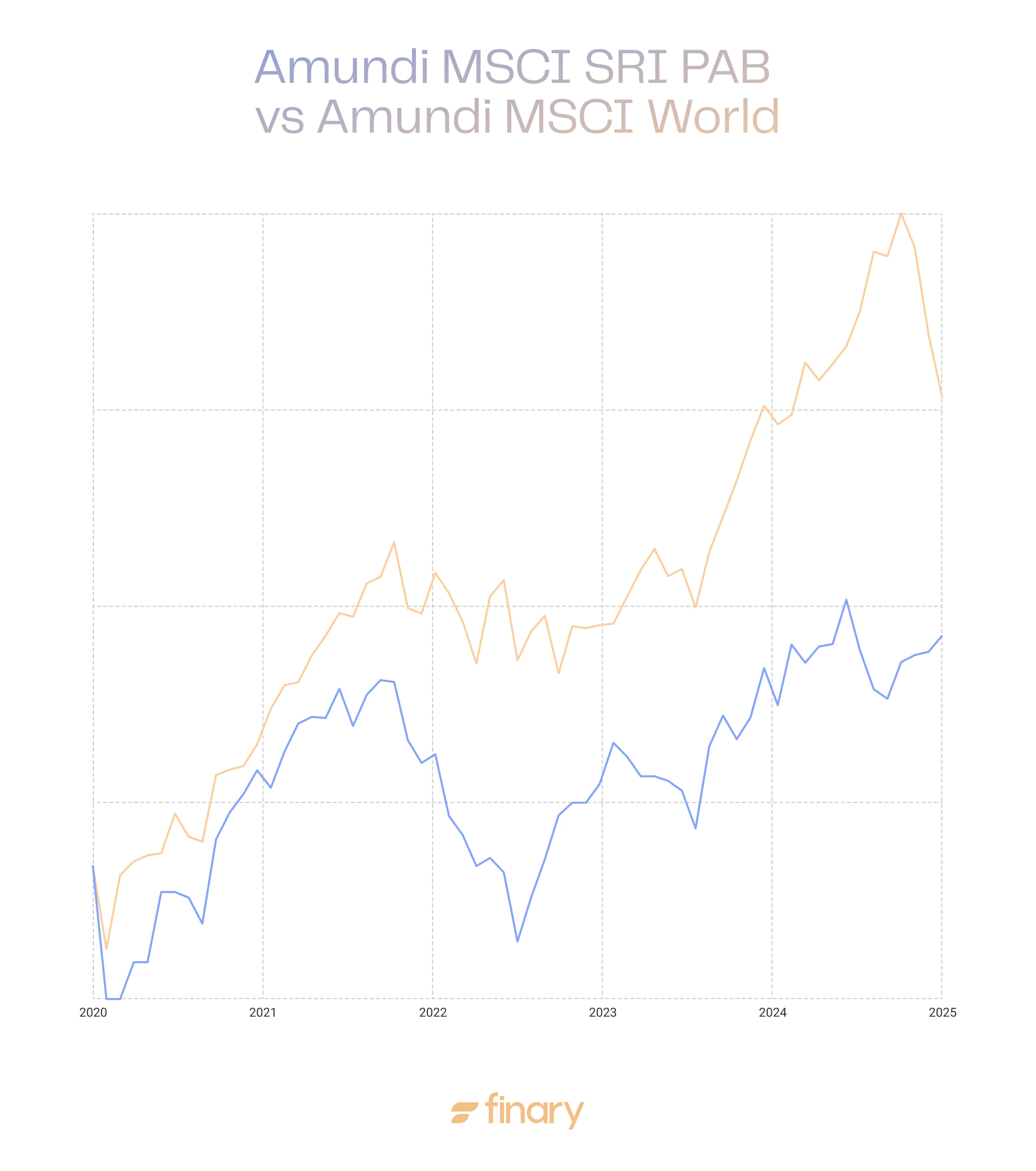
Several ESG indices have clearly outperformed their traditional counterparts. The S&P 500 ESG rose 15.1% more than the S&P 500 over five years, for example.
Beware of fashions, though. An ETF that performs well over 3 years can disappoint over 10 if its methodology excludes sectors that eventually rebound. It is therefore crucial to understand where the performance comes from: is it rigorous ESG selection, or heavy exposure to US tech?
Replication method: physical vs synthetic
Replication is central to an ETF. There are two methods:
- Physical replication, where the ETF really holds the shares: reassuring, but it limits access to non-EU markets within a PEA.
- Synthetic replication, which makes global indices reachable while staying PEA-eligible. In exchange, it adds counterparty risk and less transparency.
Before investing, always check PEA eligibility and the quality of the issuer: the structure and the collateral matter as much as performance.
Geographic and sector diversification
Diversification protects your portfolio, but ESG can complicate it.
A World ESG ETF offers good spread, but it is rarely PEA-eligible when physically replicated. Synthetic ETFs fill that gap, at the cost of a more complex structure.
Regional ETFs (Europe, US, emerging markets) let you tailor your allocation, but watch out for sector concentration. An S&P 500 ESG ETF, for example, stays heavily exposed to US tech even after screening.
One often overlooked point: the correlation between ESG ETFs. Two “green” ETFs can share 80% of their holdings, which limits real diversification.
To build a solid portfolio, combine different approaches, monitor the overlaps and accept that perfection does not exist.
What matters most is consistency with your goals, your values and your risk tolerance.
ESG ETFs: conviction is no substitute for rigour
ESG ETFs can let investors act concretely for a positive impact while still seeking sound financial results. By choosing ETFs that apply precise ESG strategies, anyone can build a portfolio aligned with their values and their return objectives.
Goals
Frequently asked questions
Does an ESG ETF perform worse than a conventional ETF?
Not systematically. Over five years the S&P 500 ESG outperformed the standard S&P 500 by a cumulative 15.1%, while the ESG version of the MSCI World slightly underperformed over the same period. Performance depends mainly on the sector composition produced by the ESG screen, not on the ESG approach itself.
Which ESG ETF should you choose to invest through a PEA?
Only synthetically replicated ESG ETFs (such as the Amundi PEA MSCI USA ESG Selection or the Amundi PEA Emergent ESG Transition) or those physically replicating European equities (Amundi EMU SRI, Amundi CAC 40 ESG) are PEA-eligible. Physically replicated World ESG ETFs are generally excluded.
What sets the ISR label apart from an SRI or ESG Leaders screen?
The ISR label is a French certification granted fund by fund after an audit, whereas SRI and ESG Leaders/Selection are MSCI index methodologies applying exclusions and an ESG selection. A fund can follow a strict SRI methodology and also hold the ISR label, as several of the Amundi ETFs cited in this article do.
Are thematic ESG ETFs riskier than broad ESG ETFs?
Generally yes. A thematic ETF (water, hydrogen, renewable energy) concentrates exposure on a small number of stocks and sectors, which raises volatility and reduces diversification compared with a broad World or European ESG ETF.
Can two different ESG ETFs overlap in a portfolio?
Yes: two World ESG ETFs from different providers can share up to 80% of their holdings, because they apply similar ESG screens to the same equity universe. Combining several broad ESG ETFs often adds only limited diversification.
Sources
Global Sustainable Investment Alliance, Global Sustainable Investment Review 2022
justETF, iShares MSCI World SRI UCITS ETF EUR (Acc) profile
justETF, Amundi MSCI World SRI Climate Paris Aligned UCITS ETF Acc profile
justETF, Amundi PEA MSCI USA ESG Selection UCITS ETF profile
justETF, Amundi MSCI EMU SRI Climate Paris Aligned UCITS ETF DR profile
justETF, BNP Paribas Easy Low Carbon 100 Europe PAB UCITS ETF profile
justETF, Amundi CAC 40 ESG UCITS ETF DR profile
justETF, Amundi PEA Emergent ESG Transition UCITS ETF Acc profile
S&P Dow Jones Indices, the S&P 500 ESG Index, 5 Years of Defining Core Through an ESG Lens
Regulatory disclaimers: Marketing communication. Investing carries a risk of partial or total capital loss. Past performance is not a reliable indicator of future performance. This article is provided for information and educational purposes only; it does not constitute personalised investment advice, a buy or sell recommendation, or tax advice.
Before investing, read the Key Information Document (KID) and, where relevant, consult an authorised adviser.
Finary SAS, an investment firm authorised by the ACPR (no. 19283), member of AMAFI. Insurance broker registered with ORIAS (no. 21001279), member of the CNCGP (association approved by the AMF). Crypto-Asset Service Provider (CASP) authorised by the AMF under the MiCA regime, references no. A2026-026 and no. N2026-008.