Best Life Insurance in France 2026: Criteria, Fees, Ranking



In 2026, the best life insurance policy in France combines four criteria: minimal fees, a wide range of investment options, a well-performing euro fund and the insurer's financial strength. With €2.119 trillion in assets under management at the end of January 2026, up 5.1% year-on-year (source: France Assureurs), life insurance keeps its place as the French people's favourite savings vehicle. In January 2026 alone, contributions reached €19.2 billion, up 9% from January 2025.
With the Livret A savings account rate at 1.5% since 1 February 2026, raised to 1.7% from 1 August 2026 (source: service-public.fr) and a favourable tax regime after 8 years, life insurance remains one of the best-performing vehicles for growing savings over the medium to long term.
But behind this success lies a simple reality: not all policies are equal. Between a traditional bank life insurance policy and an online life insurance policy, the capital gap after 20 years can exceed 30%.
To help you choose, this guide combines a technical analysis of the criteria, a data-driven demonstration of the fee impact over 20 years, and warning signs to watch for. A seven-point checklist at the end lets you quickly validate a policy's quality before subscribing.
The criteria behind the best life insurance policy
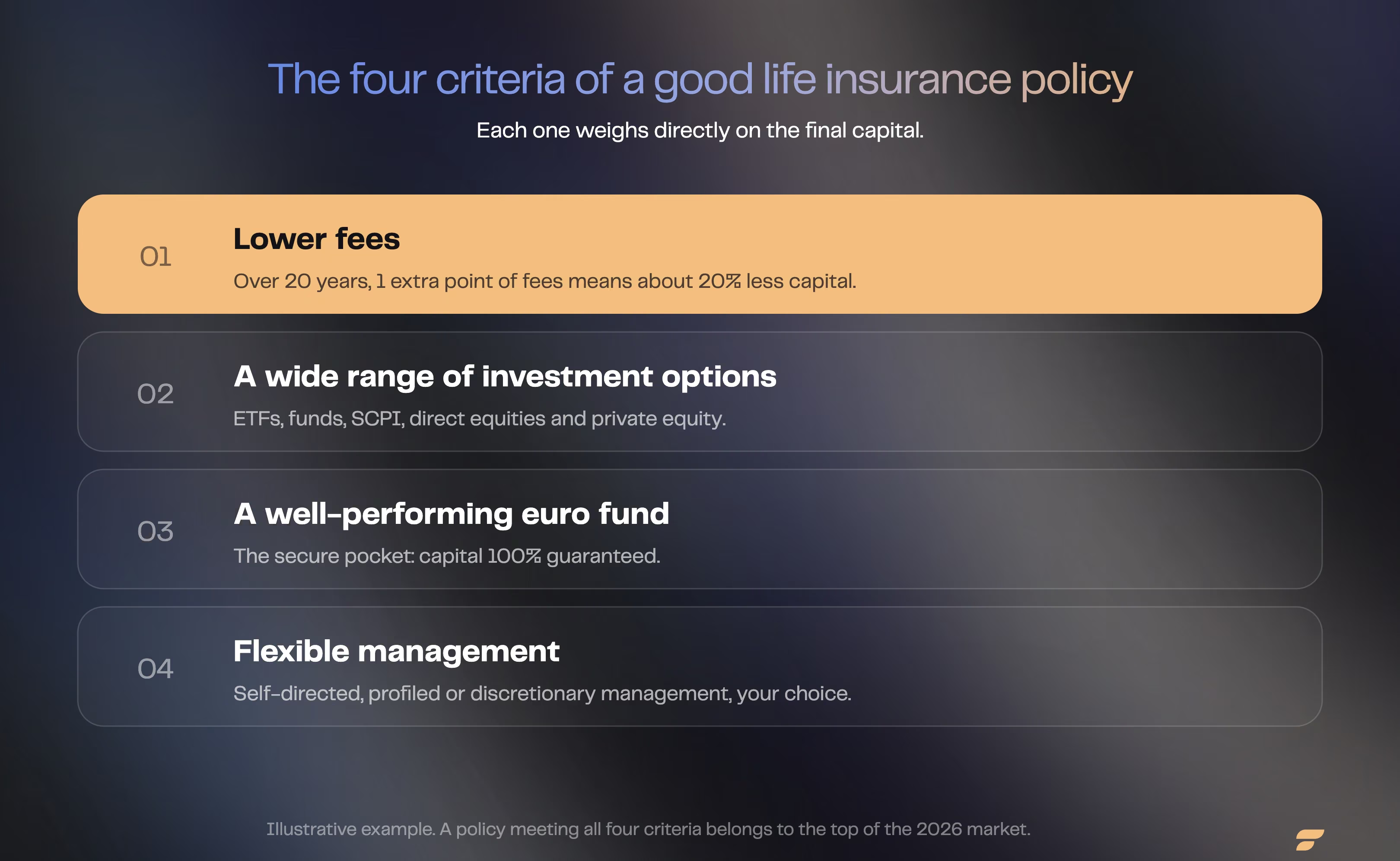
A good life insurance policy in 2026 combines four elements: minimal fees, a wide range of investment options, a competitive euro fund and flexible management. Each criterion has a direct impact on the final capital.
Fees, the first criterion to analyse
The fees on a life insurance policy stack up at several levels. They can weigh up to 3% a year in some bank policies, against less than 1% at the best online providers. This difference translates into large gaps over the long run.
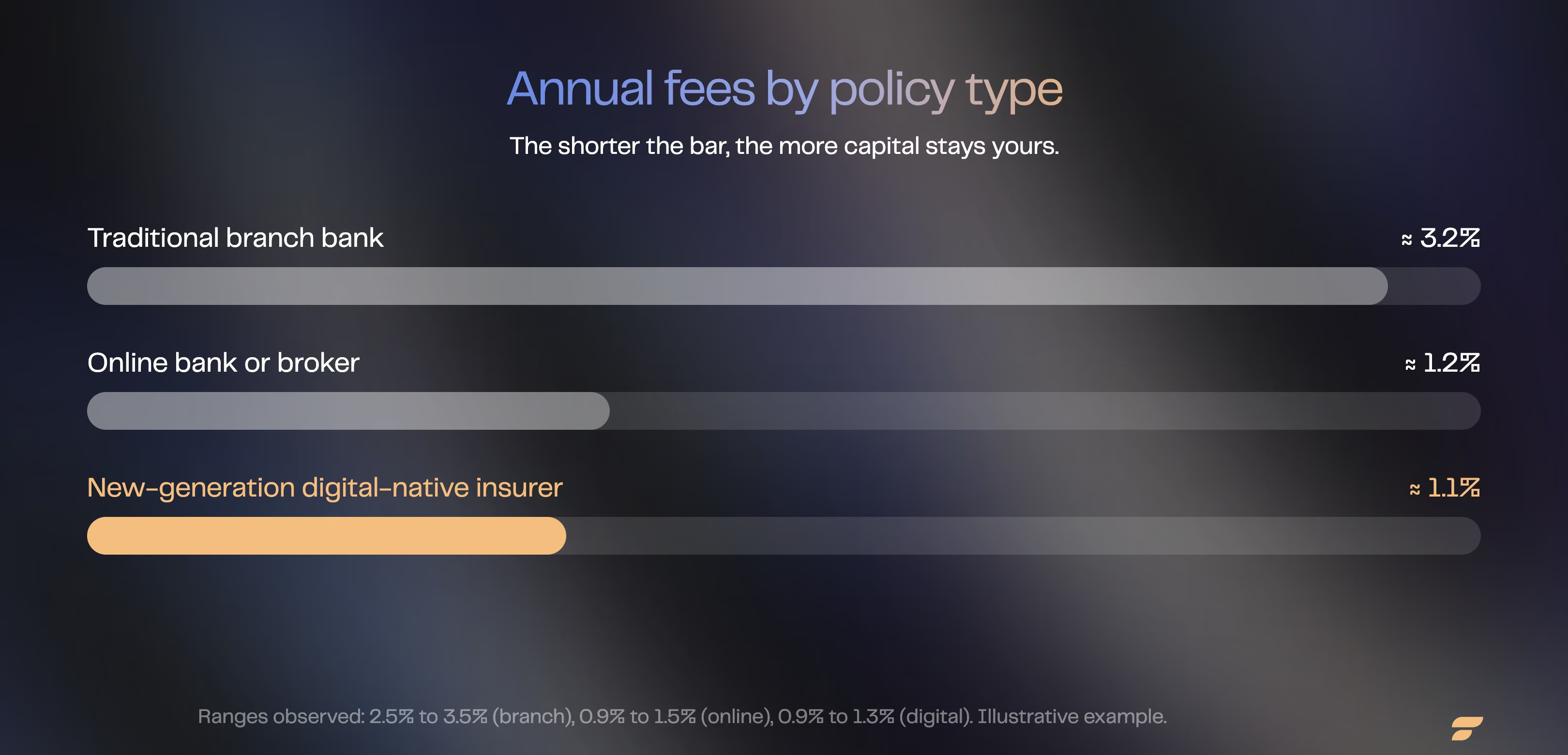
Annual life insurance fees by policy type: traditional bank 3.2%, online bank 1.2%, digital-native insurer 1.1%
Entry and contribution fees
Entry and contribution fees are deducted when the policy is opened and on every additional payment. A policy with 3% entry fees invests only €9,700 of every €10,000 paid in. These fees, which can reach up to 5% on some traditional bank policies, must be disclosed in the Key Information Document (KID, called the DIC in France) handed over before subscription.
Annual management fees
Management fees apply every year to the entire balance. They range from 0.5% to 1.5% depending on the policy and the fund (source: ACPR, France Assureurs 2025). Fees on unit-linked funds are generally higher than on the euro fund. On a €100,000 balance, a 0.5-point gap represents €500 of difference every year.
Switching fees
A switch moves savings between funds within the same policy. On some policies, each switch costs between 0.5% and 1% of the transferred amount. Ten switches in a year at 0.5% each represent 5% of drag on the amounts switched. Modern policies offer free switching.
Some policies also let you automate these operations through management options: gradual profit lock-in, periodic rebalancing, scheduled investment. These options are sometimes billed on top of the base policy.
TER of the underlying funds
The TER, or Total Expense Ratio, covers the internal costs of an investment fund. An ETF costs between 0.1% and 0.3% a year, against 1.5% to 2.5% for a typical active fund (sources: Morningstar France and AMF, annual fund fee study). These fees are deducted from the fund's value, so they are invisible on statements. They add to the policy's own fees.
The KID for each fund shows its TER, and it is handed over before any subscription. Over 20 years at 5% gross performance, a 2% TER instead of 0.2% cuts the cumulative net gain almost in half. Checking this figure for every fund selected is essential.
The quality and breadth of the fund range
A high-performing life insurance policy gives access to a wide range of investment options. This diversity protects savings and lets investors align their holdings with their own convictions.
The main investment options offered on a modern policy:
- ETFs (trackers): automatically replicate a stock market index such as the MSCI World or the S&P 500. Their very low internal fees make them the basic building block of a modern portfolio. Investing €10,000 in a World ETF at 0.2% TER rather than an active fund at 1.5% brings in several thousand euros more over 20 years, at equal gross performance.
- SCPI (a French non-listed real-estate investment fund, comparable to a REIT): let you invest in commercial real estate (offices, retail, logistics) without direct rental management. SCPI within life insurance posted variable distribution rates in 2025, but the average performance of unit-linked real-estate funds (SCI) stands at +1.47% (source: ASPIM, SCPI observatory 2025). Past performance is not a reliable indicator of future performance. SCPI availability varies by policy: some online providers focus on ETFs, equity funds and private equity to optimise management fees and the clarity of the allocation.
- Thematic and SRI (socially responsible investment) funds: give exposure to specific sectors or non-financial criteria. They let you, for example, overweight healthcare, tech or the energy transition without managing each line yourself.
- Direct equities: for self-directed investors who want to choose every line of the portfolio.
- Private equity: access to unlisted companies with a long-term horizon. The entry ticket is generally higher and liquidity more constrained than on listed options.
A policy limited to the insurer's own in-house funds deprives savers of the market's best options. The presence of benchmark ETFs in the range remains the most decisive criterion for long-term performance. SCPI within life insurance are a complementary option to consider depending on profile and real-estate exposure goals.
Euro fund performance
The euro fund is life insurance's secure pocket. Capital is 100% guaranteed on the best policies. 2025 returns ranged from 1.5% to 3.75% depending on the insurer, with an average around 2.65% (source: France Assureurs, 2025 statistics).
How the euro fund works is based on a portfolio invested mainly in bonds. Returns fell between 2015 and 2021 as interest rates declined. Since 2022, rising rates have let insurers reinvest in new bonds at better yields, which is gradually feeding through into an improved rate.
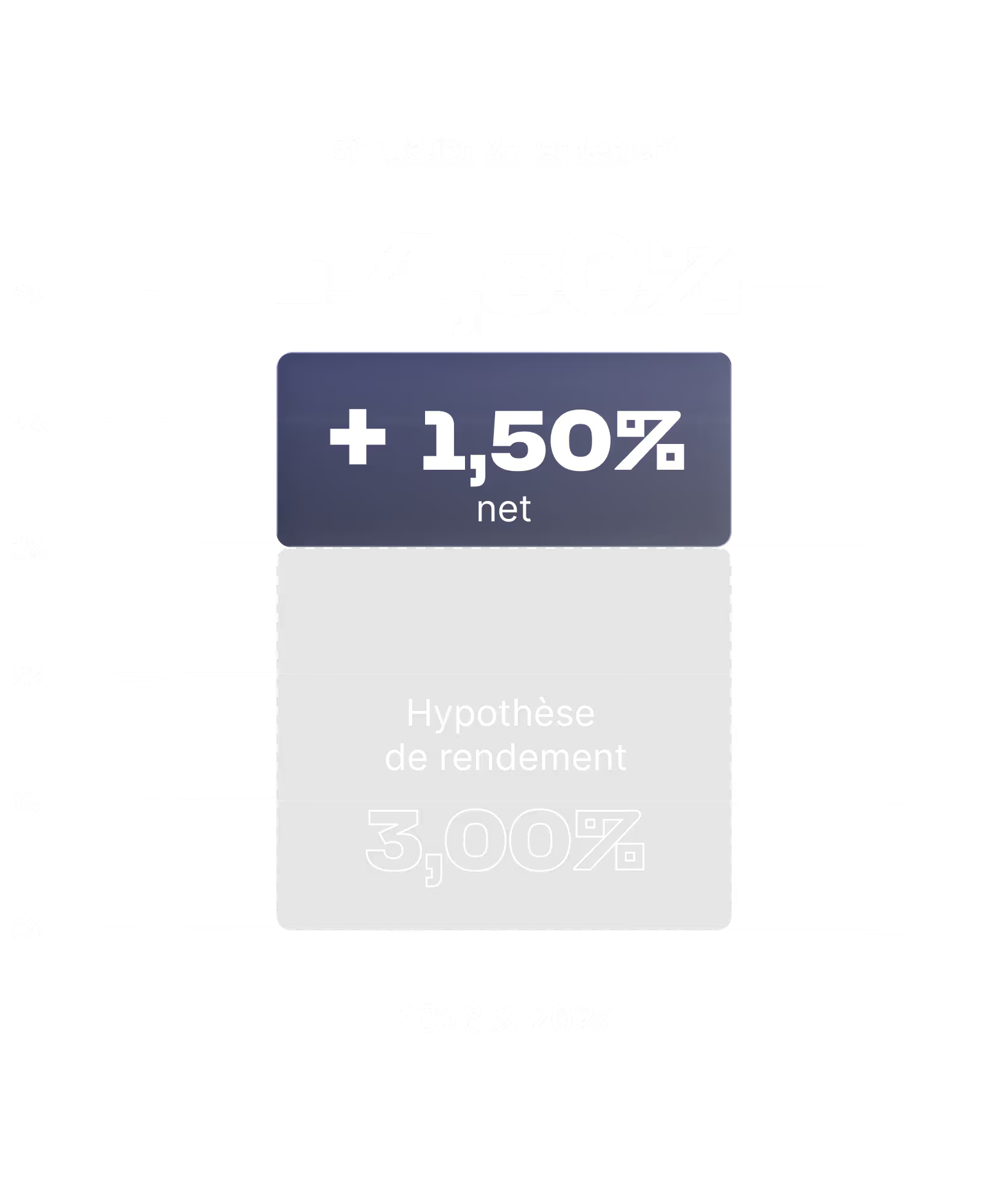
For 2026, some insurers offer return bonuses conditional on the split between the euro fund and unit-linked funds. Generali Vie's Netissima fund announces a return of 4.5% net of management fees in 2026 and 2027, subject to subscription conditions.
Euro fund performance over 3 to 5 years is a key indicator of policy quality. A euro fund paying less than 2% in 2025, when the market average stands at 2.65%, points to underperforming management. The best funds exceed 3% net return.
Netissima
Non-contractual document for promotional purposes. Investment in unit-linked vehicles carries a risk of capital loss, since their value is subject to fluctuation, both upwards and downwards, depending in particular on developments in the financial markets. The insurer's undertaking relates to the number of units, not their value, which it does not guarantee. The e-vie life insurance policy is an individual life insurance policy, denominated in euros and/or unit-linked vehicles, underwritten by Generali Vie, a company governed by the French Insurance Code. Finary SAS - 58 rue de Monceau 75380 Paris 8 - Investment Firm authorised by the ACPR under no. 19283, ORIAS no. 21001279, member of AMAFI
Flexibility of management
Three management modes coexist in life insurance. The best policy lets you combine them within the same wrapper.
| Management mode | Who decides | Target profile |
|---|---|---|
| Self-directed management | The saver | Self-directed investor who wants control over every line |
| Profiled management | The insurer or a partner (BlackRock, for example) | Passive investor who prefers to delegate |
| Personalised discretionary management | A dedicated manager | Substantial wealth, specific requirements |
The best life insurance policy leaves the choice between autonomy and delegation. This flexibility lets you adjust the strategy according to life stages and the time available to follow the markets.
The strength of the partner insurer
The insurer guarantees the funds entrusted to it. The best life insurance policy relies on a solid insurer, regulated by the ACPR, the Autorité de Contrôle Prudentiel et de Résolution (Prudential Supervision and Resolution Authority), the French body that supervises banks and insurance companies to guarantee their solvency and regulatory compliance. Generali Vie, Suravenir (Crédit Mutuel), Spirica (Crédit Agricole Assurances) and CNP Assurances are among the most prominent players in the French market.
The ACPR checks insurer solvency under the European Solvency II rules, a directive that came into force in 2016 and requires insurers to hold a minimum capital ratio proportional to their risks. The riskier an insurer's portfolio, the higher its capital buffer must be. Companies must maintain this ratio at all times and publish their SCR (Solvency Capital Requirement) ratio every year. This regulation strengthens the stability of the French market.
The security triangle rule legally separates the insurer's assets, the custodian and the policyholder. This structure protects the capital if the insurer fails. The Fonds de Garantie des Assurances de Personnes (FGAP), created in 1999 and funded by the insurance companies themselves, also covers each policy up to €70,000 per insured person per company. Beyond this threshold, the policyholder becomes an ordinary creditor of the insurer in the event of bankruptcy, which makes the company's financial strength a top-priority criterion for substantial estates.
How much does a €10,000 life insurance policy return?
Over 20 years, €10,000 invested in life insurance can return between €14,000 and €21,000 depending on the policy's fee structure. The gap comes almost entirely from the difference in fees between providers.
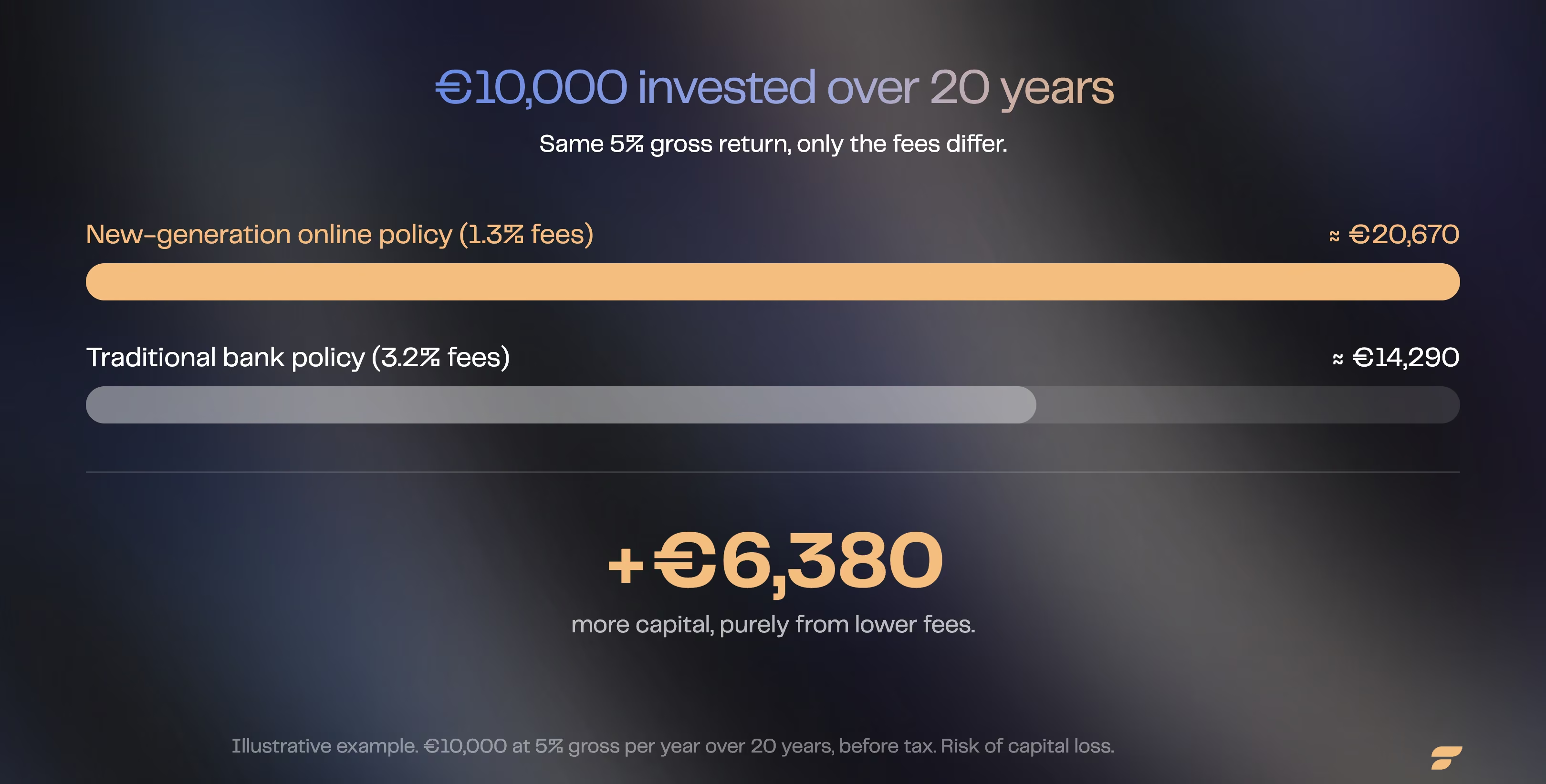
Simulation assumptions: initial payment of €10,000, no additional contributions, over 20 years, 5% gross annual return.
| Traditional bank policy | New-generation online policy | |
|---|---|---|
| Total annual fees | 3.2% | 1.3% |
| Net annual return | 1.8% | 3.7% |
| Capital after 20 years | €14,290 | €20,670 |
| Gap vs traditional policy | reference | +€6,380 |
More than a €6,000 gap on an initial payment of €10,000, purely because of fees. On a €100,000 balance, the gap reaches €63,800 over the same period.
A concrete example: Marie, 32, a tech executive. In January 2026, Marie invests €10,000 to prepare a property down payment 20 years out. If she opens her traditional bank's policy (3.2% cumulative fees), she will have €14,290 at 52. If she opens a new-generation online policy with the same investment options (1.3% cumulative fees), she will have €20,670 by the same date, or €6,380 more. That difference nearly covers the first year of a child's higher education or a 6-month stay abroad, without paying in a single extra euro. A policy's fee structure is not a technical detail, it is a life project in its own right.
This calculation does not account for any difference in the quality of the investment options. It only illustrates the mechanical effect of fees on capitalisation. On top of these fees come the funds' TER, which can widen the gap further between an ETF portfolio (about 0.3% average TER according to the AMF, 2025 data) and an actively managed fund portfolio (about 1.4% TER).
More capital invested

Non-contractual document for promotional purposes. Investment in unit-linked vehicles carries a risk of capital loss, since their value is subject to fluctuation, both upwards and downwards, depending in particular on developments in the financial markets. The insurer's undertaking relates to the number of units, not their value, which it does not guarantee. The e-vie life insurance policy is an individual life insurance policy, denominated in euros and/or unit-linked vehicles, underwritten by Generali Vie, a company governed by the French Insurance Code. Finary SAS - 58 rue de Monceau 75380 Paris 8 - Investment Firm authorised by the ACPR under no. 19283, ORIAS no. 21001279, member of AMAFI
Which life insurance policies to avoid in 2026?
A life insurance policy to avoid combines several traits: high entry fees, an underperforming euro fund, a limited range of investment options and paid switching fees. Five warning signs to check before any subscription.
1. Entry fees above 0%. No modern policy charges fees at subscription. Policies that do mechanically deduct 1% to 5% from every payment. On €50,000 paid in at 3% entry fees, €1,500 disappears before the money even starts working.
2. Management fees on unit-linked funds above 1%. The best policies charge between 0.5% and 0.8% a year. Above 1%, the drag on performance is significant. Over 20 years, an extra 0.5 point of fees represents about 10% less capital.
3. Paid switching fees. Any policy that charges for switches penalises allocation adjustments. Switches should be free on online policies. A policy that charges for them discourages regular portfolio rebalancing.
4. A euro fund underperforming for 5 years. A euro fund paying less than 2% for 5 years, when the market average is 2.65%, points to failing management. Consistency over time matters more than a single year's one-off return.
5. A range limited to in-house funds. A policy that offers only the insurer's own funds deprives savers of the market's best options, in particular ETFs from Amundi, iShares or Vanguard. The breadth of the range is a direct indicator of the policy's quality.
For more detail, the ranking of the worst life insurance policies lists the policies to avoid on the French market.
Which profile for which type of policy?
There is no universal policy. The choice depends on the level of autonomy wanted in management, the amount available and the investment horizon. The table below summarises the match between profile and policy type.
| Profile | Main goal | Recommended management mode | Suitable policy type |
|---|---|---|---|
| Self-directed investor | Build a portfolio line by line | Self-directed management | Policy with a wide unit-linked range, low fees |
| Passive investor | Delegate management | Profiled ETF management | Profile built with ETFs, controlled fees |
| Cautious saver | Secure the capital | Mostly euro fund | Policy with a well-performing euro fund |
| Substantial wealth | Optimise the estate transfer | Discretionary mandate | Luxembourg life insurance |
| Preparing a project | Fund a project 8 years out or more | Management suited to the horizon | Flexible policy, free switching |
When to open a life insurance policy?
Opening a life insurance policy is less about the amount than about the opening date. The earlier the policy is opened, the more valuable its tax seniority becomes.
Start the clock as soon as possible
The annual tax allowances of €4,600 (single) and €9,200 (couple) only apply after 8 years of holding the policy. The tax clock starts on the opening date, even with a modest initial payment. Opening a policy at 25-30 with €100 lets you, by 35, hold a tax-mature wrapper ready to receive large payments (released employee savings, an inheritance, a business-sale bonus) while immediately benefiting from the preferential regime.
Three key life-cycle moments
Three key moments justify opening (or upgrading) a policy:
- First stable job: start the clock with a minimum payment, even a symbolic one. The goal is not to invest right away but to start the tax counter.
- A project 8 years out or more (second home, children's education, early retirement): open a policy dedicated to the project, separate from the precautionary policy. This makes it easier to isolate flows and switch.
- Business sale or inheritance: a policy with 8 years of tax seniority lets you optimise the tax treatment of a large capital placement, avoiding the flat tax (PFU) at 30% that applies before 8 years.
Every year without tax seniority, withdrawals would be taxed at 30% (PFU) instead of benefiting from the preferential 24.7% regime available after 8 years, provided total premiums paid in do not exceed €150,000; beyond that, the 30% rate applies even after 8 years.
Common mistakes to avoid
The most common mistakes made when subscribing to a life insurance policy penalise savers for decades. Six traps to know before signing.
- Choosing based on brand recognition. The best-known bank policies are often the most expensive. Brand recognition does not make performance. A traditional bank policy can cost three times more than an online policy for equivalent investment options. Checking the fee structure and the fund range remains more useful than looking at the size of the branch network.
- Ignoring the funds' TER. An ETF at 0.2% and an active fund at 2% tracking the same index produce radically different results over 20 years. The TER should be checked for every fund selected, by consulting the KID provided by the insurer.
- Underestimating repeated switching fees. Four switches a year at 0.5% represent 2% of annual drag on the amounts switched. On a portfolio rebalanced regularly, that alone can be enough to wipe out performance.
- Poorly drafting the beneficiary clause. A generic or imprecise clause can block the transfer or change the intended split between heirs. A tailor-made clause, drafted with a notary or an adviser, lets you anticipate special situations: children from a first marriage, a person with a disability, transfer across multiple generations.
- Rushing into your own bank's policy. Branch proximity does not make up for a 1-to-2-point fee gap. Over 20 years, a 1-to-2-point fee differential between a traditional bank policy and an online policy translates into roughly 18% to 33% less capital, for equivalent investment options.
- Confusing the opening date with tax seniority. The allowances of €4,600 (single) and €9,200 (couple) only apply from the policy's 8th year onward. Starting the clock early builds tax seniority, even with a modest initial payment, and lets you benefit from these allowances later.
Checklist before subscribing
Before opening a life insurance policy, the seven points to check systematically.
- 0% entry fees
- Unit-linked management fees below 0.7%
- 0% switching fees
- Access to benchmark ETFs (Amundi, iShares, Vanguard)
- Euro fund with an average return above 2.5% over 3 years
- Self-directed and profiled management available
- Solid insurer regulated by the ACPR
A policy that ticks all seven boxes belongs to the top of the market. A policy missing two or more should be ruled out.
Comparison of the best life insurance policies 2026
New-generation online policies dominate the 2026 market on every fee criterion. The table below compares six representative policies, from recent digital-native providers to traditional bank policies.
| Policy | Insurer | Entry fees | Unit-linked management fees | Switching fees | Profiled management included |
|---|---|---|---|---|---|
| Finary Life | Generali Vie | 0% | 0.5% | 0% | Yes |
| Linxea Spirit 2 | Spirica | 0% | 0.5% | 0% | No |
| Lucya Abeille | Abeille Assurances | 0% | 0.6% | 0% | No |
| Fortuneo Vie | Suravenir | 0% | 0.75% | 0% | No |
| BoursoVie | Generali Vie | 0% | 0.75% | 0% | No |
| LCL Vie | Predica | 3.5% | 0.95% | 0.7% | No |
On ongoing fees, Finary Life and Linxea Spirit 2 tie at the bottom of the market at 0.5% annual management on unit-linked funds. The difference lies in flexibility: Finary Life includes profiled management built with BlackRock at no extra cost, while Linxea Spirit 2 remains a 100% self-directed policy. Traditional bank policies (LCL Vie, but also Caisse d'Épargne Millevie Initiale 2 with up to 3.5% entry fees, or La Banque Postale Cachemire 2 at 3%) stack up contribution and management fees that keep them out of the top of the market.
One question often comes up once the policy is chosen: is life insurance or the PER (France's retirement savings plan) better? The two wrappers are complementary and serve different goals. We compare them in detail, with 2026 tax rules, in our dedicated guide life insurance or the PER.
Frequently asked questions
What is the best life insurance policy in 2026?
The best life insurance policy in 2026 combines four criteria: 0% entry and switching fees, management fees on unit-linked funds below 0.7%, a broad range including ETFs, SCPI and private equity, and a euro fund with a net return above 2.5% on average over 3 years. New-generation online policies meet these criteria today, while most traditional bank policies fall short on fees.
Which life insurance policies to avoid in 2026?
Life insurance policies to avoid combine entry fees above 0%, unit-linked management fees above 1%, paid switching fees and a fund range limited to in-house funds. These policies are designed to pay distribution rather than to grow savings.
How much does a €10,000 life insurance policy return?
Over 20 years at 5% gross return, €10,000 returns about €14,300 in a bank policy at 3.2% fees and €20,700 in an online policy at 1.3% fees. The €6,400 gap comes solely from the policy's fee structure.
Which fees should you prioritise checking on a life insurance policy?
Annual management fees and the funds' TER weigh the most over the long run. Entry fees penalise the initial capital. Switching fees create drag at every rebalancing. Over 20 years, one extra point of annual fees represents roughly 17% to 18% less capital (at equivalent gross return).
What is the minimum amount to open a life insurance policy?
The opening amount varies by policy: from €100 to €500 on most new-generation online policies. Luxembourg policies generally require a minimum entry ticket of between €125,000 and €250,000 depending on the insurer. No maximum cap applies to standard French policies.
Does the 2026 rise in social security contributions affect life insurance?
No. The 2026 Social Security Financing Act raised the CSG (France's general social-security contribution) by 1.4 points from 1 January 2026, bringing social security contributions to 18.6% on most investments (securities accounts, the PEA, France's tax-advantaged equity savings account, cryptocurrencies, dividends, capital gains on securities, employee savings schemes such as the PEE and PERCO, and the PER) and the overall flat tax (PFU) to 31.4% for these products. Life insurance was explicitly excluded from this increase and keeps its social security contributions at 17.2%. Its overall PFU therefore stays at 30%, making it one of the most tax-efficient wrappers in the new 2026 tax landscape.
Regulatory disclaimers:
Marketing communication. Investing carries a risk of partial or total capital loss. Past performance is not a reliable indicator of future performance. This article is provided for information and educational purposes only; it does not constitute personalised investment advice, a buy or sell recommendation, or tax advice.
The capital guarantee on euro funds is provided by the insurer and depends on its financial strength. In the event of a severe systemic crisis, the French "Sapin 2" law allows withdrawals to be temporarily restricted (liquidity), without affecting the guaranteed capital. Unit-linked funds are not guaranteed and carry a risk of capital loss.
Before investing, read the Key Information Document (KID) and, where relevant, consult an authorised adviser.
Finary SAS, an investment firm authorised by the ACPR under no. 19283, member of AMAFI. Insurance broker registered with ORIAS under no. 21001279, member of the CNCGP (association approved by the AMF). Crypto-Asset Service Provider (CASP) authorised by the AMF under the MiCA regime, references no. A2026-026 and no. N2026-008.