How to Get Positive Cash Flow on a Rental Property in France?

Updated on 28 July 2026
A rental property in France has positive cash flow when the rent covers the loan repayments and all the costs, with a surplus left over. On paper, that sounds simple. In practice, it is far rarer than advertised.
To show it, this article relies on a real, itemised balance sheet: that of Mounir, Finary's co-founder, who detailed the full accounts of his rental property, a T2 (a two-room flat, roughly a one-bedroom apartment in the French classification) in Chambéry, bought in 2020 and sold in 2025.

- Cash flow is the difference between the rent collected and the sum of the loan repayments and all the costs.
- On this real balance sheet, a positive cash flow of €150 to €200 was expected: once every cost was factored in, the property was only just self-financing.
- Property tax (taxe foncière) up 25% in 4 years, accounting fees, management at 7% of the rent: the side costs eat into cash flow.
- The LMNP status (a French non-professional furnished-rental scheme) under the actual-expenses regime allows the property to be depreciated and rental income tax reduced to zero, but the 2025 reform makes resale taxation heavier.
- Final result: a €27,079 net gain over 4.5 years (+62.9%), at the cost of a mental load that many underestimate.
What is cash flow in rental property?
Cash flow is your rent minus your loan repayments and your costs: property tax (taxe foncière), management, accounting, upkeep, insurance.
Three scenarios are possible. Negative cash flow: you top it up from your own pocket every month. Self-financing: the property covers exactly its own costs. Positive cash flow: the property generates a monthly surplus.
It is this last scenario that most investors are aiming for, and it is the hardest to reach. Our complete rental property investment guide lays the groundwork; here, we look at what reality delivers over 5 years.
The real case: a flat bought in 2020, sold in 2025
In 2020, a period of historically low rates, Mounir buys a flat in Chambéry, his hometown: €120,650, plus €10,577 in acquisition costs (of which about €9,000 in notary fees).
The choice of property limits the surprises: no lift, no garden, low service charges, a small co-owned building with few collective decisions to make. A real advantage for a first investment with no experience.
The financing: €43,015 in personal contribution, a third of the property's value and a leverage factor of 3, topped up by an €88,960 loan at 1.10% over 15 years.
On the operating side: rent of €760 to €780 per month, against loan repayments of €542. In months when it is rented, the rent covers the repayments and the management costs: the property is self-financing.
The tax lever: LMNP under the actual-expenses regime
To make the deal profitable, the regime chosen is LMNP (location meublée non professionnelle, France's non-professional furnished-rental status) under the actual-expenses regime. This status allows the purchase price to be depreciated over 25 to 40 years: every year, the accountant deducts the documented actual costs (works, furniture, interest) and the depreciation from the rent.
The result: taxable rental income that can drop to zero. You collect rent with no tax on it for years. The status applies as long as rental income stays under €23,000 per year, or below your other earned income.
Self-managing to save on agency fees
To limit costs, management was first handled without an agency. The property was rented at the time of purchase, but the tenant ended their lease within a month of the acquisition.
The method was empirical: watch which listings worked on classified-ad sites, then reproduce the formula. A clear title, the floor area, the neighbourhood, a price, bright, well-lit photos, and a description spelling out transport links, shops and the condition of the property.
Viewings targeted students as a priority, for stable demand. The application chosen was solid, with a guarantor whose income was well over three times the rent.
The rest comes down to organisation: standard documents prepared once and for all (lease, listing, furniture inventory) and a trusted person on the ground for move-ins, move-outs and emergencies. Over the 5 years, tenants followed one another with no vacancy period at all, each change allowing the rent to be raised by €20.
Why is positive cash flow rarer than advertised?
Because side costs, often left out of simulations, eat into the surplus month after month. The initial expectation was a positive cash flow of €150 to €200 per month; once every cost was factored in, the property was only just self-financing.
| Item | Actual amount |
|---|---|
| Monthly rent | €760 to €780 |
| Loan repayment | €542 |
| Rental management (from 2024) | 7% of the rent, just under €55 per month |
| Property tax (taxe foncière) | €509 in the first year, €638 in the last (+25% over 4 years) |
| Annual accounting | €300 |
Source: real balance sheet of the property, 2020-2025.
On top of that come the ups and downs of management. Three tenants in 5 years, the last of whom regularly paid late, by 3 to 10 days on each rent payment. A failing syndic (the building's co-owners' management body): general meetings running late, paper documents sent the day before, service quality declining. Roof works to finance, thankfully handled by the syndic.
Worth noting, two protections not taken out in this case: GLI (garantie loyers impayés, French unpaid-rent insurance) and the Visale guarantee from Action Logement. The furnished lease allowed for a deposit of two months' rent, judged sufficient at the time. The chronically late-paying tenant showed the limits of that choice.
Worn down, management was eventually handed to an agency in 2024, for 7% of the rent. Our 6 tips to improve rental yield detail the other levers still available.

What does the LMNP reform change on resale?
Since 1 January 2025, two changes have made taxation heavier for furnished-rental landlords. The micro-BIC allowance drops from 50% to 30% for a standard furnished let. And more importantly, depreciation deducted during the rental period must now be added back into the resale capital-gains calculation, under article 150 VB III of the French General Tax Code (Code général des impôts).
On this balance sheet, the impact is clear. Over four years of ownership, €11,670 in depreciation had been deducted from rental income. On resale, it reduces the adjusted acquisition price: €131,227 minus €11,670, giving €119,557.
The taxable capital gain jumps: €6,023 before the reform, €17,693 after. That is €4,225 in extra tax to pay, for the exact same sale.
One detail that matters: the flat-rate 15% works allowance on the acquisition price only applies after five years of ownership. As the property was sold after four years and ten months, that allowance was lost by just two months.
The final result: +62.9% over 4.5 years
Sold for €144,250, minus €7,000 in agency fees: €137,250. The notary first repays the €60,751 of outstanding capital owed to the bank.
On top of that, €3,362 in income tax on the capital gain (at the 19% rate) and €3,043 in social security contributions (17.2% at the time of the sale), for €6,405 in taxes.
The notary finally transfers €70,094. Once the initial €43,015 contribution is subtracted, the net gain comes out at €27,079: +62.9% over 4.5 years. A strong result in absolute terms. Past performance is not a reliable indicator of future performance.
With one caveat: by waiting, the property could probably have sold for around €165,000 instead of €144,250. The decision to move on therefore also had a cost of its own.
Rental property or the stock market: how big was the gap?
The gap is considerable, at least in hindsight. What would have happened by investing the price of the flat, €131,975, in an accumulating MSCI World ETF over the same period? The retrospective simulation, with the same contribution and an Lombard loan of €88,960 as leverage, is dizzying.
Between September 2020 and March 2025, the ETF's unit price rises from €54.96 to €97.12: +76.7%. After repaying the loan, €4,401 in interest, and the taxation in force at the time, the net gain comes out at €109,472 via a securities account (+155%) or €122,428 via a PEA (a French tax-advantaged equity savings account) held for more than 5 years (+185%).
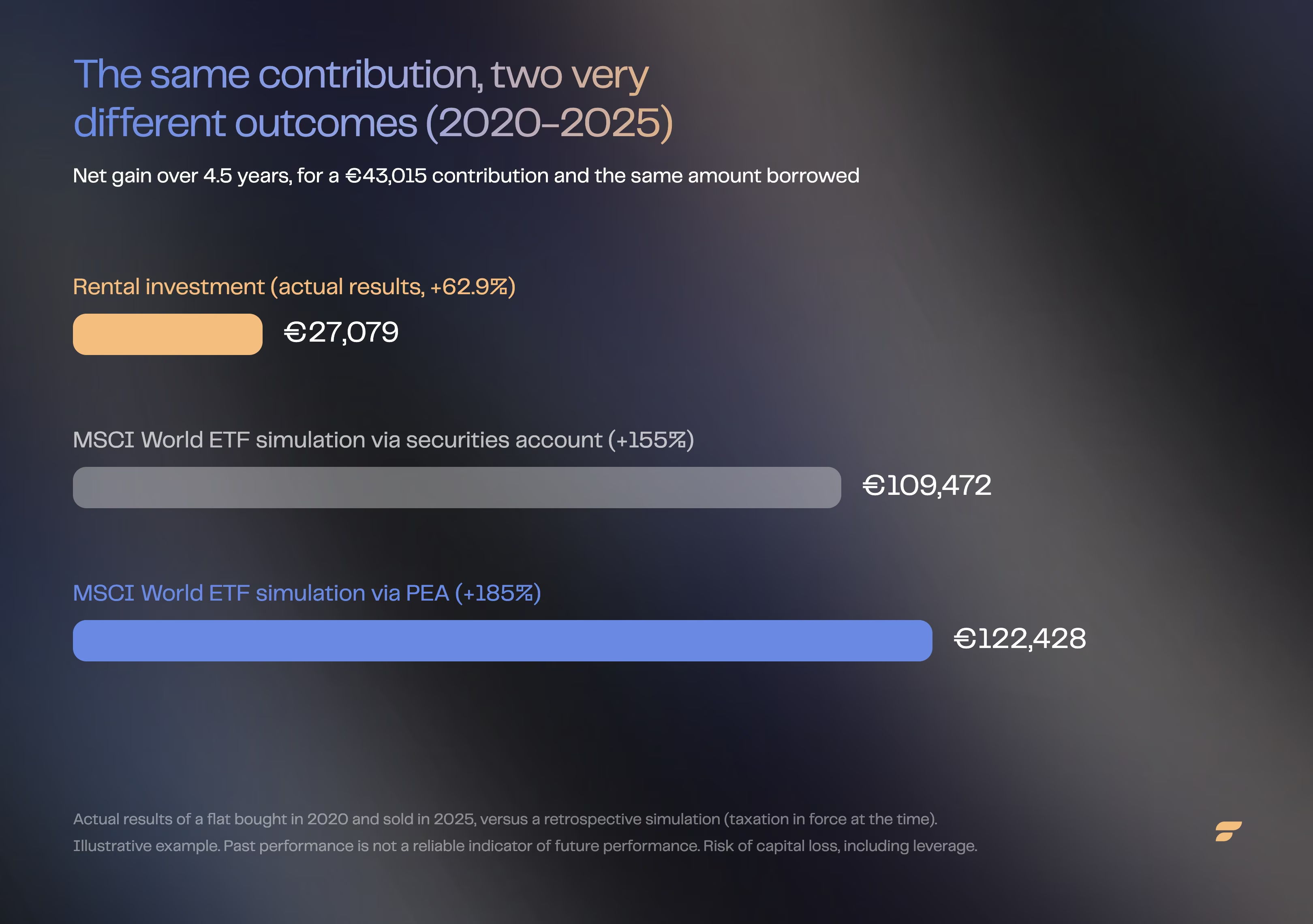
The opportunity cost reaches €95,349. But this simulation comes with three caveats.
First, reasoning backwards from past performance is a classic bias: nobody can predict the market, and had the 2020 stock market crash dragged on, the loss could have been heavy.
Second, a Lombard loan is not a mortgage: usually structured as a bullet loan (principal repaid at maturity), often at a variable rate, it requires pledging more than €100,000 in assets to borrow €88,960, and exposes you to a margin call in a crash: either you top up the collateral, or you get liquidated.
Third, a portfolio made up of a single ETF is not recommended: the simulation illustrates a principle, not a strategy to copy.
The real lesson lies elsewhere: stocks offer performance but are highly volatile; real estate offers less potential return, but more stability and predictability. In a portfolio, it acts as a shock absorber. Our guide on how to invest in real estate reviews the other ways to gain exposure to it.
What this balance sheet means for your cash flow
First lesson: count everything. Property tax (taxe foncière, and its rise), accounting, management, potential vacancy, works, guarantees. A positive cash flow on paper quickly turns into simple self-financing in reality.
Second lesson: time is a cost. Chasing a late-paying tenant, dealing with a failing syndic, handling small day-to-day issues: more than four years of effort for a €27,000 gain. With hindsight, Mounir would use an agency from the start, even at 7% of the rent, and would buy closer to home.
Third lesson: leverage is powerful, a low initial investment can let you gain a great deal, but everything is decided at the moment of purchase, and the loan must be repayable in every scenario.
Last and most important lesson: rental property is not for everyone. Some people love renovating, negotiating, managing. Others discover that it is not what they want. Investing is also a way of learning about yourself.

Frequently asked questions
What is a cash-flow-positive rental investment?
A property whose rent covers the loan repayments and all the costs (property tax, management, accounting, upkeep), with a monthly surplus left over. When the rent covers exactly the costs, that is called self-financing, not positive cash flow.
What is the LMNP status?
LMNP stands for location meublée non professionnelle, France's non-professional furnished-rental status. Under the actual-expenses regime, it allows the purchase price to be depreciated over 25 to 40 years and the actual costs to be deducted: taxable rental income can drop to zero. The status applies as long as income stays under €23,000 per year or below your other earned income.
What changes with the 2025 LMNP reform?
Two things: the micro-BIC allowance drops from 50% to 30% for a standard furnished let, and the depreciation deducted during the rental period is added back into the resale capital-gains calculation. On the balance sheet studied here, that add-back cost €4,225 in extra tax.
Rental property or the stock market: which should you choose?
Stocks offer more potential performance, but with high volatility. Real estate generally returns less, but moves slowly and acts as a shock absorber in a portfolio. Nobody can predict the market, and past performance is not a reliable indicator of future performance.
Should you outsource rental management?
With hindsight, on this balance sheet the answer is yes: an agency from the start, for around 7% of the rent (under €55 per month here), would have avoided most of the management issues. Provided that cost is included in the initial cash-flow calculation.
Sources
impots.gouv.fr - Location meublée
impots.gouv.fr - Les régimes d'imposition
Service-Public - Impôt sur le revenu : plus-value immobilière
Regulatory disclaimers: Marketing communication. Investing carries a risk of partial or total capital loss. Past performance is not a reliable indicator of future performance. This article is for informational and educational purposes only; it does not constitute personalised investment advice, a buy or sell recommendation, or tax advice. Before investing, read the Key Information Document (KID) and, where relevant, consult an authorised adviser. Borrowing amplifies losses as well as gains and can lead to a loss greater than the capital invested (you remain liable for the loan). Complex, high-risk product. Finary SAS, an investment firm authorised by the ACPR (no. 19283), member of AMAFI. Insurance broker registered with ORIAS (no. 21001279), member of the CNCGP (association approved by the AMF). Crypto-Asset Service Provider (CASP) authorised by the AMF under the MiCA regime, references no. A2026-026 and no. N2026-008.