Stock Picking: How to Choose the Right Stocks

Updated on 23 July 2026
Stock picking is the art of choosing individual stocks to try to beat the market. It can pay off handsomely, but it is also difficult and risky.
You do not need to be a trader: with common sense and a solid method, any investor can give it a try. The golden rule is knowing what you are buying.
Here is the method, the indicators to watch, and the keys to managing your portfolio.

- Stock picking can outperform an index, but more than 90% of professional fund managers fail to beat theirs over 10 years (SPIVA study).
- Peter Lynch's method fits in one sentence: invest in what you know, then validate it with analysis.
- Sorting a stock into one of Lynch's 6 categories helps calibrate your expectations and strategy.
- A few simple indicators are enough: P/E ratio, earnings growth, dividends, debt, competitive advantage, and insider buying.
- Managing the position matters as much as picking it: patience, a concentrated portfolio, and knowing when to sell.
What is stock picking, and who is it for?
Stock picking means selecting specific companies rather than buying a basket of stocks like an ETF. Its main appeal: aiming for returns above the market.
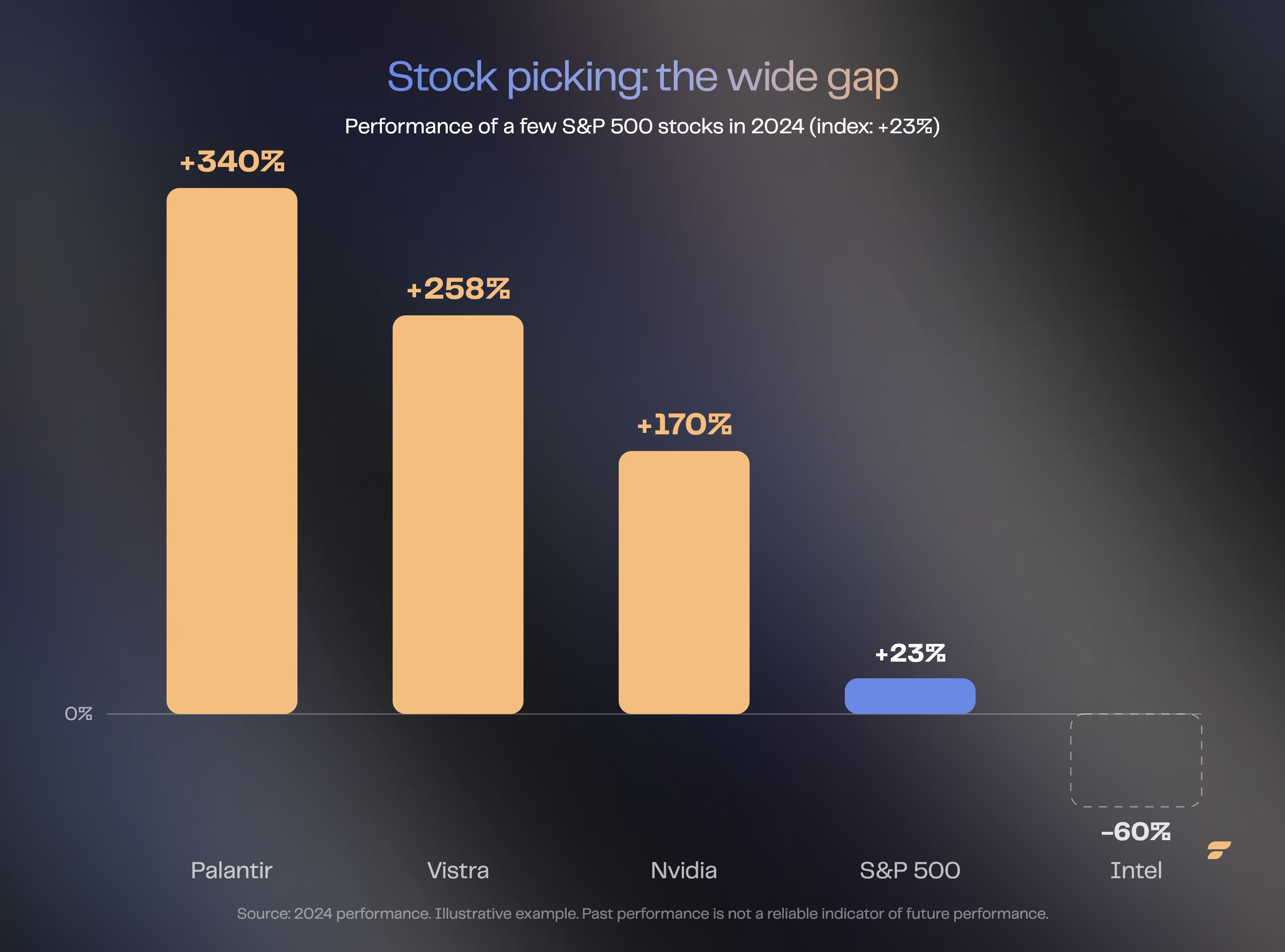
In 2024, the S&P 500 gained about 23%. But some of its stocks did far better: +107% for Broadcom, +170% for Nvidia, +258% for Vistra, and up to +340% for Palantir. Past performance is not a reliable indicator of future performance.
The flip side is risk. That same year, Intel lost 60%. And above all, it is hard: according to the SPIVA study by S&P Dow Jones Indices, more than 90% of professional fund managers underperformed their index over ten years, despite their teams and their tools.
Stock picking therefore requires two things: time to analyse companies, and enough risk tolerance to absorb sharp swings. Many investors devote only a limited share of their portfolio to it, keeping the rest invested in ETFs.
One last useful distinction: technical analysis (studying charts, mostly for the short term) and fundamental analysis (understanding the company, its products, its finances, its management). It is the latter, long-term focused, that guides the rest of this guide.
Peter Lynch's method: invest in what you know
Faced with thousands of listed companies, where do you start? For Peter Lynch, the answer is simple: invest in what you know.
Lynch is one of the most famous investors in history. At the helm of the Fidelity Magellan Fund from 1977 to 1990, he delivered an average annual return of 29.2%, growing the fund from $18 million to $14 billion.
His principle: your everyday life is a goldmine. By watching the products and services you and the people around you adopt, you often spot trends before financial analysts do.
But observing is not enough. Spotting a promising company guarantees nothing: you need to validate the hunch with financial analysis, after first understanding which category it belongs to.

The 6 types of stocks according to Peter Lynch
Categorising a stock helps you understand its risks, its opportunities and its place in a strategy. Lynch identifies six such families.
| Category | Profile | Examples |
|---|---|---|
| Slow Growers | 2% to 4%/year growth, regular dividends | Procter & Gamble, Johnson & Johnson, EDF |
| Stalwarts | Moderate growth (about 4%/year), stable | Coca-Cola, Nestlé, McDonald's |
| Fast Growers | More than 20%/year, high potential but risky | Tesla, Nvidia |
| Cyclicals | Performance tied to the economic cycle | Air France-KLM, Airbus, TotalEnergies |
| Turnarounds | All-or-nothing bet on a rebound | BlackBerry, Intel |
| Asset Plays | Assets (real estate, cash, patents) undervalued by the market | - |
This classification is not just academic: it sets your expectations. You do not expect the same thing from a stalwart as from a fast grower, and you do not buy them for the same reasons.
Which indicators should you look at?
A few simple indicators are enough to analyse a company without spending your days on it.
The first is the price-to-earnings ratio (P/E): it measures how much investors pay for each euro of profit. A high P/E reflects strong expectations (Nvidia traded at a P/E of 53), while a low P/E can signal an undervalued stock or a risky company.
The second is earnings growth: how fast the company turns sales into profits. One trick is to compare it with the P/E: if growth is higher than the P/E, the stock may be undervalued; if it is lower, be cautious.
Next come dividends (a key criterion if you are after income, with the Dividend Aristocrats that have raised theirs for 25 years and the Dividend Kings for 50 years) and the debt-to-assets ratio, which measures the share of assets financed by debt.
Three qualitative criteria matter just as much. The competitive advantage, or the moat Warren Buffett is fond of: what durably protects a company, such as Apple's ecosystem or Meta's network effect. The positioning in a growing market. And the quality of management, particularly its alignment with shareholders.
Lastly, one bonus indicator: the insider-buying signal. When executives buy shares in their own company, it is often a sign of confidence, because they sell for many reasons but only buy for one: they believe in the company's future. Sites such as secform4.com let you track these transactions.
The 5 keys to managing your portfolio
Picking good stocks is not enough: management makes the difference.
1. Time is your best ally. Solid stocks reveal their value over the long term. Bought in 2003, Nvidia stock took until 2015 to double, before multiplying 230-fold between 2015 and 2025. Panicking at the slightest dip is the classic mistake.
2. Ignore market noise. Alarming headlines rarely reflect a company's true value. Focus on growth and earnings.
3. Diversify, but not too much. A few companies you understand well beat a long list you do not follow. Concentrated stock picking, around five positions, stays easier to manage.
4. Know when to sell. Two cases justify a sale: obvious overvaluation (a P/E that has become too high, slowing growth) or a better opportunity elsewhere. Avoid getting sentimentally attached to a stock.
5. See dips as opportunities. Market corrections are normal. Rather than fearing them, use them to add to good companies at a lower price.

Frequently asked questions
What is stock picking?
It is the selection of individual stocks with the aim of doing better than the market, rather than investing in a diversified basket like an ETF. The preferred approach is fundamental analysis: understanding the company, its products, its finances and its management over the long term.
Is stock picking profitable?
It can be, but it is hard. According to the SPIVA study, more than 90% of professional fund managers underperform their index over ten years. The dispersion is enormous: in 2024, some S&P 500 stocks gained more than 300% while others lost 60%. Past performance is not a reliable indicator of future performance.
How many stocks should you hold?
Rather than multiplying positions, it is better to focus on a few well-understood companies. A concentrated portfolio, around five positions, cuts transaction costs and stays easier to follow than a list of dozens of stocks.
How do you know when to sell a stock?
Two situations justify a sale: when the stock is clearly overvalued relative to its fundamentals (P/E too high, slowing growth), or when a better opportunity comes up elsewhere. The mistake is getting attached to a stock for the wrong reasons.
Technical analysis or fundamental analysis?
Technical analysis studies charts and price trends, mostly for the short term. Fundamental analysis seeks to understand the company as a whole, over the long term. For an individual investor, fundamental analysis is generally the better fit.
Sources
SEC Form 4 - tracking insider transactions (insider buying)
justETF - Dividend Aristocrats ETF
Regulatory disclaimers: Marketing communication. Investing carries a risk of partial or total capital loss. Past performance is not a reliable indicator of future performance. This article is provided for information and educational purposes only; it does not constitute personalised investment advice, a buy or sell recommendation, or tax advice. Before investing, read the Key Information Document (KID) and, where relevant, consult an authorised adviser. Finary SAS, an investment firm authorised by the ACPR (no. 19283), member of AMAFI. Insurance broker registered with ORIAS (no. 21001279), member of the CNCGP (association approved by the AMF). Crypto-Asset Service Provider (CASP) authorised by the AMF under the MiCA regime, references no. A2026-026 and no. N2026-008.