

Archegos, or how to lose $20 billion in a week

Updated on July 30, 2026
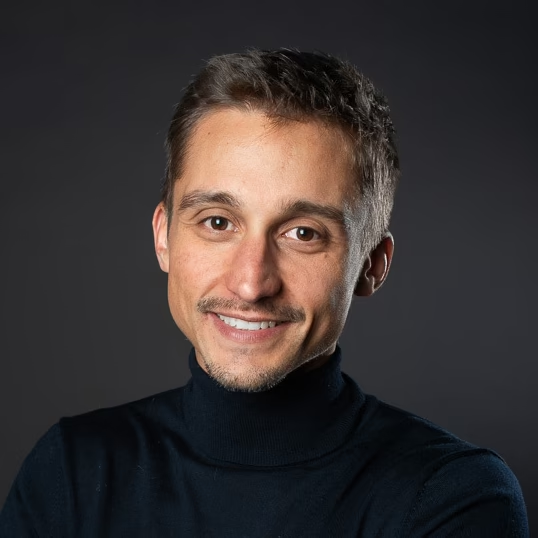
Bill Hwang, founder of the family office Archegos, was one of the richest financiers on Wall Street. In late March 2021, he lost most of his fortune, around $20 billion, within days, dragging several major global banks down with him.

- Bill Hwang built his fortune at Tiger Management, then through Archegos, the family office he founded in 2013 with $200 million.
- Archegos placed leveraged bets through Total Return Swaps on stocks like Viacom, Baidu and Tencent, without disclosing its positions.
- Viacom's stock collapse in late March 2021 triggered a cascade of margin calls, causing Archegos to fail on March 29, 2021.
- Credit Suisse and Nomura were among the hardest-hit banks, with losses of around $5.5 billion and $2.85 billion respectively.
- Bill Hwang was found guilty of fraud and market manipulation in July 2024, and sentenced to 18 years in prison in November 2024.
| Date | Event |
|---|---|
| 2013 | Bill Hwang founds Archegos Capital Management with around $200 million in personal capital |
| March 24-26, 2021 | Viacom's stock collapse triggers margin calls the fund cannot meet |
| March 29, 2021 | Archegos fails, costing Bill Hwang around $20 billion and its prime brokers several billion more |
| July 2024 | Bill Hwang is found guilty of securities fraud and market manipulation by a federal jury |
| November 2024 | Bill Hwang is sentenced to 18 years in prison, a sentence he is currently appealing |
| January 2026 | Bill Hwang requests a presidential pardon for his conviction |
| March 2026 | The SEC reports progress toward a settlement with Bill Hwang, who remains free on bail pending his appeal |

Who is Bill Hwang, the founder of Archegos?
Bill Hwang is a Korean-American investor and a former manager at Tiger Management, who founded the family office Archegos Capital Management in 2013 before losing most of his fortune in March 2021.
Before every market open, Bill Hwang has his roughly thirty employees listen to readings from the Bible. His faith and his talent for investing in the stock market let him climb the ranks of market finance very quickly.
To understand Bill Hwang's story, you have to look at his past. A Korean immigrant and the son of a pastor, he learned to speak English while working at McDonald's. He then studied at the University of California before earning his MBA at Carnegie Mellon University. He became a "sales equity" (an equities salesman) in the investment banking division of Hyundai, one of Korea's largest conglomerates. A poor salesman, he excelled at analysis and showed a strong appetite for risk.
How did Bill Hwang learn to make big bets at Tiger Management?
Bill Hwang learned leveraged strategies and short selling at Tiger Management, Julian Robertson's hedge fund, which hired him as a manager for Asian markets.
That is where he caught the attention of Julian Robertson, the founder of Tiger Management. A brilliant trader, according to public sources, he reportedly turned $8 million into $22 billion by the late 1990s (the fund peaked at $22 billion in 1998) by buying and selling every type of financial instrument, including ETFs. Bill Hwang's analytical skill won over Mr. Robertson, who hired him to become his manager for Asian markets.

At Tiger, Bill Hwang had a mandate to do what no wealth management advisor would ever recommend to an individual investor: he took on enormous risk and used short selling, borrowing shares to bet against a stock (known in the trade as "shorting" it). In practice, he borrows and then sells shares because he believes they are overvalued. If the stock falls, he buys it back at a lower price, returns it to the lender and pockets the difference as profit. This practice is often amplified by the use of leverage, the equivalent of credit: borrowing from a lending bank to buy more securities than the capital posted as collateral.
This strategy proved especially lucrative. In one of his best trades, Bill pocketed $16 million in profits from shorting three Chinese banks. According to public sources from the time, his fund posted annual returns of between 20% and 40% (historical data, not representative of future performance), placing him among the best managers in the world. His clients, wealthy investors who go through private banks, were thrilled. Julian Robertson, his boss, nicknamed him the Michael Jordan of Asian markets and paid him enormous bonuses.
The problem is that Bill sometimes stacked the deck by using confidential information obtained through another division of Tiger Management. In 2012, the SEC, the US stock-market regulator, ordered Tiger to pay $44 million in damages over the Chinese bank short affair. Bill was let go by Tiger and lost the right to manage third-party funds. Back to square one.
What is Archegos, Bill Hwang's family office?
Archegos Capital Management is the family office Bill Hwang founded in 2013 to manage his personal fortune using the same leveraged strategies as at Tiger Management.
That is when he decided to launch Archegos, his family office. A family office is a structure dedicated to a single person's wealth management. The name is a biblical reference meaning "prince of Christ," underscoring Mr. Hwang's faith. Backed by $200 million, his entire personal fortune, the family office let Bill keep exercising his talents and taking major risks. In eight years, he multiplied his fortune 100-fold, reaching, according to estimates reported by the financial press, $20 billion, making him one of the most active traders on Wall Street. Unknown to the general public and unattached to material possessions, Bill regularly rides the bus and lives in an anonymous New York suburb, far from Fifth Avenue and the financial elite.
Archegos was an excellent client for investment banks' prime brokerage divisions (the equivalent of a sophisticated trading platform for hedge funds). The fund used leveraged derivatives to boost its positions and its potential returns. An emergency fund had no place in Bill Hwang's approach. Banks like Credit Suisse, Nomura, Deutsche Bank and Goldman Sachs were delighted to sell him products (highly profitable ones) and lend him money so he could keep betting bigger. According to several banks, Archegos's total exposure just before its collapse exceeded $100 billion, five times its assets.

How did Archegos collapse in March 2021?
Archegos collapsed on March 29, 2021, after Viacom's stock crash triggered a cascade of margin calls that Bill Hwang could not meet.
After one big bet too many, Archegos eventually tripped itself up. The fund's collapse played out as a drama in three acts:
- Bill Hwang built a gigantic long position in US and Chinese stocks, particularly Viacom, Discovery, Baidu and Tencent. He did not buy the shares directly, but instead used "Total Return Swaps" (see below). These leveraged derivatives let him gain amplified exposure to the price moves of these companies, without having to disclose his positions. He operated in the shadows.

- In late March, Viacom announced a $3 billion capital raise. Issuing new shares means dilution for existing shareholders, which is bad news. Predictably, the announcement sent the stock sharply lower, putting Archegos under pressure. The losses quickly became unmanageable. Mr. Hwang received margin calls from several prime brokers: he had to post more collateral to keep his positions open. The problem: he had no capital left, he was all-in. The prime brokers began selling Archegos's positions to limit their own losses. Morgan Stanley and Goldman got out first and took no losses. Nomura and Credit Suisse were slower to react and lost fortunes.
- Faced with the scale of potential losses, the prime brokers started selling other Archegos positions to hedge against Viacom's fall. The result: Baidu and Tencent collapsed too. The domino effect meant that the more the stocks fell, the more the prime brokers sold, deepening their own losses. A textbook case in investor psychology.
What were the consequences of Archegos's collapse for the banks?
On Monday, March 29, 2021, Archegos collapsed into bankruptcy. Bill Hwang had just lost $20 billion in a matter of days. The banks that had facilitated his trades tallied the damage, and the toll was brutal: Nomura lost around $2.85 billion and Credit Suisse around $5.5 billion. Their own shares also plunged, leaving the banks badly weakened. Once again, the question of banks' risk management resurfaced. Taxpayer money from around the world had helped bail them out during the 2008 financial crisis, in exchange for solemn promises.
The reality is that markets activities (which include prime brokerage) are among the most profitable for them. It is hard for a company chasing maximum profit to give up a golden goose, especially when it knows the state will step in to save it in a disaster. Archegos's collapse did not pose systemic risk, but a cascade of similar failures could well trigger the next financial crisis.
What happened to Bill Hwang after Archegos's collapse?
Bill Hwang had to answer for Archegos's collapse before US justice, for conduct distinct from a simple risk-management failure.
Back to Bill Hwang. The crusading capitalist won big for a long time before losing it all. Well, almost. His gains from previous years had let him set up his own foundation, The Grace & Mercy Foundation, endowed with $500 million. Highly secretive, it is known only to fund (among other things) a Catholic school in New York. This foundation also serves as a wealth-structuring vehicle for Bill Hwang. He reportedly also donated Amazon shares to the foundation, a move that, under US tax rules, carries specific treatment for capital gains and tax deductions.
Did Bill Hwang eventually go to prison? Yes: on July 10, 2024, a federal jury in Manhattan found him guilty of securities fraud, wire fraud, racketeering conspiracy and market manipulation. He was sentenced to 18 years in prison on November 20, 2024. He remains free on bail to this day while he appeals his conviction, and has also requested a presidential pardon. His career as a financier, however, is well and truly over.

Frequently asked questions
What is a Total Return Swap (TRS)?
A Total Return Swap is a derivative that lets an investor gain exposure to a stock's performance without holding it directly. The bank keeps the shares and passes the gains or losses on to the investor in exchange for a fee, which allows significant leverage without any public disclosure of the position.
Why did Archegos's collapse hit the banks so hard?
Several major banks, including Credit Suisse, Nomura, Morgan Stanley and UBS, acted as prime brokers for Archegos and had lent it large sums through Total Return Swaps. When the fund could not meet its margin calls, they had to liquidate its positions in an emergency, each taking losses of several billion dollars.
Was Bill Hwang convicted over Archegos's collapse?
Yes. A federal jury in Manhattan found him guilty of securities fraud, wire fraud, racketeering conspiracy and market manipulation in July 2024. He was sentenced to 18 years in prison in November 2024 and currently remains free on bail while he appeals his conviction.
What is a family office?
A family office is a private structure dedicated to managing the wealth of a single family or a wealthy individual, unlike a traditional hedge fund, which manages money for multiple outside investors. Bill Hwang founded Archegos as a family office in 2013 after losing the right to manage third-party funds.
How did Archegos differ from a traditional hedge fund?
Unlike a hedge fund, which manages the savings of many outside clients and often must disclose its large positions, Archegos managed only Bill Hwang's personal fortune. That let it escape certain transparency requirements, notably through its use of Total Return Swaps, which concealed the true scale of its stock positions.
Sources
Wikipedia (EN), Archegos Capital Management: history, bank losses and fund exposure
Wikipedia (EN), Bill Hwang: background, 2024 criminal conviction and the Grace and Mercy Foundation
Wikipedia (EN), Julian Robertson: Tiger Management's historical performance
Wikipedia (FR), Archegos Capital Management
Reuters, SEC reports progress toward settling with Archegos' Bill Hwang (March 13, 2026)
Regulatory disclaimers: Marketing communication. Investing carries a risk of partial or total capital loss. Past performance is not a reliable indicator of future performance. This article is provided for information and educational purposes only; it does not constitute personalised investment advice, a buy or sell recommendation, or tax advice. Before investing, read the Key Information Document (KID) and, where relevant, consult an authorised adviser. Finary SAS, an investment firm authorised by the ACPR (no. 19283), member of AMAFI. Insurance broker registered with ORIAS (no. 21001279), member of the CNCGP (association approved by the AMF). Crypto-Asset Service Provider (CASP) authorised by the AMF under the MiCA regime, references no. A2026-026 and no. N2026-008.