


Tesla Stock: Analysis and History

Updated on 29 July 2026
Tesla stock (TSLA) is the most highly valued automaker in the world, with a market capitalisation of around $1.24 trillion in mid-2026. Carried by Elon Musk's brand, it trades at a very high valuation and has had a volatile run on the stock market since its 2010 listing. This article traces its history and breaks down its valuation.

- Tesla designs electric vehicles, batteries and solar solutions; its CEO Elon Musk became the richest person in the world in 2026.
- The stock trades at a P/E ratio of around 290 in mid-2026, far above traditional automakers and tech names like Microsoft (around 23).
- Listed at $17 in 2010, the stock has had a spectacular but highly volatile run.
- Investing in an individual stock like Tesla carries a high risk of capital loss; diversifying through ETFs is worth considering.
It is only in the past few years that Elon Musk has come to be seen as a visionary, with financial markets applauding the performance of his companies (Tesla, SpaceX, SolarCity). Before that, the media regularly criticised Tesla: cars catching fire, production-line problems, Elon Musk's antics on social media, his resignation from the chairmanship of Tesla...
What is the history of Tesla?
Founded in 2003, Tesla went from a startup on the brink of bankruptcy to the world's most highly valued automaker in about twenty years.
2003-2004: Tesla is founded by Martin Eberhard and Marc Tarpenning. Elon Musk, a member of the PayPal Mafia, funds the first round of financing.

2008: Launch of the Roadster, a sports coupe that wins over stars like George Clooney and Leonardo DiCaprio. Despite Hollywood's enthusiasm, it turns out to be a semi-failure: too expensive, limited range (370 km), unreliable, and a far too long charging time (up to 48 hours). Founders Martin and Marc leave the venture and Elon Musk becomes CEO. He lays off 25% of the staff and reorganises the company.
2010: The long-awaited Model S is being finalised, but Tesla is on the edge of collapse. The company ends the year with only $10 million in the bank. It refinances with various investors, raises $226 million, and finally goes public at $17 per share for a $1.9 billion valuation.
2012: Launch of the Model S. Critically acclaimed, it comes alongside the rollout of Tesla charging stations across the United States and worldwide. Elon Musk also announces the construction of "Gigafactories", plants that let him build his cars and batteries at scale.
2015: Launch of the Model X, the Tesla SUV with butterfly doors, just like a Ferrari. Yes, absolutely essential.
2017-2019: In early 2018, Tesla stock loses 5% (which doesn't sound like much these days...), mainly due to major production problems. Only 50% of the production capacity of the first Gigafactory to come online is operational, and Tesla falls behind on deliveries. Several of Elon Musk's tweets draw the wrath of the SEC and will eventually cost him his role as Tesla's chairman (he remains CEO). The Model 3, the mass-market model, is released but also suffers delivery delays.
2019: Musk announces the upcoming release of a fully electric truck and unveils the first fully electric pickup with bulletproof windows, the Cybertruck. Global buzz. Production problems appear to be resolved.
2020: Tesla posts a profit for four straight quarters for the first time in its history, carries out a 5-for-1 stock split in August, then joins the S&P 500 index on 21 December.
2021: driven by the ramp-up of the Model Y and a 100,000-vehicle order from rental company Hertz, Tesla crosses the $1 trillion market-cap mark for the first time, on 25 October.
2022: the stock carries out a second split, 3-for-1, in August. Elon Musk buys Twitter (renamed X) in October, and the stock falls sharply over the year amid a sharp rise in interest rates.
2023: Tesla delivers its first Cybertrucks on 30 November and sets a record of around 1.81 million vehicles delivered for the year.
2024-2025: Tesla records the first annual drop in deliveries in its history (around 1.79 million vehicles in 2024, then 1.64 million in 2025) and gets overtaken by China's BYD, which becomes the world's top seller of fully electric vehicles in 2025. In mid-2026, the stock is nonetheless worth around $1.24 trillion, close to 650 times its 2010 IPO price.

How has the Tesla stock price evolved?
Listed at $17 in 2010, Tesla stock has multiplied several hundredfold, at the cost of very high volatility. In 2020, Tesla posts a profit for four consecutive quarters for the first time in its history, which opens the door to the S&P 500. It now ranks among the world's eleven largest companies by market capitalisation, across all sectors.
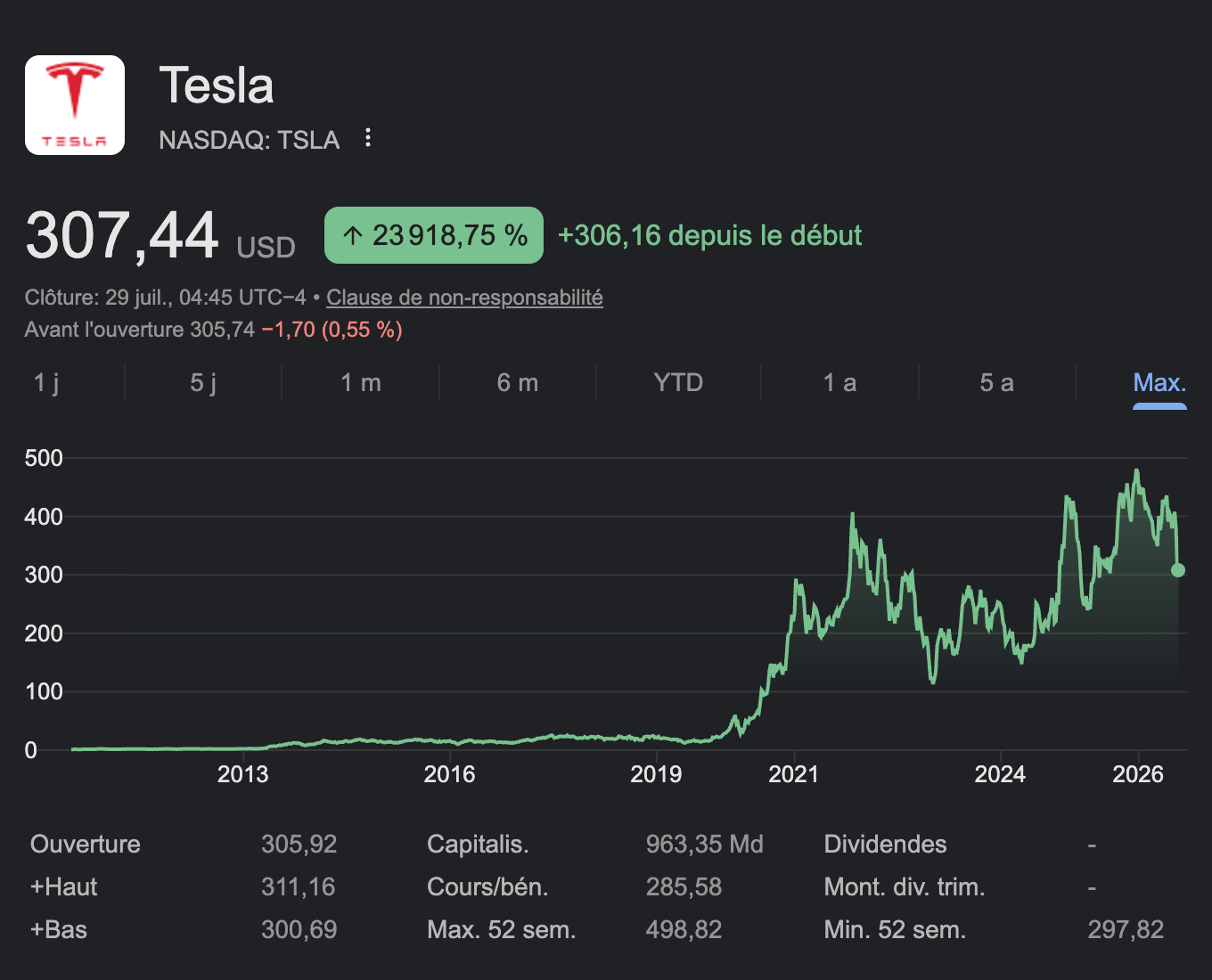
Tesla has pulled off a crazy challenge: launching a new automaker in the 21st century. It is well on its way to profitability and growth. Is that enough reason to buy the stock, though?
At around $1.24 trillion, Tesla is the automaker with the largest market capitalisation in the world, ahead of Toyota. One might wonder why, since its competitors sell far more cars. Just a passing trend?
In mid-2026, Tesla's valuation is still seen as very high by many analysts. The price/earnings ratio (P/E) sits at around 290, meaning investors pay about $290 for every dollar of Tesla's annual earnings. By comparison, Microsoft trades at around 23 and most automakers below 10. Elon Musk regularly points out that the stock is expensive, which hasn't stopped him from becoming the richest man in the world. Tesla remains one of the most closely watched tech stocks among investors.
In brief
Tesla enjoys strong international name recognition and an active community. Its stock, however, has reached a very high valuation level. Investing in an individual stock like Tesla carries a high risk of capital loss.
Finding tomorrow's winners takes time and happens well before the media start talking about them. If you aren't ready to spend several hours a week researching and analysing promising stocks, a diversified approach through ETFs may be worth considering, depending on your profile. According to S&P Dow Jones Indices' SPIVA studies, around 90% of active fund managers fail to beat their benchmark index over ten years. Apps like Finary also let you centralise the tracking of your stock and ETF positions across all brokers.

Frequently asked questions
Should you invest in Tesla stock in 2026?
Whether to invest in Tesla stock depends on your risk profile. The stock carries a very high valuation (a P/E of around 290 in mid-2026) and high volatility. A diversified approach reduces the risk specific to an individual stock, which exposes you to capital loss.
What is Tesla's market capitalisation?
In mid-2026, Tesla is worth around $1.24 trillion, making it the world's most highly valued automaker, ahead of Toyota. This market capitalisation places it among the eleven largest listed companies, across all sectors.
Why is Tesla stock considered expensive?
Tesla trades at around 290 times its annual earnings (P/E), compared with around 20 for Microsoft and under 10 for most automakers. This premium reflects investors' growth expectations, but it also makes the stock highly sensitive to disappointments.
How can you invest in Tesla stock from France?
Tesla stock is listed on the Nasdaq and accessible through a securities account (CTO) at most brokers, but not through a PEA, which is reserved for European securities. You can also gain indirect exposure via a US index ETF, or favour PEA-eligible stocks.
Sources
Companiesmarketcap, Tesla (TSLA) market capitalisation
Companiesmarketcap, Tesla price/earnings (P/E) ratio
Regulatory disclaimers: Marketing communication. Investing carries a risk of partial or total capital loss. Past performance is not a reliable indicator of future performance. This article is provided for information and educational purposes only; it does not constitute personalised investment advice, a buy or sell recommendation, or tax advice. Before investing, read the Key Information Document (KID) and, where relevant, consult an authorised adviser. Finary SAS, an investment firm authorised by the ACPR (no. 19283), member of AMAFI. Insurance broker registered with ORIAS (no. 21001279), member of the CNCGP (association approved by the AMF). Crypto-Asset Service Provider (CASP) authorised by the AMF under the MiCA regime, references no. A2026-026 and no. N2026-008.