


Should you invest with a capitalization contract in France?

Updated on 7 August 2026
In France, the capitalization contract is a tax wrapper similar to life insurance, with the same taxation on gains but different inheritance rules. This article details how it works, its taxation, and its advantages for estate planning.

- A capitalization contract is similar to life insurance, but it is part of the taxable estate: there is no named beneficiary clause.
- It can be passed on by gift without closing the contract, including as split ownership, by separating bare ownership and usufruct.
- Its taxation applies a 30% flat tax on gains before 8 years, then an annual tax allowance beyond 8 years.
- Its main advantage remains an estate-planning one: preparing a transfer of wealth while making full use of gift tax allowances.
What is a capitalization contract?
The capitalization contract is a tax wrapper often confused with life insurance. Although similar in their general workings, the capitalization contract serves different estate-planning purposes.
Definition of the capitalization contract
The capitalization contract is an investment solution for individuals, allowing them to build capital across various investment products (euro funds, bonds, shares, collective investment funds (OPC), property investment funds…) under more advantageous tax conditions than the securities account (CTO). Tools like Finary, for example, let you track a capitalization contract alongside your other holdings, such as a PEA (a French tax-advantaged equity savings account), shares, or real estate.
The capitalization contract can also apply to a legal entity. It can notably be used to manage a company's surplus cash, whether the company is subject to income tax (IR) or corporate tax (IS).
To take out a capitalization contract as a legal entity, that entity must in principle be:
- A non-profit private-law organisation (association, foundation, etc.)
- A company whose purpose is to manage its own movable and/or real-estate assets (asset-holding company, holding company, SCI, etc.)
The difference between euro-fund and unit-linked capitalization contracts
As with life insurance, the capitalization contract splits into two main categories:
- the euro-fund capitalization contract
- the unit-linked capitalization contract
The euro-fund capitalization contract is a wrapper whose capital is protected by the insurer, with limited risk of loss. As a low-risk investment, you should not expect a high return on this type of contract. It averaged 2.6% net of fees in 2025 according to the ACPR, up since 2022 thanks to rising interest rates.
More capital invested

Non-contractual document for promotional purposes. Investment in unit-linked vehicles carries a risk of capital loss, since their value is subject to fluctuation, both upwards and downwards, depending in particular on developments in the financial markets. The insurer commits to the number of units, not to their value, which it does not guarantee. This life insurance policy is an individual life insurance policy, denominated in euros and/or unit-linked vehicles, underwritten by Generali Vie, a company governed by the French Insurance Code. Finary SAS, 58 rue de Monceau 75380 Paris 8, Investment Firm authorised by the ACPR under no. 19283, ORIAS no. 21001279, member of AMAFI
Conversely, the unit-linked capitalization contract lets you invest in a wide range of financial and real-estate assets (in the form of property investment funds), but the capital invested cannot be guaranteed. Potential returns vary widely depending on the investment options chosen, with no guarantee of performance. This choice depends on your investment horizon, your risk tolerance and your personal financial situation. To help you, we have written a series of articles on Where to invest your money and a dedicated guide to investing in the stock market.
What is the difference between a capitalization contract and life insurance?
Given how the capitalization contract works and the products it holds, it's natural to wonder how it differs from life insurance.
As we'll see, several points set them apart, mainly around inheritance:
- the capitalization contract can be passed on by gift or inheritance without closing the contract
- it is part of the deceased's taxable estate, whereas life insurance capital falls outside standard inheritance law and goes directly to the named beneficiaries under favourable tax conditions
- a capitalization contract can be split into bare ownership and usufruct, for example to make a gift with a reserved usufruct (more on this below)
| Criterion | Capitalization contract | Life insurance |
|---|---|---|
| Transfer by gift | Yes, without closing the contract | No, requires a withdrawal |
| Part of the taxable estate | Yes | No (beneficiary clause) |
| Split ownership (bare ownership / usufruct) | Possible | No |
| Taxation of withdrawals | Same as life insurance | PFU 30% before 8 years, allowance after |
| Open to legal entities | Possible | No, reserved for individuals |
Read also: Investing your money: 6 mistakes to avoid
What is the taxation of a capitalization contract?
The taxation of a capitalization contract applies to full or partial withdrawals. The tax is, of course, calculated on the share of income and capital gains generated by your investments, not on the entire capital withdrawn.
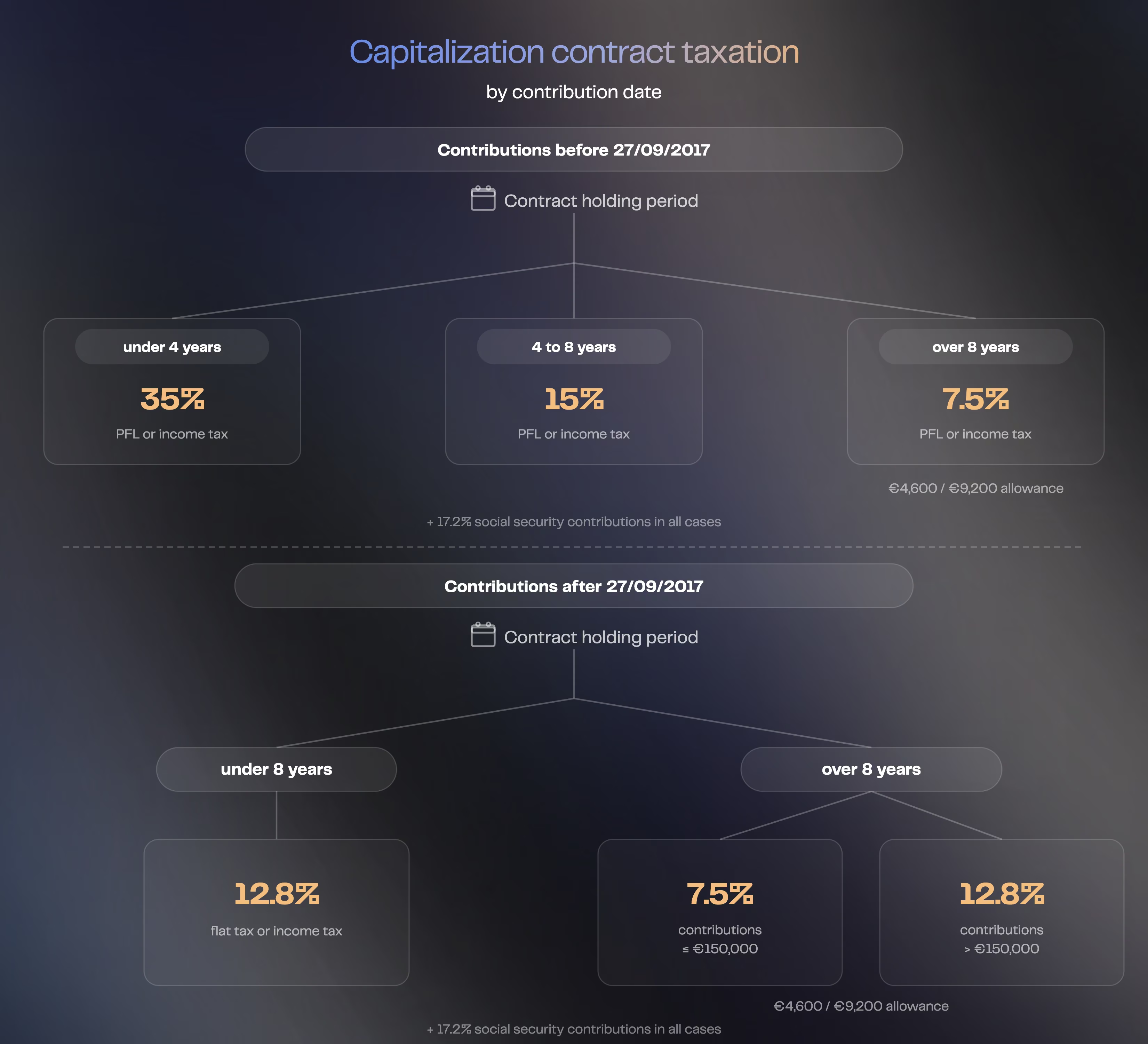
To know which tax rules apply, you need to distinguish between contributions made before and after 27 September 2017.
Taxation on withdrawals for contributions made before 27 September 2017
For any withdrawal from your capitalization contract relating to contributions made before 27 September 2017, you have two options:
- include your gains in your annual income tax return (at your marginal tax rate)
- opt for the PFL (prélèvement forfaitaire libératoire, the flat-rate withholding levy)
The PFL rate on a capitalization contract depends on how long the contract has been held:
- 35% for withdrawals made before 4 years
- 15% for withdrawals made between 4 and 8 years
- 7.5% after 8 years
So, except for heavily taxed individuals, the PFL on a capitalization contract becomes worthwhile from the 4th year onward. In addition, for any withdrawal after the 8th year, you benefit from a €4,600 tax allowance for a single person (€9,200 for a married or civil-partnered couple).
Note: the gains from your capitalization contract's returns are subject to social security contributions of 17.2%.
Taxation on withdrawals for contributions made after 27 September 2017
The introduction of the flat tax by the 2018 Finance Act overhauled the taxation of capitalization contracts before 8 years.
Now, and only for contributions made after 27 September 2017, withdrawals from a capitalization contract are taxed as follows:
- Before 8 years: 12.8% (income tax) + 17.2% social security contributions, for a combined 30% levy (flat tax)
- After 8 years:
- 7.5% on returns generated by contributions under €150,000, after applying the €4,600 tax allowance (€9,200 for a couple)
- 12.8% on returns generated by contributions above €150,000, after applying the €4,600 tax allowance (€9,200 for a couple)
The returns generated are also subject to social security contributions of 17.2%.

The benefits of a capitalization contract for estate planning
The capitalization contract is a valuable wrapper when used for estate-planning purposes. In other cases, life insurance may be better suited, depending on your goals (inheritance, liquidity, taxation).
Indeed, unlike life insurance, the capitalization contract can be transferred. This makes it possible to plan ahead for inheritance by gifting the wrapper without closing the contract.
This means you can avoid a full withdrawal (which is taxable under the conditions above) by gifting the contract directly instead. Gifting a capitalization contract also lets you make full use of the special allowances that apply to gifts.
Two options are available to you:
- an outright gift of the capitalization contract
- a gift of the contract's bare ownership with a reserved usufruct
Gifting a capitalization contract
Gifting a capitalization contract triggers gift-transfer duties. These are calculated on the value of the contract at the time of the gift (contributions plus interest).

The advantage of an early transfer through gifting lies in the tax allowances that apply based on the family relationship:
- €100,000 for a gift to a child
- €31,865 for a gift to a grandchild
- €5,310 for a great-grandchild
- €15,932 between siblings
- €7,967 for a nephew or niece
This allowance “resets” every 15 years. During those 15 years, however, the recipient cannot combine the gift allowance with the inheritance allowance: they are, in fact, one and the same allowance shared between gifts and inheritance. To make the most of it, it is common practice to plan ahead as early as possible, for example by opening several capitalization contracts to be passed on every 15 years.
Gifting a capitalization contract with a reserved usufruct
To reduce the taxable base for gift duties (and so make the most of the allowance), you can also consider gifting only the bare ownership of the capitalization contract. This is known as a gift with a reserved usufruct.
In other words, you keep the usufruct, meaning the enjoyment of the contract, but you transfer the bare ownership: the right to dispose of it.
This mechanism is abstract but entirely legal, and it lowers the taxable value of the contract at the time of the gift. When the usufructuary dies, full ownership of the capitalization contract is automatically restored to the bare owner (the person who received the gift), without triggering any inheritance duties!
So the taxable value of the contract, when gifted with a reserved usufruct, is discounted according to the usufructuary's age (Article 669 of the French General Tax Code):
Example : on your 70th birthday, you want to plan ahead for your estate by gifting a capitalization contract worth €150,000 to your child.
With an outright gift, you would pay gift duties on a base of €150,000 - €100,000 (allowance) = €50,000. By gifting only the bare ownership, the taxable base for gift duties becomes:
- taxable value of the bare ownership: €150,000 x 0.6 = €90,000
- taxable base after allowance: €90,000 - €100,000 = -€10,000, i.e. €0
So, by choosing to gift the capitalization contract with a reserved usufruct, there are no gift duties to pay at all!
Also, the earlier you plan for your estate, the lower the taxable value of the bare ownership will be.
Frequently asked questions
How do you open a capitalization contract?
To open a capitalization contract, you can turn to a bank or to an insurance company. Be sure to choose your capitalization contract carefully, based on the range of available assets and the management fees charged!
Can you open several capitalization contracts?
Unlike the PEA, you can open as many capitalization contracts as you like. Holding several capitalization contracts can be worthwhile, particularly if you want to plan an early transfer for each of your children.
Is a capitalization contract subject to the IFI?
Yes, but only partly. Only the portion of the contract invested in real-estate assets (SCPI, a French non-listed real-estate fund comparable to a REIT, SCI, or OPCI held as unit-linked funds) is included in the taxable base of the IFI (France's real-estate wealth tax). Euro funds and non-real-estate unit-linked funds (shares, bonds) remain outside the scope of the IFI.
Can you convert a life insurance policy into a capitalization contract?
No, there is no direct route between the two wrappers: a life insurance policy cannot be converted into a capitalization contract without a full withdrawal, which triggers taxation of the gains. You need to open a separate capitalization contract to benefit from its estate-planning advantages.
Sources
ACPR: Life insurance in France in 2025 (no. 179)
impots.gouv.fr: Gift tax allowances
Article 669 of the French General Tax Code (Légifrance)
Regulatory disclaimers: Marketing communication. Investing carries a risk of partial or total capital loss. Past performance is not a reliable indicator of future performance. This article is provided for information and educational purposes only; it does not constitute personalised investment advice, a buy or sell recommendation, or tax advice. The capital guarantee on euro funds is provided by the insurer and depends on its financial strength. In a severe systemic crisis, the French "Sapin 2" law allows withdrawals to be temporarily restricted (liquidity), without affecting the guaranteed capital. Unit-linked funds are not guaranteed and carry a risk of capital loss. Before investing, read the Key Information Document (KID) and, where relevant, consult an authorised adviser. Finary SAS, an investment firm authorised by the ACPR (no. 19283), member of AMAFI. Insurance broker registered with ORIAS (no. 21001279), member of the CNCGP (association approved by the AMF). Crypto-Asset Service Provider (CASP) authorised by the AMF under the MiCA regime, references no. A2026-026 and no. N2026-008.