


Synthetic or physical ETF: which should you choose?

Updated 17 July 2026
A synthetic ETF is an index fund that reproduces an index's performance through a swap contract with a financial counterparty, rather than by holding that index's assets directly. This mechanism notably gives access to markets outside the euro area through a PEA (a French tax-advantaged equity savings account).

- Physical replication means holding the index's shares directly, whereas synthetic replication goes through a swap with a counterparty.
- UCITS rules cap exposure to the swap's counterparty risk at 10% of the fund's net assets, a limit monitored daily.
- If every counterparty were to default, the synthetic ETF does not disappear: it becomes a simple fund tracking the assets it holds physically.
- Most synthetic ETFs are accumulating: the swap's performance is reinvested automatically, which benefits from compound interest over the long run.
- Management fees on ETFs, synthetic or physical, remain among the lowest on the market, generally between 0.10% and 0.30% per year.
What is a synthetic ETF?
A synthetic ETF is an ETF that reproduces an index's performance through a swap contract with a financial counterparty, rather than by holding that index's assets directly. Before investing in the stock market, it is important to understand what an ETF and replication mean.
What is an ETF?
An ETF (Exchange Traded Fund), or tracker, is an index fund created by an asset manager to reproduce the performance of a benchmark index. In plain terms, it is a set of listed company shares that follows the movements of its "pilot index", the CAC 40 for instance, in which case we speak of a CAC 40 ETF.
A tracker lets you invest in dozens of companies with a single order, saving you considerable time: you diversify your portfolio in one click. ETFs also carry very low management fees, between 0.10% and 0.30% on average as an indication (2026 data), thanks to passive management. All of that makes it a product accessible to most investors, one that fits into all sorts of wealth management strategies.
And to reproduce the benchmark index's performance, two types of replication coexist: physical replication and synthetic replication.
What is the difference between synthetic and physical replication?
A tracker can use 3 types of replication in Europe:
- full physical replication
- sampled, or partial, physical replication
- synthetic, or indirect, replication
Full physical replication means the asset manager buys all the assets (e.g. shares) of a benchmark index in the same proportions. It is called sampled or partial when the ETF holds only a fraction of the assets. That is generally used when there are too many holdings to track or when some are too illiquid. The asset manager then selects holdings from within the index in order to optimise the ETF's cost and/or liquidity, while staying as close as possible to the expected performance.
Synthetic, or indirect, replication is more complex, in that the asset manager uses a different method to build the ETF. A synthetic replication tracker can buy the benchmark index's assets and exchange them for the performance of another basket of shares. To do so, the asset manager uses a "swap", an exchange, with another financial player, called the counterparty, generally an investment bank or its parent bank. That third party physically holds the securities that are not part of the benchmark index and undertakes to deliver their performance to the ETF, in return for a fee.
The main difference between synthetic and physical replication therefore lies in how the tracker is built.
Good to know : the synthetic ETF is very widespread in English-speaking countries and its range is growing steadily in Europe. It opens new possibilities for investors, who can thereby diversify their portfolio easily and access markets normally out of reach within a PEA (a French tax-advantaged equity savings account). That wrapper does not allow investment in American or Asian physical replication ETFs. The synthetic ETF is a way around that rule.

How does an ETF work, synthetic or physical?
A physical replication ETF works simply: the asset manager buys the index's securities directly, either in full (full replication) or by sampling (optimised replication) for the broadest indices. To generate extra income, it frequently lends part of those securities to third parties against collateral, which creates a counterparty risk specific to physical replication, governed by the European ESMA guidelines on ETFs (ESMA/2014/937).
A synthetic ETF works in a straightforward way: when the performance of the swap's benchmark index exceeds that of the assets physically held by the asset manager, the counterparty must pay the performance difference to the manager. In practice, the ETF buys more physical assets.
Conversely, if the benchmark index's performance is below that of the physical assets, the ETF owes money to the counterparty. It therefore sells physical assets and pays the swap holder.
Good to know : For the investor, the swap's performance is not meant to affect their returns, since most trackers are accumulating and therefore automatically benefit from compound interest. It is nonetheless an essential indicator of the tracker's health and reliability, to be checked without fail before investing. This instrument can be examined as part of an overall wealth review. What is a synthetic or physical ETF useful for?
The PEA-eligible ETF is useful within a PEA because it allows, in compliance with UCITS regulation (Undertakings for Collective Investment in Transferable Securities, the set of European rules governing investment funds), indirect exposure to assets outside the PEA-eligible zone while still respecting the requirement to hold only European securities in this kind of account. The swap therefore makes it possible to invest partly in assets outside Europe.
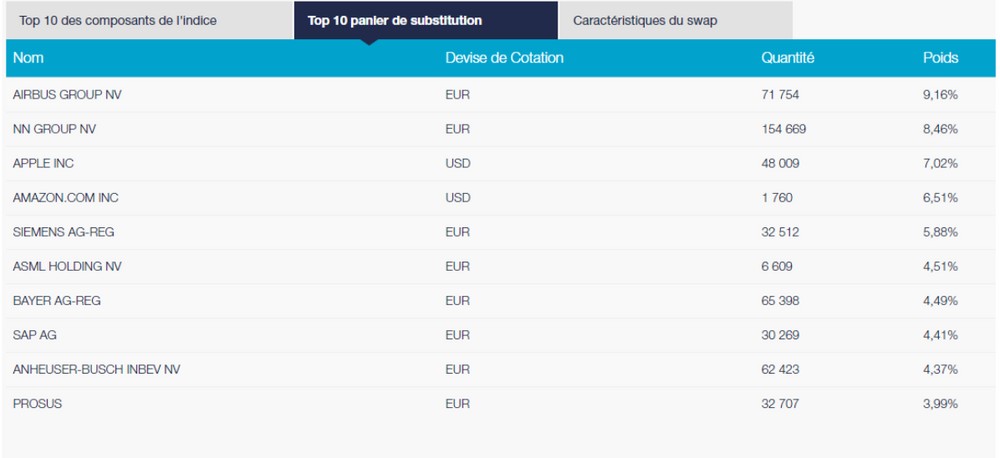
As an educational illustration only (and not as a recommendation), the Amundi PEA S&P 500 UCITS ETF tracker (formerly Lyxor S&P 500 UCITS ETF, ISIN FR0011871128) shows how synthetic replication works. The asset manager (Amundi, formerly Lyxor) physically buys European assets up to 75% in order to meet the PEA's eligibility criteria. It then exchanges, through the swap, its basket of shares for the performance of US S&P 500 shares held by the counterparty. It is currently one of the ways to invest in an S&P 500 ETF through a PEA.
Here is the basket of assets Lyxor holds physically:
And the basket it is exchanged for:
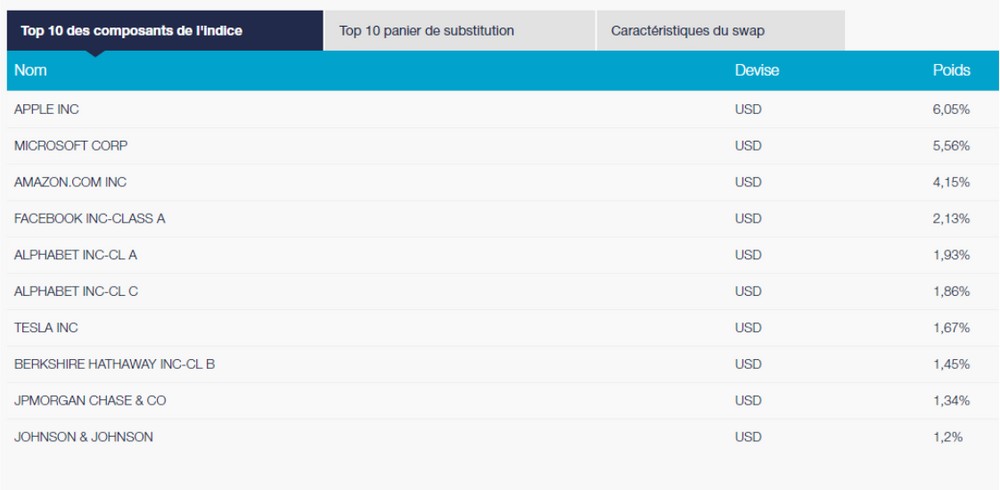
Source: Lyxor (historical data, the company is now part of Amundi)
A synthetic PEA ETF therefore lets you hold US market assets indirectly while enjoying the benefits of this tax wrapper.
A physical ETF, by contrast, has the advantage of simplicity and transparency: the investor knows exactly which securities make up the fund, without depending on a swap's performance. It is the default choice for exposure to liquid indices outside a PEA (S&P 500, MSCI World, CAC 40), where physical replication generally remains the benchmark and where it is often cheaper: the iShares Core S&P 500 UCITS ETF (IE00B5BMR087), using full physical replication, has a TER of 0.07%, against 0.12% for the Amundi PEA S&P 500 UCITS ETF using synthetic replication.
What are the risks of an ETF, synthetic or physical?
Whether physical or synthetic, an ETF remains a market product that is risky by nature. It is not suited to holding your emergency savings. That said, the synthetic tracker carries risks of its own. The main one is drifting too far from the benchmark index's performance, since it depends partly on the swap's performance.
That is not the only risk that can worry investors. What happens if the counterparty or the issuer fails?
Securities lending, a risk specific to physical replication
The physical ETF is not free of risk: when it lends part of its securities to third parties to generate extra income, it is exposed to counterparty risk if the borrower defaults. That risk is governed by diversified, liquid collateral valued daily, in line with the ESMA guidelines on ETFs. On very broad or illiquid indices, physical replication by sampling can also generate a larger tracking error than expected.
Counterparty failure
Counterparty risk, meaning the failure of the third party holding the swap, is a concern that comes up often among investors. On one hand, counterparties have made major efforts to improve swap transparency, so it is relatively easy to find the relevant information (assets held, value, identity of the counterparty, adjustment method and so on).
On the other hand, such an event has no major consequences for the investor, in that the asset manager generally provides for several counterparties to limit this risk. Adjustments are frequently made daily to track the benchmark index's performance as closely as possible.
Moreover, should no counterparty remain able to carry out the swap, your ETF does not disappear: it will simply track the assets it holds physically. It then becomes a plain European ETF.
Finally, under article 52 of the European UCITS directive, exposure to a swap's counterparty risk is capped at 10% of the fund's net assets. That regulatory cap is reinforced by daily collateralisation, which in practice keeps actual exposure well below the threshold.

Issuer failure
This risk is relatively low, since an ETF's issuer is often a subsidiary of a major banking group (Crédit Agricole for Amundi, which bought Lyxor, Société Générale's former ETF arm, in 2021-2022; BNP Paribas for BNP Paribas Easy, and so on). Asset managers are unlikely to fail overnight.
What is more, an ETF has its own legal identity, entirely separate from the issuer's. The issuer's failure therefore does not close the synthetic or physical tracker. Finally, the securities are held by "fund custodians", which are large financial institutions.
Good to know : Using a synthetic ETF gives investors access to indices outside the PEA zone within the PEA's tax framework. Asset managers put in place mechanisms governed by UCITS regulation to limit the counterparty risk tied to the swap. They nonetheless remain market vehicles whose level of risk depends on the composition of the index and its underlyings. If you are looking for a very low-risk investment, the synthetic ETF does not match that risk profile. Synthetic or physical ETF: which should you choose?
The choice depends mainly on the tax wrapper and the index you are targeting: the table below sums up the key differences.
In practice: outside a PEA, on broad and liquid indices (S&P 500, MSCI World, CAC 40), a physical ETF is generally preferable for its simplicity, its transparency and its often lower fees. To hold a global or US index inside a PEA, the synthetic ETF remains the only option, thanks to the swap mechanism.
Frequently asked questions
How can an ETF on a US index be listed in Paris?
The different opening hours of US and European exchanges make it impossible to track each index's performance in real time. Corrections are therefore applied each day after the Paris market closes, and the futures market allows US trends to be anticipated.
Is a synthetic replication ETF riskier than a physical one?
Generally, no: observers such as the AMF, the EDHEC Risk Institute and Morningstar do not consider synthetic replication riskier than physical replication. The two methods work differently but both make a wide variety of assets available to investors.
Which are the best synthetic ETFs?
There is no universal ranking: the choice depends on your strategy, your horizon and your risk tolerance. The key criteria are the index replicated, the assets under management, the fees (TER) and PEA eligibility. PEA-eligible examples: Amundi PEA S&P 500 (FR0011871128, TER 0.12%) and Amundi PEA Global MSCI ACWI (FR0014017NX3, TER 0.25%).
How do you know whether an ETF uses synthetic or physical replication?
The replication method appears in the Key Information Document (KID) and on the product pages of platforms such as JustETF or of the asset managers, under the heading physical or synthetic replication. This information is mandatory and verifiable before any investment.
Sources
ESMA, UCITS interactive single rulebook, article 52 (counterparty risk limit)
JustETF, Amundi PEA S&P 500 UCITS ETF factsheet
JustETF, Amundi PEA Emergent (MSCI Emerging) ESG Transition UCITS ETF factsheet
JustETF, Amundi Stoxx Europe 50 UCITS ETF factsheet
JustETF, SPDR MSCI ACWI UCITS ETF factsheet
ETF World, launch of the Amundi PEA Global MSCI ACWI UCITS ETF